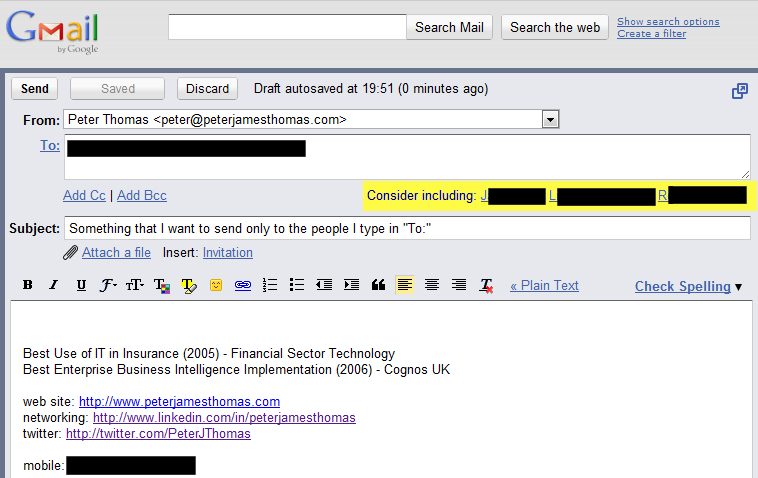
Consider including…

Gmail logo

Let me get something out of the way straight up. I am a fan of Google. Are their services and products flawless? Probably not. Did they live up to their stated objective of “do no evil”? Well I guess the Chinese difficulties didn’t exactly paint them in the best light, nevertheless I can think of less savoury technology companies. On the plus side, I have used Google’s services and, in particular, their cloud-based e-mail – Gmail – for years and been very happy with them. If I explain that my smart phone is a Nexus One, you will probably get the general idea.

Gmail fail?
Image edited and truncated to fit page - click for full version

However, Google have introduced a “feature” into Gmail which leads me to question what on earth they were thinking. This is the “Consider including” function. When you type an e-mail, Gmail comes up with a list of people that you may like to also copy it to. Let’s pause and just think about this. You are writing an e-mail, generally the first thing that you do is to type in the address of the person (or people) you are writing to. Gmail has a useful feature that scans your previous mails, so typing “Pe” will bring up “Peter Thomas” as an option. So far so good. But then, based solely on this first e-mail entered (not even on the subject), the bar highlighted in pale yellow appears above with a list of people that you may consider including on the mail.

Google’s algorithms may be great at figuring out which context-based ads to display alongside the advertising-supported Gmail (though I must admit to never having clicked on any of these and to generally mentally filtering them out), but how does an algorithm know better than me who I want to send an e-mail to? I suppose we could give the geniuses at Google the benefit of the doubt, maybe they do know.

Sadly empirical evidence is that the software doesn’t have a clue. In the example above, the contacts “J”, “L” and “R” (the names have been anonymised to protect those irrelevant to the context) have nothing whatsoever to do with the e-mail recipient (again anonymised) that I started writing. Aside from perhaps once being cc’ed in an e-mail sent to the person whose address I typed in, they have no relation to either the intended recipient, or indeed to each other. As to content, at this point there isn’t any, so it is anyone’s guess how Google generates the list; an even more worrying question is why do they?

Not only does the feature fail to work, it is also totally asinine. It might make some sense for say Facebook to suggest people with whom you might want to share a link. However, there are people who you might e-mail twice a year for very specific purposes, that still get suggested in a “Consider including”. Google plainly doesn’t know better than me to whom I actually want to send an e-mail. A worry is that a stray click and a lack of attention could send an e-mail to someone who is not intended to see it. Given the fact that many small businesses and sole-trader consultants rely on Gmail, then – in extremis – this could lead to commercially sensitive (or indeed personally private) information being sent to the wrong person. The feature is clearly ill-advised and – worst of all – you cannot (at present) turn it off.

In searching (via Google) for tips on how to get rid of this truly abysmal piece of functionality I came across two things: screeds of people just like me asking what Google was thinking and the an article entitled: Gmail’s Most Ridiculous, Idiotic, Intrusive, Useless Feature Ever by Zoli Erdos, which covers the problems and potential implications of “Consider including” in more depth. Here is a pithy quote:

I’ve never thought the day would come I would write the words utterly ridiculous, iditiotic, intrusive, with absolute certainly about a Google feature

This “feature” is bad enough to have merited me writing to Google asking them to remove it, or at least make it optional. Their support forums are full of people saying the same. It will be interesting to see whether or not they listen.

[Disclosure: I have more than one Gmail account and also use Google apps from time to time, as stated above, I also use Feedburner and have a Google smart phone. Other than this I have no commercial relationship with Google and have never bought or recommended their services in a business context]
 

The CIO / IT Director Survey – Redux

linkedin CIO Magazine CIO Magazine forum

Back in January 2009, I started the process of using both this blog and LinkedIn.com to solicit feedback on the top issues facing CIOs and IT Directors. This was in preparation for a seminar I was helping a recruitment agency – Chase Zander – to run. I got a lot of very interesting feedback, some of it also from people e-mailing my directly. This was summarised in The Top Business Issues facing CIOs / IT Directors – Results.

I thought that it might be interesting to revisit this area and so am seeking your feedback, either in the comments section of this article below, or again via LinkedIn.com and, in particular as before, the CIO.com magazine group.

I look forward to your thoughts.

Peter
 

Illuminating the darkness

Recrudescence

My partner was kind enough to buy me an Amazon Kindle for Christmas and I have enjoyed using it. Yes there were the problems with them registering me to Amazon.com, rather than Amazon.co.uk (thereby incurring foreign transaction charges). And yes they didn’t cancel a trial Economist subscription I took out on the former when I was transferred to the latter. However, these issues were sorted out and money refunded.

I suppose I had the same initial reaction as many people; that they had left a sticker covering the screen, which was intended to demonstrate what the display looked like. After failing to peal it off (thankfully not too energetically) I realised that the screen was actually that clear and that different from a “normal” computer display (I was thinking smart ‘phone or laptop). I am writing this post on one of my many laptops, the screen is OK, but the Kindle is much easier on the eye and pretty close to a high-quality printed page. Suffice it to say that I downloaded new copies of several of my favourite books to it with the prospect of re-engaging with them at my leisure.

But enough of me singing the general praises of the device, I have discovered a particular benefit. While this may well be realised by other people, it is of particular pertinence to devotees of the works of Joseph Conrad.

Joseph Conrad

As one of the undisputed giants of English prose, it is rather ironic that English itself was either Conrad’s fifth, or sixth, language (chronologically: Polish; Russian – though he later, perhaps understandably given the turbulence of the times, repudiated this as a language; French; Latin; German; and – finally, when he was in his twenties, English). I have greatly appreciated his work, since first reading Heart of Darkness. I won’t attempt to offer a literary appreciation of his genius and leave this to others with greater talents in that area. However, despite coming late to the English tongue, Conrad was a master of it and had an amazing vocabulary.

An indispensable companion to Conrad's works

I generally view myself as being reasonably erudite (less charitably I have been accused of having swallowed a thesaurus), but used to have to keep a dictionary at hand when reading Conrad; either that or try to impute meaning from context (probably getting it wrong more times that I care to admit). In some ways, my own limitations slightly diluted my enjoyment of reading. It is a bit distracting to put down one book, pick up a dictionary, look up a word and then revert to the original tome (it was even more complicated as a child reading Jules Verne’s 20,000 Leagues under the Sea with both a dictionary and gazetteer to hand!).

Incidentally my fondness of Conrad led to my one contribution to the field of science. I established my result after extensive fieldwork involving Nostromo and a daily commute. Thomas’ Theorem is as follows:

While this feat is more than achievable with the works of other authors, it is impossible to read Conrad on the Tube.

However, the Kindle is a joy in this respect as you can look up words using the built in dictionary, quickly, easily and without disturbing the thread of the narrative too much. This has got me out of my rather lazy habit of assuming that I sort of know what a word means and thereby given me a few surprises. Based on the the initial illustration above, for example, I had to modify my understanding of recrudescence!

Of course this means that I may have to re-evaluate whether Thomas’ Theorem holds in all conditions. Perhaps a sub-clause excluding the use of a Kindle is required. I will report back…


This is not the first time that Conrad has appeared in the pages of this blog, I had the temerity to also reference him in Aphorism of the Week some time ago.
 

How to use your BI Tool to Highlight Deficiencies in Data

My interview with Microsoft’s Bruno Aziza (@brunoaziza), which I trailed in Another social media-inspired meeting, was published today on his interesting and entertaining bizintelligence.tv site.

You can take a look at the canonical version here and the YouTube version appears below:

The interview touches on themes that I have discussed in:


Another social media-inspired meeting

Lights, camera, action!

Back in June 2009, I wrote an article entitled A first for me. In this I described meeting up with Seth Grimes (@SethGrimes), an acknowledged expert in analytics and someone I had initially “met” via Twitter.com.

I have vastly expanded my network of international contacts through social media interactions such as these. Indeed I am slated to meet up with a few other people during November; a month in which I have a couple of slots speaking at BI/DW conferences (IRM later this week and Obis Omni towards the end of the month).

Another person that I became a virtual acquaintance of via social media is Bruna Aziza (@brunoaziza), Worldwide Strategy Lead for Business Intelligence at Microsoft. I originally “met” Bruno via LinkedIn.com and then also connected on Twitter.com. Later Bruno asked me for my thoughts on his article, Use Business Intelligence To Compete More Effectively, and I turned these into a blog post called BI and competition.

bizintelligence.tv - by Bruno Aziza of Microsoft

We have kept in touch since and last week Bruno asked me to be interviewed on the bizintelligence.tv channel that he is setting up. It was good to meet in person and I thought that we had some interesting discussions. Though I have done video and audio interviews before with organisations like IBM Cognos, Informatica, Computing Magazine and SmartDataCollective (see the foot of this article for links), these were mostly a while back and so it was interesting to be in front of a camera again.

The bizintelligence.tv format seems to be an interesting one, with key points in BI discussed in a focussed and punchy manner (not an approach that I am generally associated with) and a target audience of busy senior IT managers. As I have remarked elsewhere, it is also notable that the more foresighted of corporations are now taking social media seriously and getting quite good at engaging without any trace of hard selling; something that perhaps compromised the earlier efforts of some organisations in this area (for the avoidance of doubt, this is a general comment and not one levelled at Microsoft).

Bruno and I touched on a number of areas including, driving improvements in data quality, measuring the value of BI programmes, using historical data to justify BI investments (something that I am overdue writing about – UPDATE: now remedied here) and the cultural change aspect of BI. I am looking forward to seeing the results. Watch this space and in the meantime, take a look at some of the earlier interviews that Bruno has conducted.


Other video and audio interviews that I have recorded:


The Cloud Circle Forum – London

The Cloud Circle

Introduction

Earlier this week I attended the inaugural The Cloud Circle Forum in London. The Cloud Circle is the UK’s first independent Business and IT focused Cloud Computing Community. It is also the sister community of the Business Intelligence-focussed Obis Omni, an organisation with whom I have a longstanding (though I hasten to add, non-contractual) relationship (a list of Obis Omni seminars at which I have presented appears here, and you can also find some of my articles syndicated on their site).

There was a full programme with the morning being taken up by plenary presentations from Harrogate’s InTechnology (@InTechnology) and CloudOrigin (aka Cloud Computing evangelist Richard Hall – @CloudOrigin), followed by two Windows Azure case studies; one from EasyJet and one from Active Web Solutions (@AWSIpswich) for the Royal National Lifeboat Association – these were hosted by Microsoft themselves.

The afternoon programme saw delegates split into two work-streams, one focussed on strategy and management, the other on technology. Work-related pressures meant that I was unable to attend this part of the day, which was a shame as several bits of the morning speeches were helpful.

Who you gonna call?

Unfortunately, despite the fact that virtually every organisiation and individual I have mentioned so far has a Twitter account and the additional fact that there were hundreds of delegates at the forum, there was virtually no Twitter coverage. Maybe we can get too carried away with the all pervasiveness of social media sometimes. There are clearly some avenues of professional life where its influence is yet to be fully felt; even IT conferences!

I tweeted some commentary on the InTechnology presentation and the stream may be viewed here while it persists. However by the time that Richard Hall stood up to speak, a combination of a lack of reception (the auditorium was in the basement) and issues with mobile Twitter on my hand-held brought this activity to a halt.
 
 
The morning presentations

Note: I don’t want to steal the thunder from any of the speakers and so this article does not cover the content of their presentations in any detail. Instead my aim is to highlight a few points and provide a flavour of their talks.

 
InTechnology

The InTechnology talk was interesting in parts, in particular their focus on the savings to be achieved in cloud-based telephony alone. One of their speakers also suggested that the benefits of Cloud Computing were potentially reduced if an organisation worked with more than one vendor, which is clearly an aspect to consider.

Their presentations were topped and tailed by two segments of a Cloud Computing-related spoof of The Apprentice. Clearly some money had gone into this and the results were either hilarious or somewhat ill-advised depending on your personal taste. I have to admit to falling closer to the latter camp. While some delegates seemed to enjoy the fun of the fair, I felt the video distracted somewhat from InTechnology’s core message.

 
 
Cloud-origin

I billed Richard Hall as a Cloud Computing evangelist and certainly his tub-thumping upped the tempo. He made some interesting points, which included his assertion that the proprietors of cloud server farms were employing cutting edge technology that was not currently commercially available and might never be. The point here was that cloud providers were becoming true experts in the area with capabilities far beyond normal organisations. This segued with his prediction that there would be only four, or at most five, mega cloud vendors in the future.

Richard did have one slide focusing on the potential drawbacks (or current short-comings) of Cloud Computing, but you could tell his heart wasn’t really in it. One sensed that Richard never met a cloud he didn’t like, even referring to his only personal Road to Damascus during his talk. However one very valid point he made was that the legal agreements and licensing arrangements for Cloud Computing were significantly lagging the flexibility of the technology itself. This chimes with my own experience of the area.


Microsoft easyJet.com Active Web Solutions

The real-life case studies of cloud-based success were perhaps more telling than the earlier sessions. Bert Craven, Enterprise Architect at EasyJet, spoke about how his company had been moving selected elements of their IT assets to the cloud. Interestingly, while the original plan had been to keep some critical applications (the sort for which 99.9% availability is not good enough) in-house, one of these was now in the process of becoming cloud-based.

Richard Prodger, Technical Director of AWS, spoke about the work that his company had been doing with the RNLI – a charity that runs volunteer lifeboats around the coasts of Britain. The specific project was to provide fishermen with devices that would automatically alert the RNLI control centre if they fell overboard and then provide accurate positioning information enabling a faster rescue and thus one that would be more likely to result in success. Richard shared stories of several fishermen who were alive today thanks to the system. Here the cloud was not the original vehicle, but something that was subsequently employed to scale up the service.

Both case studies used Windows Azure as a component. I have not used this toolset, nor have I been briefed on it and so will refrain from any comment beyond stating that both Bert and Richard seemed happy with its capabilities; particularly in securely exposing internal systems to external web-users.
 
 
Some thoughts on what I heard and saw

When multiple presenters state that there is no agreed definition of the central subject matter of a seminar and then proceed to provide slightly different takes on this, you know that you are dealing with an emerging technology. That is not to deny the obvious potential of the area, but a degree of maturation is still necessary in this part of the industry before – in Richard Hall’s words – Cloud Computing becomes the future of IT.

There was more than one elephant in the room. First of which is bandwidth, which is relatively plentiful and relatively cheap in many parts of the world, but equally has neither trait in many others. This will be of concern to a lot of global organisations. Of course this is a problem that will undoubtedly go away in time, but it may dog true enterprise implementations of misison-critical Cloud Computing for some years yet.

Security remains a concern, it may well be true that the experts in Cloud Computing will be an order of magnitude more careful and competent about handling their customers’ data than many internal IT departments. However the point is that they are already handling the data of many customers and one error, or one act of malfeasance by an employee, could have a major impact. You may well be safer flying than driving your own car, but when a plane crashes, people tend to notice.

Future consolidation in Cloud Computing was mentioned by a number of speakers. Although this issue is not solely the preserve of cloud technology, it does raise some concerns about betting on the right horse. As has been seen in many areas of industry, the titans of today may be the minnows of tomorrow. When you are trusting an external organisation with your transactions, it helps to know for certain (or as close as you can get to it) that they will be around in five years’ time.

One of the central pitches of Cloud Computing is “let us look after the heavy lifting and your people can focus on more value-added activities”. While there are certainly economies to be seized in this area, the Cloud Computing industry may be doing itself a disservice by stating that customers can effectively stop worrying about functions moved to the cloud. In my mind a lot of care and attention will need to be put into managing relationships with cloud vendors and into integrating cloud-based systems with the rest of the internal IT landscape (or with other cloud-based systems). It may be that this type of work costs a lot less than the internal alternative, but it is nevertheless invidious to suggest that no work at all is required. This line of attack is reminiscent of some of the turn of the millennium sales pitches of ERP vendors, not all of which turned out to be well-founded.

In finishing this slightly downbeat section (and before a more optimistic coda), I’ll return to the commercial issues that Richard Hall referenced. He claimed – correctly in my opinion – that a major benefit of cloud-based solutions was not only that they scaled-up, but that they scaled-down. The “knob” could be adjusted in either direction according to an organisation’s needs. The problem here is that many parts of the Cloud Computing industry still seem wedded to multi-year fixed licensing deals with little commercial scope to scale either up or down without renegotiating the contract. What is technologically feasible may not be contractually pain-free. In the same vein more flexible termination clauses and guaranteed portability of data from one vendor to another need to be sorted out before Cloud Computing is fully embraced by many organisations.

On a more positive note, the above issues are maybe the typical growth pains of a nascent industry. No doubt solutions to them will be knocked into shape in the coming years. It is always tempting fate to predict the future with too much accuracy, but at this point it seems certain that Cloud Computing will play an increasingly important role in the IT landscapes of tomorrow. If nothing else this is attested to by the number of delegates attending Tuesday’s meeting.

The Cloud Circle are to be commended for getting out in front of this important issue and I hope that their work will better disseminate understanding of what is likely to become and important area and enable a wider range of organisations to begin to take advantage of it.
 

Informatica interview

While spring cleaning at home at the weekend, I came across a DVD of an interview I did for Informatica back in March 2005. This is still accessible on the Informatica web-site and appears in my video library, but I thought that I had lost my copy of the original.

Having made this discovery, I added it to my selection of videos on YouTube.com.


In the interview I stress the need for consistency in management information; the dynamics of the Insurance industry and the business value added by Business Intelligence in a pan-European insurance organisation.


Disclosure – Part I: In the work I refer to above, I leveraged Infomatica’s toolset (PowerCentre) alongside software from Oracle (RDBMS and PL/SQL), IBM Cognos (PowerPlay and ReportStudio) and Microsoft (.NET). I have used tools from other vendors in other projects. While there is clearly a promotional sub-text to the video, it is not a product endorsement and I believe that my comments are generally applicable to any business intelligence / data warehousing project.
 
Disclosure – Part II: I have already had it pointed out to me – by @ocdqblog and others – that the braces (suspenders if you are from the US; suspenders having quite a different connotation in the UK) were perhaps something of a fashion faux pas. My American partner has long since despaired of my British approach to “co-ordination” of patterns. You may be glad to know that I no longer own the offending item.
 

How to Measure BI Value – Microsoft Services

Microsoft Services

One of the benefits of the WordPress.com platform is that you can get some indication as to which other parts the the web are directing traffic your way. It was via this facility that I came across an article on Microsoft‘s site linking back to my piece Measuring the benefits of Business Intelligence. The title, sub-title and authorship of the Microsoft post is as follows:

How to Measure BI Value

A thorough assessment will help you demonstrate the effectiveness of your BI investments. We offer 8 factors to consider.

By Paula Klein, TechWeb

You can read the article here.

As always, my aim in writing this column is to remain vendor-neutral, however the Microsoft piece is not specifically pushing their BI products (though clearly further information about them is only a click away), but rather offering some general commentary.

Again it is interesting to note the penetration of social media (such as this blog) into mainstream technology business.
 

Independent Analysts and Social Media – a marriage made in heaven

Oracle EPM and BI Merv Adrian - IT Market Strategies for Suppliers

I have been a regular visitor to Merv Adrian’s excellent blog since just after its inception and have got to know Merv virtually via twitter (@merv) and other channels. I recently read his article : Oracle Ups EPM Ante, which covered Oracle’s latest progress in integrating its various in-house and acquired technologies in the Enterprise Performance Management and Business Intelligence arenas.

The article is clearly written and helpful, I recommend you take a look if these areas impinge upon you. One section caught my attention (my emphasis):

Finally, Oracle has long had a sizable base in government, and its new Hyperion Public Sector Planning and Budgeting app suite continues the integration theme, tapping its ERP apps (both Oracle E-Business Suite [EBS] and PeopleSoft ERP) for bidirectional feeds.

My current responsibilities include EPM, BI and the third Oracle ERP product, JD Edwards. I don’t work in the public sector, but was nevertheless interested in the concept of how and whether JDE fitted into the above scenario. I posted a comment and within a few hours Merv replied, having spoken to his senior Oracle contacts. The reply was from a vendor-neutral source, but based on information “straight from the horse’s mouth”. It is illuminating to ponder how I could have got a credible answer to this type of question any quicker.

To recap, my interactions with Merv are via the professional social media Holy Trinity of blogs, twitter.com and LinkedIn.com. The above is just one small example of how industry experts can leverage social media to get their message across, increase their network of influence and deliver very rapid value. I can only see these types of interactions increasing in the future. Sometimes social media can be over-hyped, but in the world of industry analysis it seems to be a marriage made in heaven.


Analyst and consultant Merv Adrian founded IT Market Strategy after three decades in the IT industry. During his tenure as Senior Vice President at Forrester Research, he was responsible for all of Forrester’s technology research, covered the software industry and launched Forrester’s well-regarded practice in Analyst Relations. Earlier, as Vice President at Giga Information Group, Merv focused on facilitating collaborative research and served as executive editor of the monthly Research Digest and weekly GigaFlash.

Prior to becoming an analyst, Merv was Senior Director, Strategic Marketing at Sybase, where he also held director positions in data warehouse marketing and analyst relations. Prior to Sybase, Merv served as a marketing manager at Information Builders, where he founded and edited a technical journal and a marketing quarterly, subsequently becoming involved in corporate and product marketing and launching a formal AR role.
 

BI and Competition – Bruno Aziza at Microsoft

Bruno Aziza Worldwide Strategy Lead, Business Intelligence at Microsoft

Introduction

Bruno Aziza, Worldwide Strategy Lead for Business Intelligence at Microsoft recently drew my attention to his article on The Official Microsoft Blog entitled Use Business Intelligence To Compete More Effectively.

My blog attempts to stay vendor-neutral, but much of Bruno’s article is also in the same vein; aside from the banner appearing at the top of course. It is noteworthy how many of the big players are realising that engaging with the on-line community in a sotto voce manner is probably worth much more than a fortissimo sales pitch. This approach was also notable in another output from the BI stable at Microsoft; Nic Smith’s “History of Business Intelligence” , which I reviewed in March 2009. However, aside from these comments I’ll focus more on what Bruno says than on who he works for; and what he says is interesting.

His main thesis is that good BI can “sharpen competitive skills […] turning competitive insights into new ways to do business”. I think that it is intriguing how some organisations, ideally having already got their internal BI working well, are now looking to squeeze even further value out of their BI platform by incorporating more outward-looking information; information relating to their markets, their customers and their competitors. This was the tenth BI trend I predicted in another article from March 2009. However, I can’t really claim to be all that prescient as this development seems pretty common-sensical to me.
 
 
Setting the bar higher

Competition between companies is generally seen as a positive thing – one reason that there is so much focus on anti-trust laws at present. Competition makes the companies involved in it (or at least those that survive) healthier, their products more attuned to customer needs, their services more apt. It also tends to deliver better value and choice to customers and thus in aggregate drives overall economic well-being (though of course it can also generate losers).

Setting the bar higher

In one of my my earliest blog articles, Business Intelligence and Transparency, I argued that good BI could also drive healthy internal competition by making the performance of different teams and individuals more accessible and comparable (not least to the teams and individuals themselves). My suggestion was that this would in turn drive a focus on relative performance, rather than settling for absolute performance. The latter can lead to complacency, the former ensures that the bar is always reset a little higher. Although this might seem potentially divisive at first, my experience of it in operation was that it led to a very positive corporate culture.

Although organisations in competition with each other are unlikely to share benchmarks in the same way as sub-sections of a single organisation, it is often possible to glean information from customers, industry associations, market research companies, or even the published accounts of other firms. Blended with internal data, this type of information can form a powerful combination; though accuracy is something that needs to be born in mind even more than with data that is subject to internal governance.
 
 
A new source of competitive advantage

"Lightning" striking twice in Bejing

Bruno’s suggestion is that the way that companies leverage commonly available information (say Governmental statistics) and combine this with their own numbers is in itself a source of competitive advantage. I think that there is something important here. One of the plaudits laid at the feet of retail behemonth Wal Mart is that it is great at leveraging the masses of data collected in its stores and using this in creative ways; ways that some of its competition cannot master to the same degree.

In recent decades a lot of organisations have attempted to define their core competencies and then stick to these. Maybe a competency in generating meaningful information from both internal and external sources and then – crucially – using this to drive different behaviours, is something that no self-respecting company should be without in the 2010s.


You can follow Bruno on twitter.com at @brunoaziza