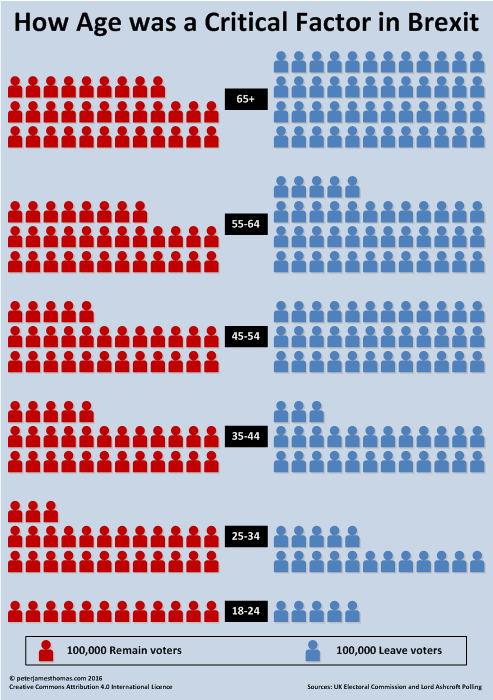
Click to download a larger PDF version in a new window.
In my last article, I looked at a couple of ways to visualise the outcome of the recent UK Referendum on Europen Union membership. There I was looking at how different visual representations highlight different attributes of data.
I’ve had a lot of positive feedback about my previous Brexit exhibits and I thought that I’d capture the zeitgeist by offering a further visual perspective, perhaps one more youthful than the venerable pie chart; namely an infographic. My attempt to produce one of these appears above and a full-size PDF version is also just a click away.
For caveats on the provenance of the data, please also see the previous article’s notes section.
Addendum
I have leveraged age group distributions from the Ascroft Polling organisation to create this exhibits. Other sites – notably the BBC – have done the same and my figures reconcile to the interpretations in other places. However, based on further analysis, I have some reason to think that either there are issues with the Ashcroft data, or that I have leveraged it in ways that the people who compiled it did not intend. Either way, the Ashcroft numbers lead to the conclusion that close to 100% of 55-64 year olds voted in the UK Referendum, which seems very, very unlikely. I have contacted the Ashcroft Polling organisation about this and will post any reply that I receive.
I’m continuing with the politics and data visualisation theme established in my last post. However, I’ll state up front that this is not a political article. I have assiduously stayed silent [on this blog at least] on the topic of my country’s future direction, both in the lead up to the 23rd June poll and in its aftermath. Instead, I’m going to restrict myself to making a point about data visualisation; both how it can inform and how it can mislead.
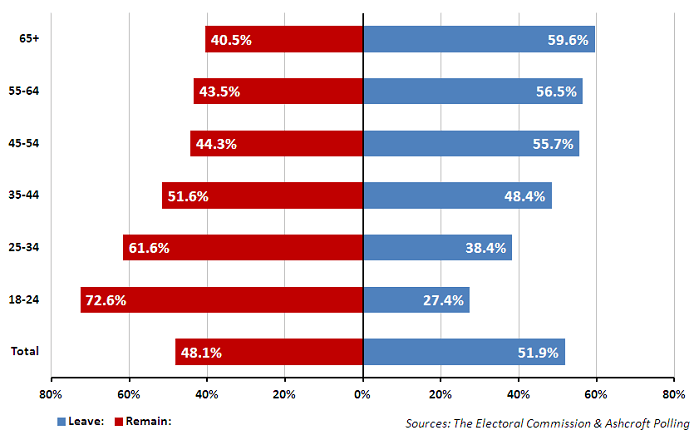
UK Referendum on EU Membership – Percentage voting by age bracket (see notes)
The exhibit above is my version of one that has appeared in various publications post referendum, both on-line and print. As is referenced, its two primary sources are the UK Electoral Commission and Lord Ashcroft’s polling organisation. The reason why there are two sources rather than one is explained in the notes section below.
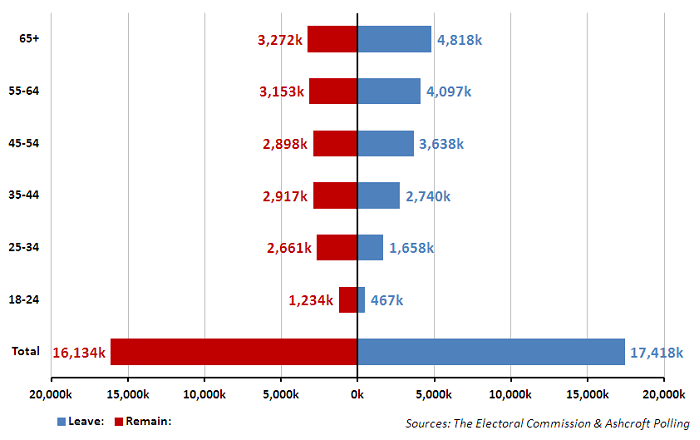
With the caveats explained below, the above chart shows the generational divide apparent in the UK Referendum results. Those under 35 years old voted heavily for the UK to remain in the EU; those with ages between 35 and 44 voted to stay in pretty much exactly the proportion that the country as a whole voted to leave; and those over 45 years old voted increasingly heavily to leave as their years advanced.
One thing which is helpful about this exhibit is that it shows in what proportion each cohort voted. This means that the type of inferences I made in the previous paragraph leap off the page. It is pretty clear (visually) that there is a massive difference between how those aged 18-24 and those aged 65+ thought about the question in front of them in the polling booth. However, while the percentage based approach illuminates some things, it masks others. A cursory examination of the chart above might lead one to ask – based on the area covered by red rectangles – how it was that the Leave camp prevailed? To pursue an answer to this question, let’s consider the data with a slightly tweaked version of the same visualisation as below:
UK Referendum on EU Membership – Numbers voting by age bracket (see notes)
[Aside: The eagle-eyed amongst you may notice a discrepancy between the figures shown on the total bars above and the actual votes cast, which were respectively: Remain: 16,141k and Leave: 17,411k. Again see the notes section for an explanation of this.]
A shift from percentages to actual votes recorded casts some light on the overall picture. It now becomes clear that, while a large majority of 18-24 year olds voted to Remain, not many people in this category actually voted. Indeed while, according to the 2011 UK Census, the 18-24 year category makes up just under 12% of all people over 18 years old (not all of whom would necessarily be either eligible or registered to vote) the Ashcroft figures suggest that well under half of this group cast their ballot, compared to much higher turnouts for older voters (once more see the notes section for caveats).
This observation rather blunts the assertion that the old voted in ways that potentially disadvantaged the young; the young had every opportunity to make their voice heard more clearly, but didn’t take it. Reasons for this youthful disengagement from the political process are of course beyond the scope of this article.
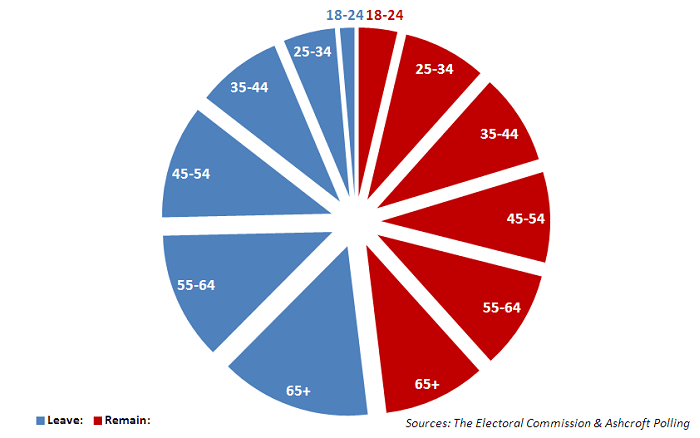
However it is still hard (at least for the author’s eyes) to get the full picture from the second chart. In order to get a more visceral feeling for the dynamics of the vote, I have turned to the much maligned pie chart. I also chose to use the even less loved “exploded” version of this.
UK Referendum on EU Membership – Number voting by age bracket (see notes)
Here the weight of both the 65+ and 55+ Leave vote stands out as does the paucity of the overall 18-24 contribution; the only two pie slices too small to accommodate an internal data label. This exhibit immediately shows where the referendum was won and lost in a way that is not as easy to glean from a bar chart.
While I selected an exploded pie chart primarily for reasons of clarity, perhaps the fact that the resulting final exhibit brings to mind a shattered and reassembled Union Flag was also an artistic choice. Unfortunately, it seems that this resemblance has a high likelihood of proving all too prophetic in the coming months and years.
Addendum
I have leveraged age group distributions from the Ascroft Polling organisation to create these exhibits. Other sites – notably the BBC – have done the same and my figures reconcile to the interpretations in other places. However, based on further analysis, I have some reason to think that either there are issues with the Ashcroft data, or that I have leveraged it in ways that the people who compiled it did not intend. Either way, the Ashcroft numbers lead to the conclusion that close to 100% of 55-64 year olds voted in the UK Referendum, which seems very, very unlikely. I have contacted the Ashcroft Polling organisation about this and will post any reply that I receive.
– Peter James Thomas, 14th July 2016
Notes
Caveat: I am neither a professional political pollster, nor a statistician. Instead I’m a Pure Mathematician, with a basic understanding of some elements of both these areas. For this reason, the following commentary may not be 100% rigorous; however my hope is that it is nevertheless informative.
In the wake of the UK Referendum on EU membership, a lot of attempts were made to explain the result. Several of these used splits of the vote by demographic attributes to buttress the arguments that they were making. All of the exhibits in this article use age bands, one type of demographic indicator. Analyses posted elsewhere looked at things like the influence of the UK’s social grade classifications (A, B, C1 etc.) on voting patterns, the number of immigrants in a given part of the country, the relative prosperity of different areas and how this has changed over time. Other typical demographic dimensions might include gender, educational achievement or ethnicity.
However, no demographic information was captured as part of the UK referendum process. There is no central system which takes a unique voting ID and allocates attributes to it, allowing demographic dicing and slicing (to be sure a partial and optional version of this is carried out when people leave polling stations after a General Election, but this was not done during the recent referendum).
So, how do so many demographic analyses suddenly appear? To offer some sort of answer here, I’ll take you through how I built the data set behind the exhibits in this article. At the beginning I mentioned that I relied on two data sources, the actual election results published by the UK Electoral Commission and the results of polling carried out by Lord Ashcroft’s organisation. The latter covered interviews with 12,369 people selected to match what was anticipated to be the demographic characteristics of the actual people voting. As with most statistical work, properly selecting a sample with no inherent biases (e.g. one with the same proportion of people who are 65 years or older as in the wider electorate) is generally the key to accuracy of outcome.
Importantly demographic information is known about the sample (which may also be reweighted based on interview feedback) and it is by assuming that what holds true for the sample also holds true for the electorate that my charts are created. So if X% of 18-24 year olds in the sample voted Remain, the assumption is that X% of the total number of 18-24 year olds that voted will have done the same.
12,000 plus is a good sample size for this type of exercise and I have no reason to believe that Lord Ashcroft’s people were anything other than professional in selecting the sample members and adjusting their models accordingly. However this is not the same as having definitive information about everyone who voted. So every exhibit you see relating to the age of referendum voters, or their gender, or social classification is based on estimates. This is a fact that seldom seems to be emphasised by news organisations.
The size of Lord Ashchoft’s sample also explains why the total figures for Leave and Remain on my second exhibit are different to the voting numbers. This is because 5,949 / 12,369 = 48.096% (looking at the sample figures for Remain) whereas 16,141,241 / 33,551,983 = 48.108% (looking at the actual voting figures for Remain). Both figures round to 48.1%, but the small difference in the decimal expansions, when applied to 33 million people, yields a slightly different result.
No, not a polemic about climate change, but instead some observations on the influence of statistical methods on statistical findings. It is clearly a truism to state that there are multiple ways to skin a cat, what is perhaps less well-understood is that not all methods of flaying will end up with a cutaneously-challenged feline and some may result in something altogether different.
So an opaque introduction, let me try to shed some light instead. While the points I am going to make here are ones that any statistical practitioner would (or certainly should) know well, they are perhaps less widely appreciated by a general audience. I returned to thinking about this area based on an article by Raphael Silberzahn and Eric Uhlmann in Nature [1], but one which I have to admit first came to my attention via The Economist [2].
Messrs Silberzahn and Uhlmann were propounding a crowd-sourced approach to statistical analysis in science, in particular the exchange of ideas about a given analysis between (potentially rival) groups before conclusions are reached and long before the customary pre- and post-publication reviews. While this idea may well have a lot of merit, I’m instead going to focus on the experiment that the authors performed, some of its results and their implications for more business-focussed analysis teams and individuals.
The interesting idea here was that Silberzahn and Uhlmann provided 29 different teams of researchers the same data set and asked them to investigate the same question. The data set was a sporting one covering the number of times that footballers (association in this case, not American) were dismissed from the field of play by an official. The data set included many attributes from the role of the player, to when the same player / official encountered each other, to demographics of the players themselves. The question was – do players with darker skins get dismissed more often than their fairer teammates?
Leaving aside the socio-political aspects that this problem brings to mind, the question is one that, at least on first glance, looks as if it should be readily susceptible to statistical analysis and indeed the various researchers began to develop their models and tests. A variety of methodologies was employed, “everything from Bayesian clustering to logistic regression and linear modelling” (the authors catalogued the approaches as well as the results) and clearly each team took decisions as to which data attributes were the most significant and how their analyses would be parameterised. Silberzahn and Uhlmann then compared the results.
Below I’ll simply repeat part of their comments (with my highlighting):
Of the 29 teams, 20 found a statistically significant correlation between skin colour and red cards […]. The median result was that dark-skinned players were 1.3 times more likely than light-skinned players to receive red cards. But findings varied enormously, from a slight (and non-significant) tendency for referees to give more red cards to light-skinned players to a strong trend of giving more red cards to dark-skinned players.
This diversity in findings is neatly summarised in the following graph (please click to view the original on Nature’s site):
To be clear here, the unanimity of findings that one might have expected from analysing what is essentially a pretty robust and conceptually simple data set was essentially absent. What does this mean aside from potentially explaining some of the issues with repeatability that have plagued some parts of science in recent years?
Well the central observation is that precisely the same data set can lead to wildly different insights dependent on how it is analysed. It is not necessarily the case that one method is right and others wrong, indeed in review of the experiment, the various research teams agreed that the approaches taken by others were also valid. Instead it is extremely difficult to disentangle results from the algorithms employed to derive them. In this case methodology had a bigger impact on findings than any message lying hidden in the data.
Here we are talking about leading scientific researchers, whose prowess in statistics is a core competency. Let’s now return to the more quotidian world of the humble data scientist engaged in helping an organisation to take better decisions through statistical modelling. Well the same observations apply. In many cases, insight will be strongly correlated with how the analysis is performed and the choices that the analyst has made. Also, it may not be that there is some objective truth hidden in a dataset, instead only a variety of interpretations of this.
Now this sounds like a call to abandon all statistical models. Nothing could be further from my point of view [3]. However caution is required. In particular those senior business people who place reliance on the output of models, but who maybe do not have a background in statistics, should perhaps ask themselves whether what their organisation’s models tell them is absolute truth, or instead simply more of an indication. They should also ask whether a different analysis methodology might have yielded a different result and thus dictated different business action.
At the risk of coming over all Marvel, the great power of statistical modelling comes with great responsibility.
In 27 years in general IT and 15 in the data/information space (to say nothing of my earlier Mathematical background) I have not yet come across a silver bullet. My strong suspicion is that they don’t exist. However, I’d need to carry out some further analysis to reach a definitive conclusion; now what methodology to employ…?
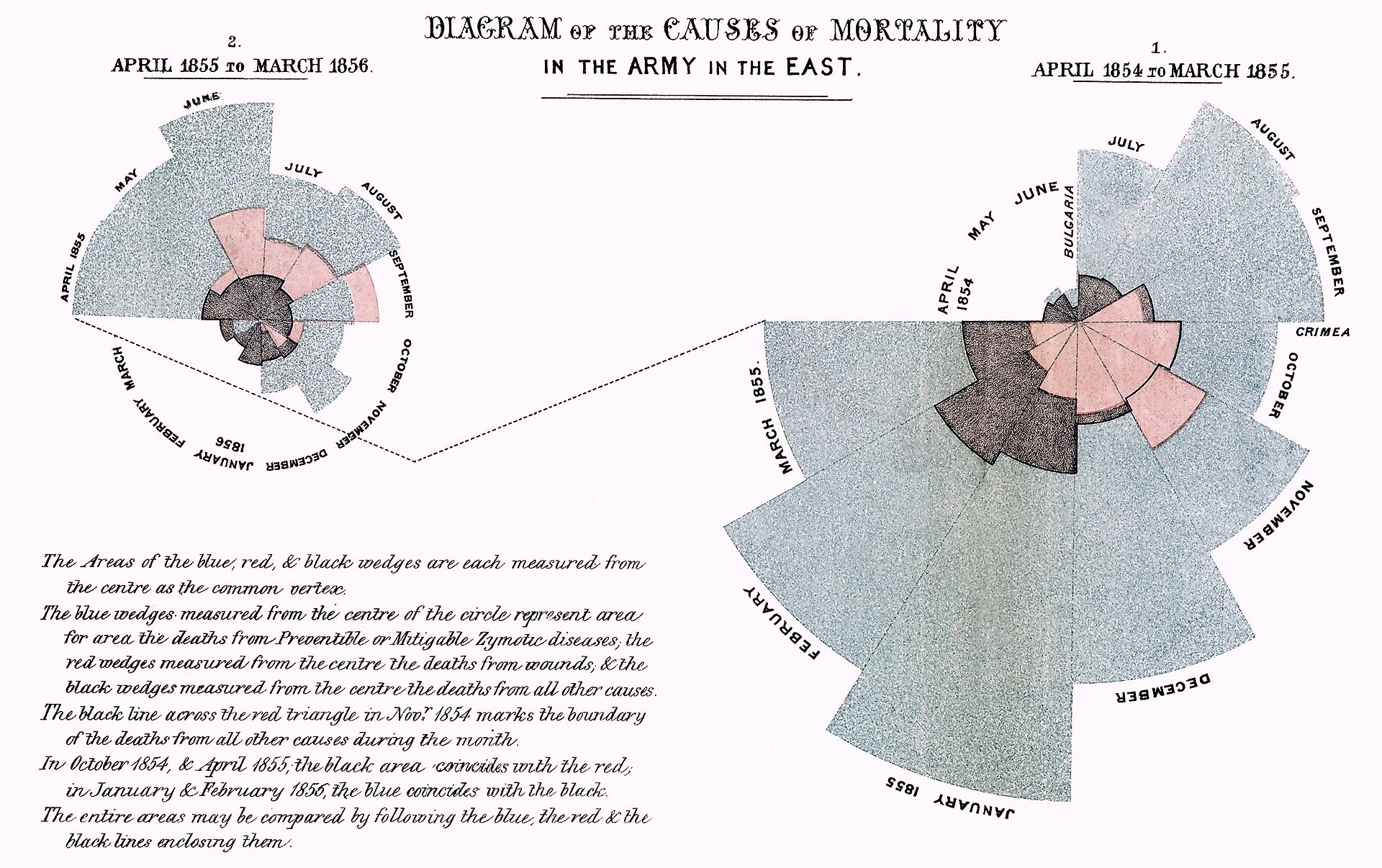
The above diagram was compiled by Florence Nightingale, who was – according to The Font – “a celebrated English social reformer and statistician, and the founder of modern nursing”. It is gratifying to see her less high-profile role as a number-cruncher acknowledged up-front and central; particularly as she died in 1910, eight years before women in the UK were first allowed to vote and eighteen before universal suffrage. This diagram is one of two which are generally cited in any article on Data Visualisation. The other is Charles Minard’s exhibit detailing the advance on, and retreat from, Moscow of Napoleon Bonaparte’s Grande Armée in 1812 (Data Visualisation had a military genesis in common with – amongst many other things – the internet). I’ll leave the reader to look at this second famous diagram if they want to; it’s just a click away.
While there are more elements of numeric information in Minard’s work (what we would now call measures), there is a differentiating point to be made about Nightingale’s diagram. This is that it was specifically produced to aid members of the British parliament in their understanding of conditions during the Crimean War (1853-56); particularly given that such non-specialists had struggled to understand traditional (and technical) statistical reports. Again, rather remarkably, we have here a scenario where the great and the good were listening to the opinions of someone who was barred from voting on the basis of lacking a Y chromosome. Perhaps more pertinently to this blog, this scenario relates to one of the objectives of modern-day Data Visualisation in business; namely explaining complex issues, which don’t leap off of a page of figures, to busy decision makers, some of whom may not be experts in the specific subject area (another is of course allowing the expert to discern less than obvious patterns in large or complex sets of data). Fortunately most business decision makers don’t have to grapple with the progression in number of “deaths from Preventible or Mitigable Zymotic diseases” versus ”deaths from wounds” over time, but the point remains.
Data Visualisation in one branch of Science
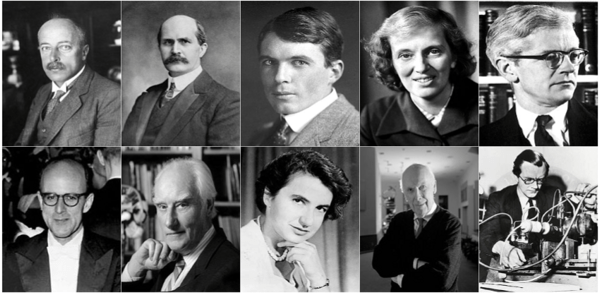
Coming much more up to date, I wanted to consider a modern example of Data Visualisation. As with Nightingale’s work, this is not business-focused, but contains some elements which should be pertinent to the professional considering the creation of diagrams in a business context. The specific area I will now consider is Structural Biology. For the incognoscenti (no advert for IBM intended!), this area of science is focussed on determining the three-dimensional shape of biologically relevant macro-molecules, most frequently proteins or protein complexes. The history of Structural Biology is intertwined with the development of X-ray crystallography by Max von Laue and father and son team William Henry and William Lawrence Bragg; its subsequent application to organic molecules by a host of pioneers including Dorothy Crowfoot Hodgkin, John Kendrew and Max Perutz; and – of greatest resonance to the general population – Francis Crick, Rosalind Franklin, James Watson and Maurice Wilkins’s joint determination of the structure of DNA in 1953.
X-ray diffraction image of the double helix structure of the DNA molecule, taken 1952 by Raymond Gosling, commonly referred to as “Photo 51”, during work by Rosalind Franklin on the structure of DNA
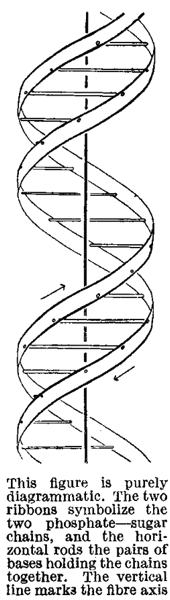
While the masses of data gathered in modern X-ray crystallography needs computer software to extrapolate them to physical structures, things were more accessible in 1953. Indeed, it could be argued that Gosling and Franklin’s famous image, its characteristic “X” suggestive of two helices and thus driving Crick and Watson’s model building, is another notable example of Data Visualisation; at least in the sense of a picture (rather than numbers) suggesting some underlying truth. In this case, the production of Photo 51 led directly to the creation of the even more iconic image below (which was drawn by Francis Crick’s wife Odile and appeared in his and Watson’s seminal Nature paper[1]):
It is probably fair to say that the visualisation of data which is displayed above has had something of an impact on humankind in the fifty years since it was first drawn.
Modern Structural Biology
Today, X-ray crystallography is one of many tools available to the structural biologist with other approaches including Nuclear Magnetic Resonance Spectroscopy, Electron Microscopy and a range of biophysical techniques which I will not detain the reader by listing. The cutting edge is probably represented by the X-ray Free Electron Laser, a device originally created by repurposing the linear accelerators of the previous generation’s particle physicists. In general Structural Biology has historically sat at an intersection of Physics and Biology.
However, before trips to synchrotrons can be planned, the Structural Biologist often faces the prospect of stabilising their protein of interest, ensuring that they can generate sufficient quantities of it, successfully isolating the protein and finally generating crystals of appropriate quality. This process often consumes years, in some cases decades. As with most forms of human endeavour, there are few short-cuts and the outcome is at least loosely correlated to the amount of time and effort applied (though sadly with no guarantee that hard work will always be rewarded).
From the general to the specific
At this point I should declare a personal interest, the example of Data Visualisation which I am going to consider is taken from a paper recently accepted by the Journal of Molecular Biology (JMB) and of which my wife is the first author[2]. Before looking at this exhibit, it’s worth a brief detour to provide some context.
In recent decades, the exponential growth in the breadth and depth of scientific knowledge (plus of course the velocity with which this can be disseminated), coupled with the increase in the range and complexity of techniques and equipment employed, has led to the emergence of specialists. In turn this means that, in a manner analogous to the early production lines, science has become a very collaborative activity; expert in stage one hands over the fruits of their labour to expert in stage two and so on. For this reason the typical scientific paper (and certainly those in Structural Biology) will have several authors, often spread across multiple laboratory groups and frequently in different countries. By way of example the previous paper my wife worked on had 16 authors (including a Nobel Laureate[3]). In this context, the fact the paper I will now reference was authored by just my wife and her group leader is noteworthy.
The reader may at this point be relieved to learn that I am not going to endeavour to explain the subject matter of my wife’s paper, nor the general area of biology to which it pertains (the interested are recommended to Google “membrane proteins” or “G Protein Coupled Receptors” as a starting point). Instead let’s take a look at one of the exhibits.
The above diagram (in common with Nightingale’s much earlier one) attempts to show a connection between sets of data, rather than just the data itself. I’ll elide the scientific specifics here and focus on more general issues.
First the grey upper section with the darker blots on it – which is labelled (a) – is an image of a biological assay called a Western Blot (for the interested, details can be viewed here); each vertical column (labelled at the top of the diagram) represents a sub-experiment on protein drawn from a specific sample of cells. The vertical position of a blot indicates the size of the molecules found within it (in kilodaltons); the intensity of a given blot indicates how much of the substance is present. Aside from the headings and labels, the upper part of the figure is a photographic image and so essentially analogue data[4]. So, in summary, this upper section represents the findings from one set of experiments.
At the bottom – and labelled (b) – appears an artefact familiar to anyone in business, a bar-graph. This presents results from a parallel experiment on samples of protein from the same cells (for the interested, this set of data relates to degree to which proteins in the samples bind to a specific radiolabelled ligand). The second set of data is taken from what I might refer to as a “counting machine” and is thus essentially digital. To be 100% clear, the bar chart is not a representation of the data in the upper part of the diagram, it pertains to results from a second experiment on the same samples. As indicated by the labelling, for a given sample, the column in the bar chart (b) is aligned with the column in the Western Blot above (a), connecting the two different sets of results.
Taken together the upper and lower sections[5] establish a relationship between the two sets of data. Again I’ll skip on the specifics, but the general point is that while the Western Blot (a) and the binding assay (b) tell us the same story, the Western Blot is a much more straightforward and speedy procedure. The relationship that the paper establishes means that just the Western Blot can be used to perform a simple new assay which will save significant time and effort for people engaged in the determination of the structures of membrane proteins; a valuable new insight. Clearly the relationships that have been inferred could equally have been presented in a tabular form instead and be just as relevant. It is however testament to the more atavistic side of humans that – in common with many relationships between data – a picture says it more surely and (to mix a metaphor) more viscerally. This is the essence of Data Visualisation.
What learnings can Scientific Data Visualisation provide to Business?
Using the JMB exhibit above, I wanted to now make some more general observations and consider a few questions which arise out of comparing scientific and business approaches to Data Visualisation. I think that many of these points are pertinent to analysis in general.
Normalisation
Broadly, normalisation[6] consists of defining results in relation to some established yardstick (or set of yardsticks); displaying relative, as opposed to absolute, numbers. In the JMB exhibit above, the amount of protein solubilised in various detergents is shown with reference to the un-solubilised amount found in native membranes; these reference figures appear as 100% columns to the right and left extremes of the diagram.
The most common usage of normalisation in business is growth percentages. Here the fact that London business has grown by 5% can be compared to Copenhagen having grown by 10% despite total London business being 20-times the volume of Copenhagen’s. A related business example, depending on implementation details, could be comparing foreign currency amounts at a fixed exchange rate to remove the impact of currency fluctuation.
Normalised figures are very typical in science, but, aside from the growth example mentioned above, considerably less prevalent in business. In both avenues of human endeavour, the approach should be used with caution; something that increases 200% from a very small starting point may not be relevant, be that the result of an experiment or weekly sales figures. Bearing this in mind, normalisation is often essential when looking to present data of different orders on the same graph[7]; the alternative often being that smaller data is swamped by larger, not always what is desirable.
Controls
I’ll use an anecdote to illustrate this area from a business perspective. Imagine an organisation which (as you would expect) tracks the volume of sales of a product or service it provides via a number of outlets. Imagine further that it launches some sort of promotion, perhaps valid only for a week, and notices an uptick in these sales. It is extremely tempting to state that the promotion has resulted in increased sales[8].
However this cannot always be stated with certainty. Sales may have increased for some totally unrelated reason such as (depending on what is being sold) good or bad weather, a competitor increasing prices or closing one or more of their comparable outlets and so on. Equally perniciously, the promotion maybe have simply moved sales in time – people may have been going to buy the organisation’s product or service in the weeks following a promotion, but have brought the expenditure forward to take advantage of it. If this is indeed the case, an uptick in sales may well be due to the impact of a promotion, but will be offset by a subsequent decrease.
In science, it is this type of problem that the concept of control tests is designed to combat. As well as testing a result in the presence of substance or condition X, a well-designed scientific experiment will also be carried out in the absence of substance or condition X, the latter being the control. In the JMB exhibit above, the controls appear in the columns with white labels.
There are ways to make the business “experiment” I refer to above more scientific of course. In retail business, the current focus on loyalty cards can help, assuming that these can be associated with the relevant transactions. If the business is on-line then historical records of purchasing behaviour can be similarly referenced. In the above example, the organisation could decide to offer the promotion at only a subset of the its outlets, allowing a comparison to those where no promotion applied. This approach may improve rigour somewhat, but of course it does not cater for purchases transferred from a non-promotion outlet to a promotion one (unless a whole raft of assumptions are made). There are entire industries devoted to helping businesses deal with these rather messy scenarios, but it is probably fair to say that it is normally easier to devise and carry out control tests in science.
The general take away here is that a graph which shows some change in a business output (say sales or profit) correlated to some change in a business input (e.g. a promotion, a new product launch, or a price cut) would carry a lot more weight if it also provided some measure of what would have happened without the change in input (not that this is always easy to measure).
Rigour and Scrutiny
I mention in the footnotes that the JMB paper in question includes versions of the exhibit presented above for four other membrane proteins, this being in order to firmly establish a connection. Looking at just the figure I have included here, each element of the data presented in the lower bar-graph area is based on duplicated or triplicated tests, with average results (and error bars – see the next section) being shown. When you consider that upwards of three months’ preparatory work could have gone into any of these elements and that a mistake at any stage during this time would have rendered the work useless, some impression of the level of rigour involved emerges. The result of this assiduous work is that the authors can be confident that the exhibits they have developed are accurate and will stand up to external scrutiny. Of course such external scrutiny is a key part of the scientific process and the manuscript of the paper was reviewed extensively by independent experts before being accepted for publication.
In the business world, such external scrutiny tends to apply most frequently to publicly published figures (such as audited Financial Accounts); of course external financial analysts also will look to dig into figures. There may be some internal scrutiny around both the additional numbers used to run the business and the graphical representations of these (and indeed some companies take this area very seriously), but not every internal KPI is vetted the way that the report and accounts are. Particularly in the area of Data Visualisation, there is a tension here. Graphical exhibits can have a lot of impact if they relate to the current situation or present trends; contrawise if they are substantially out-of-date, people may question their relevance. There is sometimes the expectation that a dashboard is just like its aeronautical counterpart, showing real-time information about what is going on now[9]. However a lot of the value of Data Visualisation is not about the here and now so much as trends and explanations of the factors behind the here and now. A well-thought out graph can tell a very powerful story, more powerful for most people than a table of figures. However a striking graph based on poor quality data, data which has been combined in the wrong way, or even – as sometimes happens – the wrong datasets entirely, can tell a very misleading story and lead to the wrong decisions being taken.
I am not for a moment suggesting here that every exhibit produced using Data Visualisation tools must be subject to months of scrutiny. As referenced above, in the hands of an expert such tools have the value of sometimes quickly uncovering hidden themes or factors. However, I would argue that – as in science – if the analyst involved finds something truly striking, an association which he or she feels will really resonate with senior business people, then double- or even triple-checking the data would be advisable. Asking a colleague to run their eye over the findings and to then probe for any obvious mistakes or weaknesses sounds like an appropriate next step. Internal Data Visualisations are never going to be subject to peer-review, however their value in taking sound business decisions will be increased substantially if their production reflects at least some of the rigour and scrutiny which are staples of the scientific method.
Dealing with Uncertainty
In the previous section I referred to the error bars appearing on the JMB figure above. Error bars are acknowledgements that what is being represented is variable and they indicate the extent of such variability. When dealing with a physical system (be that mechanical or – as in the case above – biological), behaviour is subject to many factors, not all of which can be eliminated or adjusted for and not all of which are predictable. This means that repeating an experiment under ostensibly identical conditions can lead to different results[10]. If the experiment is well-designed and if the experimenter is diligent, then such variability is minimised, but never eliminated. Error bars are a recognition of this fundamental aspect of the universe as we understand it.
While de rigueur in science, error bars seldom make an appearance in business, even – in my experience – in estimates of business measures which emerge from statistical analyses[11]. Even outside the realm of statistically generated figures, more business measures are subject to uncertainty than might initially be thought. An example here might be a comparison (perhaps as part of the externally scrutinised report and accounts) of the current quarter’s sales to the previous one (or the same one last year). In companies where sales may be tied to – for example – the number of outlets, care is paid to making these figures like-for-like. This might include only showing numbers for outlets which were in operation in the prior period and remain in operation now (i.e. excluding sales from both closed outlets or newly opened ones). However, outside the area of high-volume low-value sales where the Law of Large Numbers[12] rules, other factors could substantially skew a given quarter’s results for many organisations. Something as simple as a key customer delaying a purchase (so that it fell in Q3 this year instead of Q2 last) could have a large impact on quarterly comparisons. Again companies will sometimes look to include adjustments to cater for such timing or related issues, but this cannot be a precise process.
The main point I am making here is that many aspects of the information produced in companies is uncertain. The cash transactions in a quarter are of course the cash transactions in a quarter, but the above scenario suggests that they may not always 100% reflect actual business conditions (and you cannot adjust for everything). Equally where you get in to figures that would be part of most companies’ financial results, outstanding receivables and allowance for bad debts, the spectre of uncertainty arises again without a statistical model in sight. In many industries, regulators are pushing for companies to include more forward-looking estimates of future assets and liabilities in their Financials. While this may be a sensible reaction to recent economic crises, the approach inevitably leads to more figures being produced from models. Even when these models are subject to external review, as is the case with most regulatory-focussed ones, they are still models and there will be uncertainty around the numbers that they generate. While companies will often provide a range of estimates for things like guidance on future earnings per share, providing a range of estimates for historical financial exhibits is not really a mainstream activity.
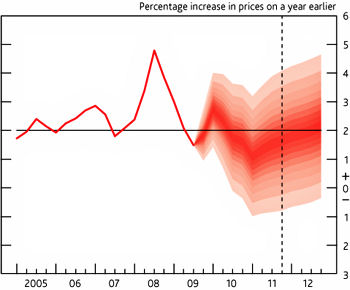
Which perhaps gets me back to the subject of error bars on graphs. In general I think that their presence in Data Visualisations can only add value, not subtract it. In my article entitled Limitations of Business Intelligence I include the following passage which contains an exhibit showing how the Bank of England approaches communicating the uncertainty inevitably associated with its inflation estimates:
Business Intelligence is not a crystal ball, Predictive Analytics is not a crystal ball either. They are extremely useful tools […] but they are not universal panaceas.
An inflation prediction from The Bank of England Illustrating the fairly obvious fact that uncertainty increases in proportion to time from now.
[…] Statistical models will never give you precise answers to what will happen in the future – a range of outcomes, together with probabilities associated with each is the best you can hope for (see above). Predictive Analytics will not make you prescient, instead it can provide you with useful guidance, so long as you remember it is a prediction, not fact.
While I can’t see them figuring in formal financial statements any time soon, perhaps there is a case for more business Data Visualisations to include error bars.
In Summary
So, as is often the case, I have embarked on a journey. I started with an early example of Data Visualisation, diverted in to a particular branch of science with which I have some familiarity and hopefully returned, again as is often the case, to make some points which I think are pertinent to both the Business Intelligence practitioner and the consumers (and indeed commissioners) of Data Visualisations. Back in “All that glisters is not gold” – some thoughts on dashboards I made some more general comments about the best Data Visualisations having strong informational foundations underpinning them. While this observation remains true, I do see a lot of value in numerically able and intellectually curious people using Data Visualisation tools to quickly make connections which had not been made before and to tease out patterns from large data sets. In addition there can be great value in using Data Visualisation to present more quotidian information in a more easily digestible manner. However I also think that some of the learnings from science which I have presented in this article suggest that – as with all powerful tools – appropriate discretion on the part of the people generating Data Visualisation exhibits and on the part of the people consuming such content would be prudent. In particular the business equivalents of establishing controls, applying suitable rigour to data generation / combination and including information about uncertainty on exhibits where appropriate are all things which can help make Data Visualisation more honest and thus – at least in my opinion – more valuable.
The list of scientists involved in the development of X-ray Crystallography and Structural Biology which was presented earlier in the text encompasses a further nine such laureates (four of whom worked at my wife’s current research institute), though sadly this number does not include Rosalind Franklin. Over 20 Nobel Prizes have been awarded to people working in the field of Structural Biology, you can view an interactive time line of these here.
[4]
The intensity, size and position of blots are often digitised by specialist software, but this is an aside for our purposes.
[5]
Plus four other analogous exhibits which appear in the paper and relate to different proteins.
[6]
Normalisation has a precise mathematical meaning, actually (somewhat ironically for that most precise of activities) more than one. Here I am using the term more loosely.
[7]
That’s assuming you don’t want to get into log scales, something I have only come across once in over 25 years in business.
[8]
The uptick could be as compared to the week before, or to some other week (e.g. the same one last year or last month maybe) or versus an annual weekly average. The change is what is important here, not what the change is with respect to.
[9]
Of course some element of real-time information is indeed both feasible and desirable; for more analytic work (which encompasses many aspects of Data Visualisation) what is normally more important is sufficient historical data of good enough quality.
[10]
Anyone interested in some of the reasons for this is directed to my earlier article Patterns patterns everywhere.
Back in 2010 I posted a piece called Patterns patterns everywhere which used the entry point of various articles on a number of web-sites relating to the, then current, Eyjafjallajokull eruption. I went ont to reference – amongst other phenomena, the weather.
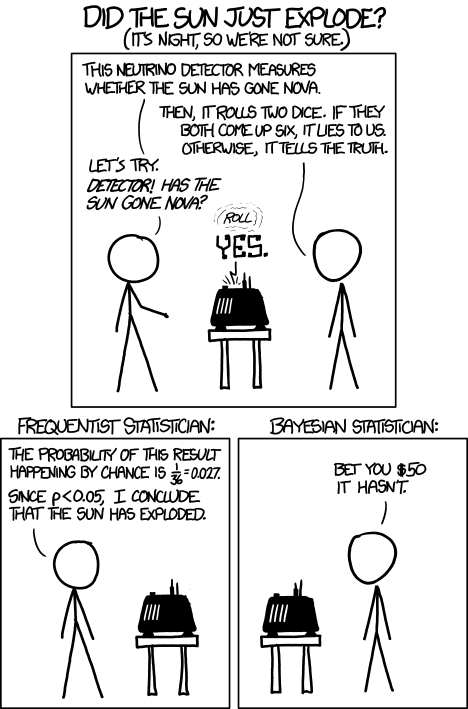
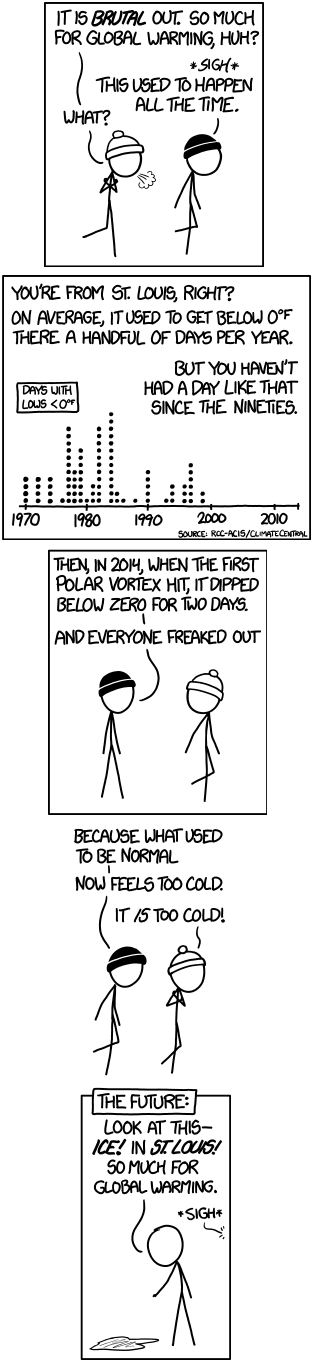
The incomparable Randall Munroe from xkcd.com has just knocked my earlier work into a cocked hat with his (perhaps unsurprisingly) much more laconic observations from last Friday, which are instead inspired by the recent cold snaps in the US:
Copyright xkcd.com
This image has been rearranged to fit in to the confines of peterjamesthomas.com
This blog primarily deals with matters relating to business, technology and change; obviously with a major focus on how information provision overlaps with each of these. However there is the occasional divertimento relating to mathematics, physical science, or that most recent of -ologies, social media.
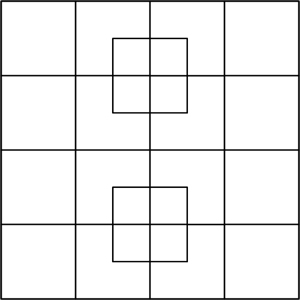
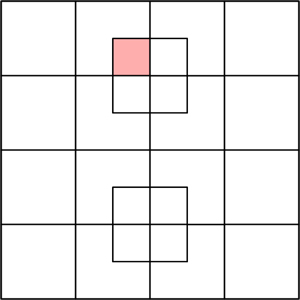
The following article could claim some connections with both mathematics and social media, but in truth relates to neither. Its focus is instead on irritation, specifically a Facebook meme that displays the death-defying resilience of a horror movie baddie. My particular bête noire relates to the following diagram, which appears on my feed more frequently that adverts for “Facebook singles”:
It is generally accompanied by some inane text, the following being just one example:
I got into a heated battle with a friend over this… I got 24 she say’s 25. How many squares do you see?
Nice grocer’s apostrophe BTW!
I realise that the objective is probably to encourage people to point out the error in the ways of the original poster; thereby racking up comments. However 24?, 25??, really???, really, really????
Let’s break it down…
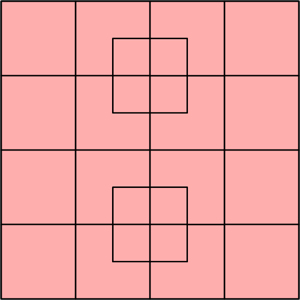
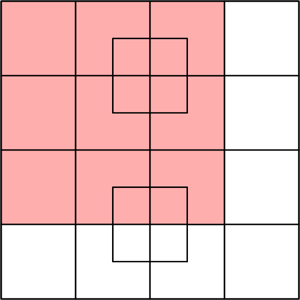
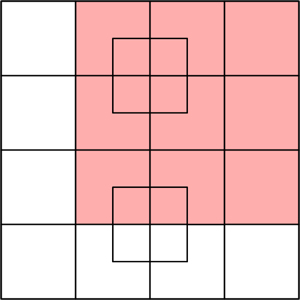
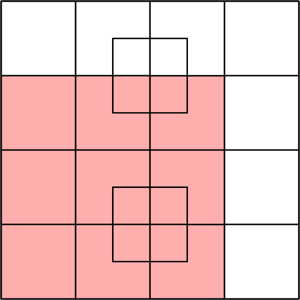
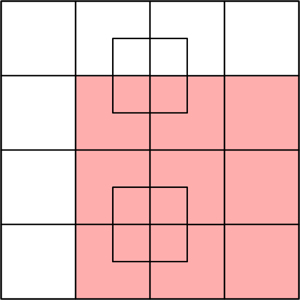
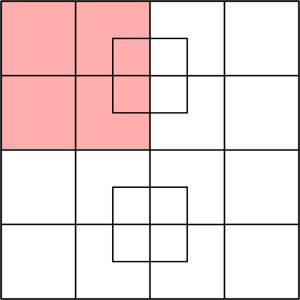
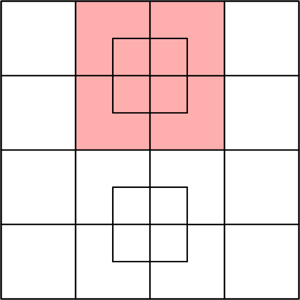
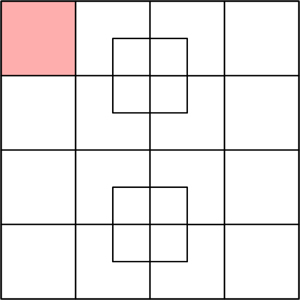
Well there is clearly one big square (a 4×4 one) staring us in the face as shown above. Let’s move on to a marginally less obvious class of squares and work these through in long-hand. The squares in this class are all 3×3 and there are 4 of them as follows:
1…
2…
3…
4…
Adding the initial 4×4 square, our running total is now 5.
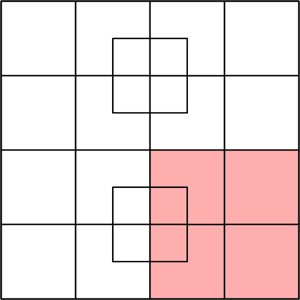
The next class is smaller again, 2×2 squares. The same approach as above works, not all the class members are shown, but readers can hopefully fill in the blanks themselves.
1…
2…
Skip a few…
9…
Adding our previous figure of 5 means our running total is now 14; we are approaching 24 and 25 fast, which one is it going to be?
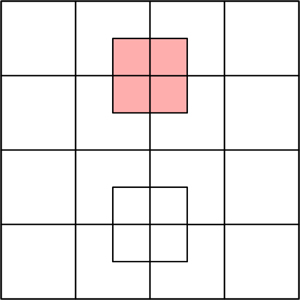
The next class is the most obvious, the sets of larger 1×1 squares.
It doesn’t require a genius to note that there are 16 of these. Oh dear, the mid-twenties estimates are not looking so good now.
Also we shouldn’t forget the two further squares of the same size (each of which is split into smaller ones), one of which is shown in the diagram above.
Our previous total was 14 and now 14 + 16 + 2 = 32.
Finally there is the second set of 1×1 squares, the smaller ones.
It’s trivial to see that there are 8 of these.
Adding this to the last figure of 32 we get a grand total of 40, slightly above both 24 and 25.
Perhaps the only thing of any note that this rather simple exercise teaches us is the relation to sums of squares, inasmuch as part of the final figure is given by: 1 + 4 + 9 + 16, or 12 + 22 + 32 + 42 = 30. Even this is rather spoiled by introducing the intersecting (and interloping) two squares that are covered last in the above analysis.
Oh well, at least now I never have to comment on this annoying “puzzle” again, which is something.
The BBC’s own take on this is summed up in the title of their bulletin, Another giant UK ash cloud ‘unlikely’ in our lifetimes. My fervent hope is that this is lazy, or ill-informed, journalism rather than a true representation of what is in the peer-reviewed journal (perhaps all the main BBC journalists are on holiday and the interns are writing the copy). To state the obvious, in general, the fact that something happens every 56 years does not guarantee that the events are always 56 years apart.
Note: In the following I have used the abridgement Maths when referring to Mathematics, I appreciate that this may be jarring to US readers, omitting the ‘s’ is jarring to me, so please accept my apologies in advance.
Introduction
Regular readers of this blog will be aware of my penchant for analogies. Dominant amongst these have been sporting ones, which have formed a major part of articles such as:
I have also used other types of analogy from time to time, notably scientific ones such as in the middle sections of Recipes for Success?, or A Single Version of the Truth? – I was clearly feeling quizzical when I wrote both of those pieces! Sometimes these analogies have been buried in illustrations rather than the text as in:
Jim Harris (@ocdqblog) frequently employs analogies on his excellent Obsessive Compulsive Data Quality blog. If there is a way to form a title “The X of Data Quality”, and relate this in a meaningful way back to his area of expertise, Jim’s creative brain will find it. So it is encouraging to feel that I am not alone in adopting this approach. Indeed I see analogies employed increasingly frequently in business and technology blogs, to say nothing of in day-to-day business life.
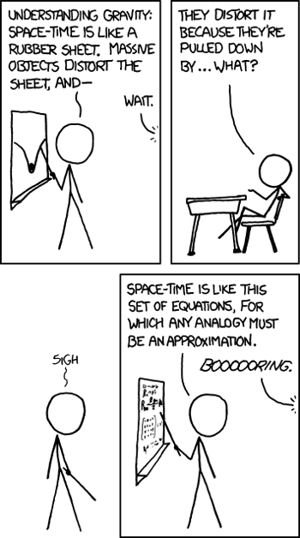
However, recently two things have given me pause for thought. The first was the edition of Randall Munroe’s highly addictive webcomic, xkcd.com, that appeared on 6th May 2011, entitled “Teaching Physics”. The second was a blog article I read which likened a highly abstract research topic in one branch of Theoretical Physics to what BI practitioners do in their day job.
An homage to xkcd.com
Let’s consider xkcd.com first. Anyone who finds some nuggets of interest in the type of – generally rather oblique – references to matters Mathematical or Scientific that I mention above is likely to fall in love with xkcd.com. Indeed anyone who did a numerate degree, works in a technical role, or is simply interested in Mathematics, Science or Engineering would as well – as Randall says in a footnote:
“this comic occasionally contains […] advanced mathematics (which may be unsuitable for liberal-arts majors)”
Although Randall’s main aim is to entertain – something he manages to excel at – his posts can also be thought-provoking, bitter-sweet and even resonate with quite profound experiences and emotions. Who would have thought that some stick figures could achieve all that? It is perhaps indicative of the range of topics dealt with on xkcd.com that I have used it to illustrate no fewer than seven of my articles (including this one, a full list appears at the end of the article). It is encouraging that Randall’s team of corporate lawyers has generally viewed my requests to republish his work favourably.
The example of Randall’s work that I wanted to focus on is as follows.
It is worth noting that often the funniest / most challenging xkcd.com observations appear in the mouse-over text of comic strips (alt or title text for any HTML heads out there – assuming that there are any of us left). I’ll reproduce this below as it is pertinent to the discussion:
Space-time is like some simple and familiar system which is both intuitively understandable and precisely analogous, and if I were Richard Feynman I’d be able to come up with it.
If anyone needs some background on the science referred to then have a skim of this article if you need some background on the scientist mentioned (who has also made an appearance on peterjamesthomas.com in Presenting in Public) then glance through this second one.
Here comes the Science…
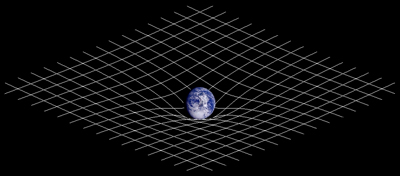
Randall points out the dangers of over-extending an analogy. While it has always helped me to employ the rubber-sheet analogy of warped space-time when thinking about the area, it is rather tough (for most people) to extrapolate a 2D surface being warped to a 4D hyperspace experiencing the same thing. As an erstwhile Mathematician, I find it easy enough to cope with the following generalisation:
S(1) =
The set of all points defined by one variable (x1)
– i.e. a straight line
S(2) =
The set of all points defined by two variables (x1, x2)
– i.e. a plane
S(3) =
The set of all points defined by three variables (x1, x2, x3)
– i.e. “normal” 3-space
S(4) =
The set of all points defined by four variables (x1, x2, x3, x4)
– i.e. 4-space
” ” ” “
S(n) =
The set of all points defined by n variables (x1, x2, … , xn)
– i.e. n-space
As we increase the dimensions, the Maths continues to work and you can do calculations in n-space (e.g. to determine the distance between two points) just as easily (OK with some more arithmetic) as in 3-space; Pythagoras still holds true. However, actually visualising say 7-space might be rather taxing for even a Field’s Medallist or Nobel-winning Physicist.
… and the Maths
More importantly while you can – for example – use 3-space as an analogue for some aspects of 4-space, there are also major differences. To pick on just one area, some pieces of string that are irretrievably knotted in 3-space can be untangled with ease in 4-space.
To briefly reference a probably familiar example, starting with 2-space we can look at what is clearly a family of related objects:
2-space:
A square has 4 vertexes, 4 edges joining them and 4 “faces” (each consisting of a line – so the same as edges in this case)
3-space:
A cube has 8 vertexes, 12 edges and 6 “faces” (each consisting of a square)
4-space:
A tesseract (or 4-hypercube) has 16 vertexes, 32 edges and 8 “faces” (each consisting of a cube)
Note: The reason that faces appears in inverted commas is that the physical meaning changes, only in 3-space does this have the normal connotation of a surface with two dimensions. Instead of faces, one would normally talk about the bounding cubes of a tesseract forming its cells.
Even without any particular insight into multidimensional geometry, it is not hard to see from the way that the numbers stack up that:
n-space:
An n-hypercube has 2n vertexes, 2n-1n edges and 2n “faces” (each consisting of an (n-1)-hypercube)
Again, while the Maths is compelling, it is pretty hard to visualise a tesseract. If you think that a drawing of a cube, is an attempt to render a 3D object on a 2D surface, then a picture of a tesseract would be a projection of a projection. The French (with a proud history of Mathematics) came up with a solution, just do one projection by building a 3D “picture” of a tesseract.
As aside it could be noted that the above photograph is of course a 2D projection of a 3D building, which is in turn a projection of a 4D shape; however recursion can sometimes be pushed too far!
Drawing multidimensional objects in 2D, or even building them in 3D, is perhaps a bit like employing an analogy (this sentence being of course a meta-analogy). You may get some shadowy sense of what the true object is like in n-space, but the projection can also mask essential features, or even mislead. For some things, this shadowy sense may be more than good enough and even allow you to better understand the more complex reality. However, a 2D projection will not be good enough (indeed cannot be good enough) to help you understand all properties of the 3D, let alone the 4D. Hopefully, I have used one element of the very subject matter that Randall raises in his webcomic to further bolster what I believe are a few of the general points that he is making, namely:
Analogies only work to a degree and you over-extend them at your peril
Sometimes the wholly understandable desire to make a complex subject accessible by comparing it to something simpler can confuse rather than illuminate
There are subject areas that very manfully resist any attempts to approach them in a manner other than doing the hard yards – not everything is like something less complex
Why BI is not [always] like Theoretical Physics
Having hopefully supported these points, I’ll move on to the second thing that I mentioned reading; a BI-related blog also referencing Theoretical Physics. I am not going to name the author, mention where I read their piece, state what the title was, or even cite the precise area of Physics they referred to. If you are really that interested, I’m sure that the nice people at Google can help to assuage your curiosity. With that out of the way, what were the concerns that reading this piece raised in my mind?
Well first of all, from the above discussion (and indeed the general tone of this blog), you might think that such an article would be right up my street. Sadly I came away feeling that the connection made was, tenuous at best, rather unhelpful (it didn’t really tell you anything about Business Intelligence) and also exhibited a lack of anything bar a superficial understanding of the scientific theory involved.
The analogy had been drawn based on a single word which is used in both some emerging (but as yet unvalidated) hypotheses in Theoretical Physics and in Business Intelligence. While, just like the 2D projection of a 4D shape, there are some elements in common between the two, there are some fundamental differences. This is a general problem in Science and Mathematics, everyday words are used because they have some connection with the concept in hand, but this does not always imply as close a relationship as the casual reader might infer. Some examples:
In Pure Mathematics, the members of a group may be associative, but this doesn’t mean that they tend to hang out together.
In Particle Physics, an object may have spin, but this does not mean that it has been bowled by Murali
In Structural Biology, a residue is not precisely what a Chemist might mean by one, let alone a lay-person
Part of the blame for what was, in my opinion, an erroneous connection between things that are not actually that similar lies with something that, in general, I view more positively; the popular science book. The author of the BI/Physics blog post referred to just such a tome in making his argument. I have consumed many of these books myself and I find them an interesting window into areas in which I do not have a background. The danger with them lies when – in an attempt to convey meaning that is only truly embodied (if that is the word) in Mathematical equations – our good friend the analogy is employed again. When done well, this can be very powerful and provide real insight for the non-expert reader (often the writers of pop-science books are better at this kind of thing than the scientists themselves). When done less well, this can do more than fail to illuminate, it can confuse, or even in some circumstances leave people with the wrong impression.
During my MSc, I spent a year studying the Riemann Hypothesis and the myriad of results that are built on the (unproven) assumption that it is true. Before this I had spent three years obtaining a Mathematics BSc. Before this I had taken two Maths A-levels (national exams taken in the UK during and at the end of what would equate to High School in the US), plus (less relevantly perhaps) Physics and Chemistry. One way or another I had been studying Maths for probably 15 plus years before I encountered this most famous and important of ideas.
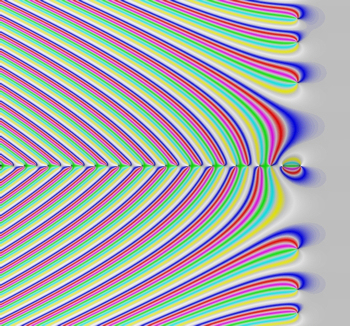
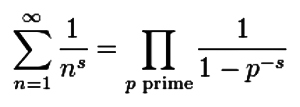
So what is the Riemann Hypotheis? A statement of it is as follows:
The real part of all non-trivial zeros of the Riemann Zeta function is equal to one half
There! Are you any the wiser? If I wanted to explain this statement to those who have not studied Pure Mathematics at a graduate level, how would I go about it? Maybe my abilities to think laterally and be creative are not well-developed, but I struggle to think of an easily accessible way to rephrase the proposal. I could say something gnomic such as, “it is to do with the distribution of prime numbers” (while trying to avoid the heresy of adding that prime numbers are important because of cryptography – I believe that they are important because they are prime numbers!).
I spent a humble year studying this area, after years of preparation. Some of the finest Mathematical minds of the last century (sadly not a set of which I am a member) have spent vast chunks of their careers trying to inch towards a proof. The Riemann Hypothesis is not like something from normal experience; it is complicated. Some things are complicated and not easily susceptible to analogy.
Equally – despite how interesting, stimulating, rewarding and even important Business Intelligence can be – it is not Theoretical Physics and n’er the twain shall meet.
And so what?
So after this typically elliptical journey through various parts of Science and Mathematics, what have I learnt? Mainly that analogies must be treated with care and not over-extended lest they collapse in a heap. Will I therefore stop filling these pages with BI-related analogies, both textual and visual? Probably not, but maybe I’ll think twice before hitting the publish key in future!
Chronological list of articles using xkcd.com illustrations:
This article completes the three-part series which started with Using historical data to justify BI investments – Part I and continued (somewhat inevitably) with Using historical data to justify BI investments – Part II. Having presented a worked example, which focused on using historical data both to develop a profit-enhancing rule and then to test its efficacy, this final section considers the implications for justifying Business Intelligence / Data Warehouse programmes and touches on some more general issues.
The Business Intelligence angle
In my experience when talking to people about the example I have just shared, there can be an initial “so what?” reaction. It can maybe seem that we have simply adopted the all-too-frequently-employed business ruse of accentuating the good and down-playing the bad. Who has not heard colleagues say “this was a great month excluding the impact of X, Y and Z”? Of course the implication is that when you include X, Y and Z, it would probably be a much less great month; but this is not what we have done.
One goal of business intelligence is to help in estimating what is likely to happen in the future and guiding users in taking decisions today that will influence this. What we have really done in the above example is as follows:
shift “now” back two years in time
pretend we know nothing about what has happened in these most recent two years
develop a predictive rule based solely on the three years preceding our back-shifted “now”
then use the most recent two years (the ones we have metaphorically been covering with our hand) to see whether our proposed rule would have been efficacious
For the avoidance of doubt, in the previously attached example, the losses incurred in 2009 – 2010 have absolutely no influence on the rule we adopt, this is based solely on 2006 – 2008 losses. All the 2009 – 2010 losses are used for is to validate our rule.
We have therefore achieved two things:
Established that better decisions could have been taken historically at the juncture of 2008 and 2009
Devised a rule that would have been more effective and displayed at least some indication that this could work going forward in 2011 and beyond
From a Business Intelligence / Data Warehousing perspective, the general pitch is then something like:
if we can mechanically take such decisions, based on a very non-sophisticated analysis of data, then if we make even simple information available to the humans taking decisions (i.e. basic BI), then surely the quality of their decision-making will improve
If we go beyond this to provide more sophisticated analyses (e.g. including industry segmentation, analysis of insured attributes, specific products sold etc., i.e. regular BI) then we can – by extrapolation from the example – better shape the evolution of the performance of whole books of business
We can also monitor the decisions taken to determine the relative effectiveness of individuals and teams and compare these to their peers – ideally these comparisons would also be made available to the individuals and teams themselves, allowing them to assess their relative performance (again regular BI)
Finally, we can also use more sophisticated approaches, such as statistical modelling to tease out trends and artefacts that would not be easily apparent when using a standard numeric or graphical approach (i.e. sophisticated BI, though others might use the terms “data mining”, “pattern recognition” or the now ubiquitous marketing term “analytics”)
The example also says something else – although we may already have reporting tools, analysis capabilities and even people dabbling in statistical modelling, it appears that there is room for improvement in our approach. The 2009 – 2010 loss ratio was 54% and it could have been closer to 40%. Thus what we are doing now is demonstrably not as good as it could be and the monetary value of making a stepped change in information capabilities can be estimated.
In the example, we are talking about £1m of biannual premium and £88k of increased profit. What would be the impact of better information on an annual book of £1bn premium? Assuming a linear relationship and using some advanced Mathematics, we might suggest £44m. What is more, these gains would not be one-off, but repeatable every year. Even if we moderate our projected payback to a more conservative figure, our exercise implies that we would be not out of line to suggest say an ongoing annual payback of £10m. These are numbers and concepts which are likely to resonate with Executive decision-makers.
To put it even more directly an increase of £10m a year in profits would quickly swamp the cost of a BI/DW programme in very substantial benefits. These are payback ratios that most IT managers can only dream of.
As an aside, it may have occurred to readers that the mechanistic rule is actually rather good and – if so – why exactly do we need the underwriters? Taking to one side examples of solely rule-based decision-making going somewhat awry (LTCM anyone?) the human angle is often necessary in messy things like business acquisition and maintaining relationships. Maybe because of this, very few insurance organisations are relying on rules to take all decisions. However it is increasingly common for rules to play some role in their overall approach. This is likely to take the form of triage of some sort. For example:
A rule – maybe not much more sophisticated than the one I describe above – is established and run over policies before renewal.
This is used to score polices as maybe having green, amber or red lights associated with them.
Green policies may be automatically renewed with no intervention from human staff
Amber polices may be looked at by junior staff, who may either OK the renewal if they satisfy themselves that the issues picked up are minor, or refer it to more senior and experienced colleagues if they remain concerned
Red policies go straight to the most experienced staff for their close attention
In this way process efficiencies are gained. Staff time is only applied where it is necessary and the most expensive resources are applied to those cases that most merit their abilities.
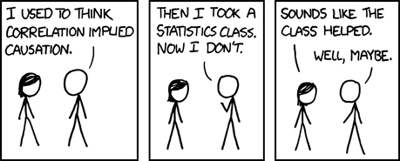
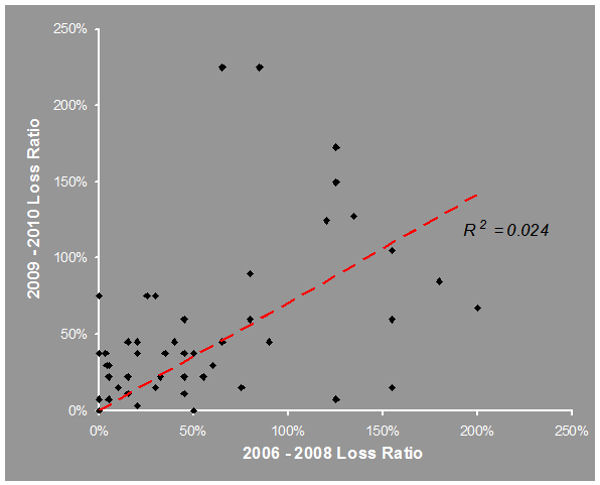
Let’s pause for a moment and consider the Insurance example a little more closely. What has actually happened? Well we seem to have established that performance of policies in 2006 – 2008 is at least a reasonable predictor of performance of the same policies in 2009 – 2010. Taking the mutual fund vendors’ constant reminder that past performance does not indicate future performance to one side, what does this actually mean?
What we have done is to establish a loose correlation between 2006 – 2008 and 2009 – 2010 loss ratios. But I also mentioned a while back that I had fabricated the figures, so how does that work? In the same section, I also said that the figures contained an intentional bias. I didn’t adjust my figures to make the year-on-year comparison work out. However, at the policy level, I was guilty of making the numbers look like the type of results that I have seen with real policies (albeit of a specific type). Hopefully I was reasonably realistic about this. If every policy that was bad in 2006 – 2008 continued in exactly the same vein in 2009 – 2010 (and vice versa) then my good segment would have dropped from an overall loss ratio of 54% to considerably less than 40%. The actual distribution of losses is representative of real Insurance portfolios that I have analysed. It is worth noting that only a small bias towards policies that start bad continuing to be bad is enough for our rule to work and profits to be improved. Close scrutiny of the list of policies will reveal that I intentionally introduced several counter-examples to our rule; good business going bad and vice versa. This is just as it would be in a real book of business.
Rather than continuing to justify my methodology, I’ll make two statements:
I have carried out the above sort of analysis on multiple books of Insurance business and come up with comparable results; sometimes the implied benefit is greater, sometimes it is less, but it has been there without exception (of course statistics being what it is, if I did the analysis frequently enough I would find just such an exception!).
More mathematically speaking, the actual figure for the correlation between the two sets of years is a less than stellar 0.44. Of course a figure of 1 (or indeed -1) would imply total correlation, and one of 0 would imply a complete lack of correlation, so I am not working with doctored figures. Even a very mild correlation in data sets (one much less than the threshold for establishing statistical dependence) can still yield a significant impact on profit.
Closing thoughts
Having gone into a lot of detail over the course of these three articles, I wanted to step back and assess what we have covered. Although the worked-example was drawn from my experience in Insurance, there are some generic learnings to be made.
Broadly I hope that I have shown that – at least in Insurance, but I would argue with wider applicability – it is possible to use the past to infer what actions we should take in the future. By a slight tweak of timeframes, we can even take some steps to validate approaches suggested by our information. It is important that we remember that the type of basic analysis I have carried out is not guaranteed to work. The same can be said of the most advanced statistical models; both will give you some indication of what may happen and how likely this is to occur, but neither of them is foolproof. However, either of these approaches has more chance of being valuable than, for example, solely applying instinct, or making decisions at random.
In Patterns, patterns everywhere, I wrote about the dangers associated with making predictions about events are essentially unpredictable. This is another caveat to be born in mind. However, to balance this it is worth reiterating that even partial correlation can lead to establishing rules (or more sophisticated models) that can have a very positive impact.
While any approach based on analysis or statistics will have challenges and need careful treatment, I hope that my example shows that the option of doing nothing, of continuing to do things how they have been done before, is often fraught with even more problems. In the case of Insurance at least – and I suspect in many other industries – the risks associated with using historical data to make predictions about the future are, in my opinion, outweighed by the risks of not doing this; on average of course!













![Look out Morlocks, here I come... [alumni of Imperial College London are so creative aren't they?]](https://peterjamesthomas.com/wp-content/uploads/2011/05/the-time-machine.jpg?w=700 "Look out Morlocks, here I come... [alumni of Imperial College London are so creative aren't they?]")