This IRM UK event will be taking place in central London from the 21st to 23rd March 2011. It is co-located with another related IRM conferences on Master Data Management.
My presentation will be entitled Making Business Intelligence an Integral part of your Data Quality Programme. Full details may be obtained from the IRM conference web-site here.
Back in June 2009, I wrote an article entitled A first for me. In this I described meeting up with Seth Grimes (@SethGrimes), an acknowledged expert in analytics and someone I had initially “met” via Twitter.com.
I have vastly expanded my network of international contacts through social media interactions such as these. Indeed I am slated to meet up with a few other people during November; a month in which I have a couple of slots speaking at BI/DW conferences (IRM later this week and Obis Omni towards the end of the month).
Another person that I became a virtual acquaintance of via social media is Bruna Aziza (@brunoaziza), Worldwide Strategy Lead for Business Intelligence at Microsoft. I originally “met” Bruno via LinkedIn.com and then also connected on Twitter.com. Later Bruno asked me for my thoughts on his article, Use Business Intelligence To Compete More Effectively, and I turned these into a blog post called BI and competition.
We have kept in touch since and last week Bruno asked me to be interviewed on the bizintelligence.tv channel that he is setting up. It was good to meet in person and I thought that we had some interesting discussions. Though I have done video and audio interviews before with organisations like IBM Cognos, Informatica, Computing Magazine and SmartDataCollective (see the foot of this article for links), these were mostly a while back and so it was interesting to be in front of a camera again.
The bizintelligence.tv format seems to be an interesting one, with key points in BI discussed in a focussed and punchy manner (not an approach that I am generally associated with) and a target audience of busy senior IT managers. As I have remarked elsewhere, it is also notable that the more foresighted of corporations are now taking social media seriously and getting quite good at engaging without any trace of hard selling; something that perhaps compromised the earlier efforts of some organisations in this area (for the avoidance of doubt, this is a general comment and not one levelled at Microsoft).
Bruno and I touched on a number of areas including, driving improvements in data quality, measuring the value of BI programmes, using historical data to justify BI investments (something that I am overdue writing about – UPDATE: now remedied here) and the cultural change aspect of BI. I am looking forward to seeing the results. Watch this space and in the meantime, take a look at some of the earlier interviews that Bruno has conducted.
Other video and audio interviews that I have recorded:
I have been a member of the Business Intelligence Mecca that is BeyeNetwork.com for quite some time, but as of this week I am delighted to announce that they will be syndicating this blog at: http://www.beyeblogs.com/pthomas/.
Thank you to all at at BeyeNetwork for setting this up.
a social media expert, nor any of its many variants.
I do not
work in marketing or PR.
I will not
be encouraging you to unleash the power of FaceTube/YouSpace/MyBook to make the world a better place (and your bank vault a fuller one), or to sell a million more of your product.
I can not
claim to have some secret formula for success in the world of on-line communication (indeed I tend to be allergic to such things as per Recipes for Success?).
If you want all the answers, then please look elsewhere. Good luck with your search!
However:
I am
an IT person, with a reasonable degree of commercial awareness and a background in sales and sales support.
I have
been involved in running web-sites and various on-line communities since 1999.
I do
author a business, technology and change blog that has been relatively well-received (why else would you be reading this?)
I think
that Twitter.com can be an extremely useful way of interacting with people, expanding your network and coming into contact with interesting new people.
This is the middle chapter of a series of articles about the experiences of a neophyte in the sometimes confusing world of social media. View this article as akin to Herodotus describing crocodiles and you won’t go far wrong. If you learn something useful, then that’s great. If not, I hope that my adventures prove a harmless diversion for the reader.
Origins
I covered some of my previous forays in what has now come to be called social media in my earlier article, so I won’t revisit them here. The main focus of this piece is Twitter, a service that I joined back in December 2008, a couple of months after establishing this blog. It took me some time to figure Twitter out and I am not sure that I entirely “get it” in full.
In a recent article – How I write – I referred to many of my blog posts flowing quickly and easily. I must admit that writing this piece is proving to be something more of a struggle. Perhaps this reflects the fact that making progress on Twitter was also anything but easy. Indeed I felt that for a long time I was blundering about without any real idea about how to use the medium, or what I wanted to use it for. It also probably reflects my admitted lack of expertise in social media.
An aside for fellow pedants:
Twitter is positioned as a micro-blogging service. This terminology offends the scientific bent of my mind. Micro (μικρός) implies 10-6 or one millionth. I tend to write relatively long blog posts and the average size of one of my articles is about 1,200 words; this equates to just over 7,000 characters. Twitter’s 140 character limit (originally set as the length of an SMS) is one fiftieth of this figure, so a more accurate description of Twitter would be a centi-blogging service; for less verbose bloggers maybe deci-blogging would also work.
Many aficionados of Twitter claim that it is the ideal way to promote your product, your service and/or yourself (or all three at the same time). The same people also say that it is a great tool for listening to existing and potential customers, obtaining information about what they like and dislike and picking up on trends. All this may very well be true, but this is not how I have come to use Twitter and I will not be covering any of these aspects here.
For me the facility is not really about reaching a wide audience – however much I may be passionate about areas such as Business Intelligence, I realise that not everyone will feel then same. Instead it has been a great way to discover the members of a broader worldwide technology community focussed on areas such as databases and data warehousing, BI tools and approaches, numerical and text-based analysis and general technology industry issues.
So what is all the fuss about anway?
Twitter started as a way to post updates from your mobile ‘phone by texting a message to a number (07624 801 423 here in the UK). The messages would generally be about the sorts of things that you would be doing when you don’t have access to a PC, but do to a mobile ‘phone. For example:
“I’m standing in line at the grocery”,
“It is raining outside“,
“The girl opposite on the bus is looking at me“,
“Oh dear so is her boyfriend and he seems less friendly“,
These messages were then posted on-line and could be read by other people. If these people found your output interesting (and let’s face it who could not be captivated by the examples I quote above), then they could subscribe to your posts (or follow your tweets in the lingo). When some one follows you, you are notified and can return the complement if you wish. In this way the network of people with whom you can share your updates grows.
At some point people began to realise that you could skip the mobile bit and use your computer to post tweets directly on-line. This opened up the entire:
"I was surfing the Net and found this cool site http://…"
type post and the rest, as they say is history. I have tweeted via my mobile ‘phone recently, but only by first loading Opera Mini and going to twitter.com. I suspect that there are people out there who have never sent an SMS to their Twitter account.
A relic of this history is the aforementioned 140 character limit. Because there is not much room to type, there is a limit to the length of thought that you can share. In turn this means that a defining characteristic of Twitter is brevity. For someone such as me who is not known for having this quality as a core characteristic, this presents something of a challenge. However when you have something exceeding 140 characters to say, the Twitter limit forces the approach of writing it down somewhere else (e.g. on a blog) and then posting a link. A lot of my Twitter posts contain either links to this site or to interesting articles that I have found elsewhere. In this way, Twitter has some attributes akin to a more dynamic version of a social bookmarking site (such as reddit.com or del.icio.us).
The other key characteristic of twitter is interaction. Most of my other tweets are either passing on comments made by other people, or links posted by them – of course this type of behaviour tends to lead to reciprocation, which binds people together (in a positive sense) and also potentially widens the network available to both. The balance of my tweeting is made up of chatting with people (tweeps if you must) either about industry issues, or – probably more frequently – just shooting the breeze.
To me rather than [insert appropriate negative power of 10 here]-blogging Twitter is much more akin to it’s historical roots of public texting. Instead of SMSing one person, or a small group, you share your abbreviated pearls of wisdom with potentially thousands of people, these people also have a much easier way of following your train of thought. Of course there is no guarantee that they put the same care and attention into reading your tweets as you did in to writing them; more on this later.
Some suggestions for blissful tweeting
These are some things that have worked for me and seem to make sense. There are lots of alternative perspectives out there, just a google away:
Go to twitter.com and sign-up for an account.
Unless you want to stay anonymous, I would suggest using your real name and a user name that is close to this: I’m @peterjthomas for example.
Fill in your profile and tell people a bit about yourself.
There is nothing more off-putting than being followed by someone, clicking on their page and finding… nothing. Why would anyone want to listen to what you have to say if you don’t lay down some markers here? While you are at it, think about customising your page to make it a bit more distinctive. But don’t go to town, at least at present, it is not that easy to come up with a scheme that will work on multiple screen resolutions.
Find some people to follow.
This can be a little easier said than done. What you are most likely looking for is people with similar interests to yourself. There are a number of approaches.
You may already know some peers who use Twitter, as well as following them, go to their page (www.twitter.com/their-account-name) and see who they interact with when speaking about subjects that you also want to talk about. If they don’t have thousands of followers, take a look at the list and also look at who they follow.
Many people in the blogosphere (as well as many corporations) have a Twitter presence and will often advertise this fact. If you have found an interesting blog article – say this one – then scan the site to see if there is a Twitter link; more often than not there will be.
If you end up following some one that you view as being influential in your area, then take a look at the people that he or she tweets with – they will probably also be worth following.
You can also use twitter search to see what other people are talking about that might be of interest – the following link looks for references to business intelligence: https://twitter.com/search?q=%23businessintelligence (more on how to tag your tweets later). It may be that some of the people that come up in a search list are worth following.
Finally you can let other people do the hard work for you every Friday. Follow Friday is a Twitter tradition in which people give recommendations of tweeps that they feel others may want to follow. This can be gold-dust for someone hoping to find like-minded people.
Think about how to get people to follow you.
Maybe a good way to think about this is to consider the exercise that you have just completed to look for people to follow. What would make your Twitter account come into focus in such a process? Whatever you are looking for in some one to follow, similar people will also be looking for, so try to fit the bill.
If you are looking for people who share cool articles, then share cool articles. If you are looking for people who express opinions about things that are important to you, then express opinions; either on Twitter, or via a blog and post links on Twitter. If you are looking for people who engage with others, then engage with others yourself. You can reference people who are not following you (and indeed who you are not following) just by putting an ‘@’ in front of their name.
For example even if you are not following me and you post:
“Wow! that @peterjthomas really knows his business intelligence”
then first of all I will notice (as you reference me) and second I’m as human as the next person and am likely to at least consider following you, or at the very least sharing your comment with my followers.
An aside on sharing tweets:
Twitter etiquette is that you don’t share other people’s tweets without referencing them. So in the above example I might re-tweet your kind comment as:
“RT @your-name Wow! that @peterjthomas really knows his business intelligence << Thanks"
the RT stands for re-tweet and the << indicates my additional comments, in this case to say thank you – people do the latter in a number of way. An alternative to using RT is as follows:
“Wow! that @peterjthomas really knows his business intelligence (via @your-name)”
Not only is this polite, but now @your-name and @peterjthomas are linked – if I was worth following, then me mentioning you is a worthwhile objective.
Of course the other two keys to gaining followers are the same as for getting people to read your blog: first share links that are worthwhile sharing (particularly if they are your own work) and second try to engage with people and refrain from being a passive by-stander.
One thing that is probably dawning on any Twitter novices right now is that the above are not discrete activities that you do once and then are finished with. If you want to get the most out of Twitter, then you will have to keep doing them.
More advanced techniques
Unless you are looking to create a social media presence for a Fortune 500 company (assuming that there are any left who have not already created such a thing), then the above pointers are probably more than enough to get you started. Like me you may then just muddle through, hopefully learning from your mistakes. Alternatively, there are any number of guides out there which may or may not strike a chord with you and suit your personal style; just search for them.
Be yourself
On the subject of personal style, I’d suggest (as I also suggested in my article on blogging) that you be yourself on Twitter. Even within 140 characters, trying to be something that you are not comes across as fake; people aren’t impressed. On the same subject, treat people as you would face-to-face. If you are trying to sell something – even just your personal brand – then would you ram this down people’s throats in person? If not, then why would it be OK to do this on Twitter? A more low key approach is likely to lead to engagement and a better outcome than blowing your trumpet from the roof-tops (I know, I have tried the latter and it doesn’t work too well).
Use hash-tags
Above I mentioned tagging your posts. So if you write something about cloud computing, you might want to tag it with a key word, e.g. “cloud”. Though Twitter’s own search engine and the various other tools that you can employ on Twitter data will search for any occurence of specified text, it is still traditional to use hash tags, so in the above example a tweet might look like:
“I have just come across a great article sumarising new development in cloud computing – http://link.here#cloud“
As ever the incomparable xkcd.com has a view on this world that is both acerbic and insightful:
To see a slightly more positive use of Twitter search and hash-tags, try looking up coverage of a recent Teradata analyst event using #td3pi.
Shorten your URLs
On the subject of links, the 140 character limitation means that you don’t want to waste space with long URLs. Using a URL shortener is mandatory – I use http://bit.ly but there are many other such tools out there.
Check out the wide range of Twitter-related tools
Now that the subject of tools has come up, there is an entire hinterland of Twitter-related tools that can do a wide range of things to help you. These include:
Twitter platforms
These which help to manage your entire Twitter experience from reading other people’s posts, to making your own (sometimes doing link shortening for you automatically). If you are successful in finding people to follow and attracting people to follow you, then there will come a time when the noise level becomes unmanageable. This type of tool can help by providing filters and groups, which enable you to make sense of a tsunami of tweets, organise them and prioritise your time.
I use TweetDeck, but again there are many alternatives.
Twitter add-ins
These are generally what you would employ on your blog or other internet site to allow people to easily tweet your content. There are several very slick and attractive looking options out there, just take a look at a handful of sites and take your pick. I’m staying old-school for present and hand-coding my Twitter links (as at the end of this article).
Twitter analytics
This is rather a grand name which covers everything from the trend of how many people are following you through to quite sophisticated analysis. Rather than provide a list, take a look at one that Pam Dyer has put together here.
Other
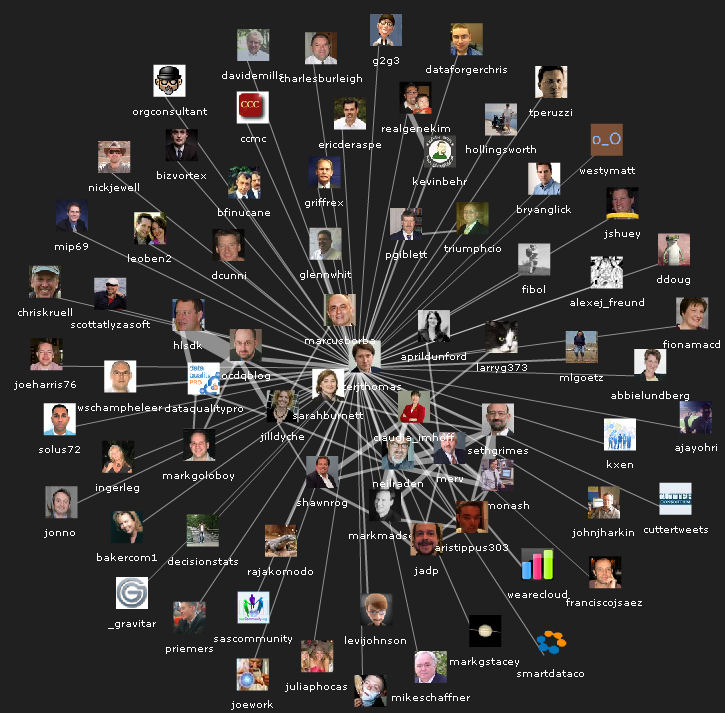
There are a lot of fun Twitter-related applications out there. Just one example to whet your appetite is the following app, written by @petewarden which graphs your relations to other people on Twitter and gives a very visual perspective on the totality of your tweeting:
I chose to close this article with the above image for a reason. To me it captures the essence of what Twitter is about; forming a network of associations with people who can enrich your understanding, provide you with fresh perspectives, or even simply make you smile. The diagram looks awfully like a community doesn’t it? If you enjoy reading this blog and are looking for people to follow who might share your world-view, then clicking on the above graphic and checking out some of the people I interact with most may be a good starting point.
If you chose to take the plunge with Twitter then good luck and I hope that you get as much out of it as I have. You can also then do me a favour and use the handy link just below to share this article with your followers!
The New Adventures in Wi-Fi series of articles on Social Media concludes with a piece on professional networking and LinkedIn here.
During a conversation with an associate last week, she commented that a lot of effort must go into creating new content for this site and posed the question of where I find the time. Part of the answer is writing in the evenings and at weekends (tick both boxes for this piece), or grabbing moments when I am travelling on business. However, another piece of the jigsaw puzzle is quite different and relates to how I write.
The same person was kind enough to say that she found my writing to be coherent and well-structured. In her mind, this implied an equally structured approach to composition. Sadly nothing could be further from the truth. In general I have an idea (sparked by a conversation on-line, something that happened in the work day, or reading an article) and create a WordPress.com draft as soon as I have time and access to the Internet. Often this is no more than a working title, maybe a line describing my idea and, if this is what inspired me to write, a link to the relevant web-page for future reference.
Sometimes I come back to these ideas as soon as I have time to write more fully. However, on occasion the gestation period is longer, either because other topics have consumed my attention, or because my thoughts have not matured enough to put fingertip to keyboard. At present for example, I have 17 drafts sitting in WordPress, the earliest of which dates back to December 2008 (maybe it will see the light of day at some point).
When I do get round to starting to write, the process is normally very fluid. Most frequently I will substantially finish a piece at a single sitting. The way that I write tends to be first via a stream of consciousness, which results in a large block of text. Next I restructure (I would be lost without cut and paste) and finally I trim (yes I do sometimes reduce the length of my articles), or expand as seems to make sense at the time.
If on re-reading I feel that I have not been clear enough in making my points, I might re-write a section, or add some clarifying comments. Sometimes I will change the order in which paragraphs appear in order to improve the flow. I may even feel that an initial draft is conflating two fairly distinct ideas and thus split the piece into separate articles; but this is very much an exception. If I ignore correcting typos, punctuation and grammar, then I would estimate that over 80% of any given article will be identical to how I first wrote it.
An idiosyncrasy is that I tend to write in the HTML pane of WordPress and often hand-craft things like tables (one reason I moved to WordPress from Blogger was that the latter didn’t – at least at the time – support HTML tables). I guess this is a hang-over from programming days (not that long ago as, alongside my other responsibilities, I was still programming professionally as recently as 2008). This means that I have greater control over how an article appears, but also leads to me using the “preview” feature quite extensively.
I also tend to spend quite a bit of time either finding suitable illustrations or creating them (I use a combination of Visio and Paint Shop Pro, both tools I have used in a work context for years). Sometimes the ideas for images come as I am in the midst of writing (and a brief search, or a quick bit of design work can give my unconscious time to think about the next bit of text), but equally often I get rather swept along by the prose, push on to completing this and then come back to add images as part of the editing process. Either way, nowadays I seem to spend almost as much time thinking about mouse-over text for images as I do coming up with images themselves.
Going back to the conversation that I mention at the beginning. We ended up talking more about how I write. I said that it was normally a relatively rapid process for me. The best analogy that I could come up with was the difference between speaking in your native tongue and translating into a language that you are not 100% fluent in. For me writing about topics in business intelligence, cultural transformation and technology feels very much a natural thing; like speaking English. It’s not something laboured and the words generally flow quickly easily.
Maybe I am just lucky in this respect. Or perhaps the secret of prolific blogging is to write about things that you both know something about and for which you have an ongoing passion.
Earlier this week I attended the inaugural The Cloud Circle Forum in London. The Cloud Circle is the UK’s first independent Business and IT focused Cloud Computing Community. It is also the sister community of the Business Intelligence-focussed Obis Omni, an organisation with whom I have a longstanding (though I hasten to add, non-contractual) relationship (a list of Obis Omni seminars at which I have presented appears here, and you can also find some of my articles syndicated on their site).
The afternoon programme saw delegates split into two work-streams, one focussed on strategy and management, the other on technology. Work-related pressures meant that I was unable to attend this part of the day, which was a shame as several bits of the morning speeches were helpful.
Unfortunately, despite the fact that virtually every organisiation and individual I have mentioned so far has a Twitter account and the additional fact that there were hundreds of delegates at the forum, there was virtually no Twitter coverage. Maybe we can get too carried away with the all pervasiveness of social media sometimes. There are clearly some avenues of professional life where its influence is yet to be fully felt; even IT conferences!
I tweeted some commentary on the InTechnology presentation and the stream may be viewed here while it persists. However by the time that Richard Hall stood up to speak, a combination of a lack of reception (the auditorium was in the basement) and issues with mobile Twitter on my hand-held brought this activity to a halt.
The morning presentations
Note:
I don’t want to steal the thunder from any of the speakers and so this article does not cover the content of their presentations in any detail. Instead my aim is to highlight a few points and provide a flavour of their talks.
The InTechnology talk was interesting in parts, in particular their focus on the savings to be achieved in cloud-based telephony alone. One of their speakers also suggested that the benefits of Cloud Computing were potentially reduced if an organisation worked with more than one vendor, which is clearly an aspect to consider.
Their presentations were topped and tailed by two segments of a Cloud Computing-related spoof of The Apprentice. Clearly some money had gone into this and the results were either hilarious or somewhat ill-advised depending on your personal taste. I have to admit to falling closer to the latter camp. While some delegates seemed to enjoy the fun of the fair, I felt the video distracted somewhat from InTechnology’s core message.
I billed Richard Hall as a Cloud Computing evangelist and certainly his tub-thumping upped the tempo. He made some interesting points, which included his assertion that the proprietors of cloud server farms were employing cutting edge technology that was not currently commercially available and might never be. The point here was that cloud providers were becoming true experts in the area with capabilities far beyond normal organisations. This segued with his prediction that there would be only four, or at most five, mega cloud vendors in the future.
Richard did have one slide focusing on the potential drawbacks (or current short-comings) of Cloud Computing, but you could tell his heart wasn’t really in it. One sensed that Richard never met a cloud he didn’t like, even referring to his only personal Road to Damascus during his talk. However one very valid point he made was that the legal agreements and licensing arrangements for Cloud Computing were significantly lagging the flexibility of the technology itself. This chimes with my own experience of the area.
The real-life case studies of cloud-based success were perhaps more telling than the earlier sessions. Bert Craven, Enterprise Architect at EasyJet, spoke about how his company had been moving selected elements of their IT assets to the cloud. Interestingly, while the original plan had been to keep some critical applications (the sort for which 99.9% availability is not good enough) in-house, one of these was now in the process of becoming cloud-based.
Richard Prodger, Technical Director of AWS, spoke about the work that his company had been doing with the RNLI – a charity that runs volunteer lifeboats around the coasts of Britain. The specific project was to provide fishermen with devices that would automatically alert the RNLI control centre if they fell overboard and then provide accurate positioning information enabling a faster rescue and thus one that would be more likely to result in success. Richard shared stories of several fishermen who were alive today thanks to the system. Here the cloud was not the original vehicle, but something that was subsequently employed to scale up the service.
Both case studies used Windows Azure as a component. I have not used this toolset, nor have I been briefed on it and so will refrain from any comment beyond stating that both Bert and Richard seemed happy with its capabilities; particularly in securely exposing internal systems to external web-users.
Some thoughts on what I heard and saw
When multiple presenters state that there is no agreed definition of the central subject matter of a seminar and then proceed to provide slightly different takes on this, you know that you are dealing with an emerging technology. That is not to deny the obvious potential of the area, but a degree of maturation is still necessary in this part of the industry before – in Richard Hall’s words – Cloud Computing becomes the future of IT.
There was more than one elephant in the room. First of which is bandwidth, which is relatively plentiful and relatively cheap in many parts of the world, but equally has neither trait in many others. This will be of concern to a lot of global organisations. Of course this is a problem that will undoubtedly go away in time, but it may dog true enterprise implementations of misison-critical Cloud Computing for some years yet.
Security remains a concern, it may well be true that the experts in Cloud Computing will be an order of magnitude more careful and competent about handling their customers’ data than many internal IT departments. However the point is that they are already handling the data of many customers and one error, or one act of malfeasance by an employee, could have a major impact. You may well be safer flying than driving your own car, but when a plane crashes, people tend to notice.
Future consolidation in Cloud Computing was mentioned by a number of speakers. Although this issue is not solely the preserve of cloud technology, it does raise some concerns about betting on the right horse. As has been seen in many areas of industry, the titans of today may be the minnows of tomorrow. When you are trusting an external organisation with your transactions, it helps to know for certain (or as close as you can get to it) that they will be around in five years’ time.
One of the central pitches of Cloud Computing is “let us look after the heavy lifting and your people can focus on more value-added activities”. While there are certainly economies to be seized in this area, the Cloud Computing industry may be doing itself a disservice by stating that customers can effectively stop worrying about functions moved to the cloud. In my mind a lot of care and attention will need to be put into managing relationships with cloud vendors and into integrating cloud-based systems with the rest of the internal IT landscape (or with other cloud-based systems). It may be that this type of work costs a lot less than the internal alternative, but it is nevertheless invidious to suggest that no work at all is required. This line of attack is reminiscent of some of the turn of the millennium sales pitches of ERP vendors, not all of which turned out to be well-founded.
In finishing this slightly downbeat section (and before a more optimistic coda), I’ll return to the commercial issues that Richard Hall referenced. He claimed – correctly in my opinion – that a major benefit of cloud-based solutions was not only that they scaled-up, but that they scaled-down. The “knob” could be adjusted in either direction according to an organisation’s needs. The problem here is that many parts of the Cloud Computing industry still seem wedded to multi-year fixed licensing deals with little commercial scope to scale either up or down without renegotiating the contract. What is technologically feasible may not be contractually pain-free. In the same vein more flexible termination clauses and guaranteed portability of data from one vendor to another need to be sorted out before Cloud Computing is fully embraced by many organisations.
On a more positive note, the above issues are maybe the typical growth pains of a nascent industry. No doubt solutions to them will be knocked into shape in the coming years. It is always tempting fate to predict the future with too much accuracy, but at this point it seems certain that Cloud Computing will play an increasingly important role in the IT landscapes of tomorrow. If nothing else this is attested to by the number of delegates attending Tuesday’s meeting.
The Cloud Circle are to be commended for getting out in front of this important issue and I hope that their work will better disseminate understanding of what is likely to become and important area and enable a wider range of organisations to begin to take advantage of it.
While spring cleaning at home at the weekend, I came across a DVD of an interview I did for Informatica back in March 2005. This is still accessible on the Informatica web-site and appears in my video library, but I thought that I had lost my copy of the original.
Having made this discovery, I added it to my selection of videos on YouTube.com.
Disclosure – Part I: In the work I refer to above, I leveraged Infomatica’s toolset (PowerCentre) alongside software from Oracle (RDBMS and PL/SQL), IBM Cognos (PowerPlay and ReportStudio) and Microsoft (.NET). I have used tools from other vendors in other projects. While there is clearly a promotional sub-text to the video, it is not a product endorsement and I believe that my comments are generally applicable to any business intelligence / data warehousing project.
Disclosure – Part II: I have already had it pointed out to me – by @ocdqblog and others – that the braces (suspenders if you are from the US; suspenders having quite a different connotation in the UK) were perhaps something of a fashion faux pas. My American partner has long since despaired of my British approach to “co-ordination” of patterns. You may be glad to know that I no longer own the offending item.
One of the benefits of the WordPress.com platform is that you can get some indication as to which other parts the the web are directing traffic your way. It was via this facility that I came across an article on Microsoft‘s site linking back to my piece Measuring the benefits of Business Intelligence. The title, sub-title and authorship of the Microsoft post is as follows:
How to Measure BI Value
A thorough assessment will help you demonstrate the effectiveness of your BI investments. We offer 8 factors to consider.
As always, my aim in writing this column is to remain vendor-neutral, however the Microsoft piece is not specifically pushing their BI products (though clearly further information about them is only a click away), but rather offering some general commentary.
Again it is interesting to note the penetration of social media (such as this blog) into mainstream technology business.
I have been a regular visitor to Merv Adrian’s excellent blog since just after its inception and have got to know Merv virtually via twitter (@merv) and other channels. I recently read his article : Oracle Ups EPM Ante, which covered Oracle’s latest progress in integrating its various in-house and acquired technologies in the Enterprise Performance Management and Business Intelligence arenas.
The article is clearly written and helpful, I recommend you take a look if these areas impinge upon you. One section caught my attention (my emphasis):
Finally, Oracle has long had a sizable base in government, and its new Hyperion Public Sector Planning and Budgeting app suite continues the integration theme, tapping its ERP apps (both Oracle E-Business Suite [EBS] and PeopleSoft ERP) for bidirectional feeds.
My current responsibilities include EPM, BI and the third Oracle ERP product, JD Edwards. I don’t work in the public sector, but was nevertheless interested in the concept of how and whether JDE fitted into the above scenario. I posted a comment and within a few hours Merv replied, having spoken to his senior Oracle contacts. The reply was from a vendor-neutral source, but based on information “straight from the horse’s mouth”. It is illuminating to ponder how I could have got a credible answer to this type of question any quicker.
To recap, my interactions with Merv are via the professional social media Holy Trinity of blogs, twitter.com and LinkedIn.com. The above is just one small example of how industry experts can leverage social media to get their message across, increase their network of influence and deliver very rapid value. I can only see these types of interactions increasing in the future. Sometimes social media can be over-hyped, but in the world of industry analysis it seems to be a marriage made in heaven.
Analyst and consultant Merv Adrian founded IT Market Strategy after three decades in the IT industry. During his tenure as Senior Vice President at Forrester Research, he was responsible for all of Forrester’s technology research, covered the software industry and launched Forrester’s well-regarded practice in Analyst Relations. Earlier, as Vice President at Giga Information Group, Merv focused on facilitating collaborative research and served as executive editor of the monthly Research Digest and weekly GigaFlash.
Prior to becoming an analyst, Merv was Senior Director, Strategic Marketing at Sybase, where he also held director positions in data warehouse marketing and analyst relations. Prior to Sybase, Merv served as a marketing manager at Information Builders, where he founded and edited a technical journal and a marketing quarterly, subsequently becoming involved in corporate and product marketing and launching a formal AR role.

























 Peter James Thomas