 |
A happy and peaceful holiday period to all readers.
Peter |
|
PS A normal (if perhaps less frequent) blogging service will recommence in the New Year.
|
A happy and peaceful holiday period to all readers.
Peter |
|
PS A normal (if perhaps less frequent) blogging service will recommence in the New Year.

Introduction
Inspiration can come from many places. For me it is often via making a connection between two separate areas. I wrote about this phenomenon in my earlier artcile, Synthesis.
A couple of inspiration-related events have led me to pen this piece today and, as a great man once said:
When two separate events occur simultaneously pertaining to the same object of inquiry we must always pay strict attention.
Thing One
The first occurrence was an article on Jeff Shuey’s blog entitled Surely, you must be joking. This borrows from the title of Nobel Laureate Richard P. Feynman‘s book Surely You’re Joking Mr. Feynman (as edited by his friend and co-drummer Ralph Leighton). I have found Feynman to be an inspirational character since I first saw him interviewed in depth on the BBC’s science magazine programme, Horizon. Some footage of this interview appears in the BBC’s archives, and may be viewed here. It is well worth a look.
I happen to have recently referenced Feynman, albeit rather obliquely, in a review of my bogging experiences, New Adventures in Wi-Fi – Track 1: Blogging. I have been delighted to receive some messages from people saying that this article had prompted them to take up blogging themselves. There can surely be no greater compliment paid in social media and I am honoured to receive it.

The idea for Jeff’s article came both from Microsoft featuring Feynman’s work on its Project Tuva site (this doesn’t seem to work for me in Chrome, though it’s fine in IE8 – maybe I’ll keep quiet about this in case the European Commission is listening in) and a subsequent exchange of tweets and links that we shared on twitter.com. Jeff’s handle is @jshuey if you would like to follow him. Also check out Jeff’s article to learn more about how a remarkable human being has influenced both him and Project Tuva.
and Thing Two
The second event relates to the traditional American diner that is round the corner from where I live. I appreciate that I live in London, but nevertheless I do have a traditional American diner round the corner. It is even owned by a Packers fan from Wisconsin. Lauren is one of the people who regularly works there and she has a talent for drawing in chocolate – no you haven’t misread that, she draws in chocolate, specifically on the plate that holds the diner’s very pleasant flourless chocolate cake.
Mermaids have been a favourite theme for Lauren, but more recently she has moved on to more ambitious works. The first was Michael Jackson for obvious reasons. This was followed by Barak Obama. The other day I suggested that, if she was working her way through American icons, then the next obvious person would be Marilyn Monroe. Lauren liked this idea and when I visited this morning to get my customary cup of coffee (skinny cappuccino rather than black and hot sadly) her lastest work greeted me:

I’m really happy that my input has played a small part in two creative acts. This is particularly the case as I am normally acknowledging the inspiration that I have drawn from other people.
This sort of give and take of ideas has of course been happening during the entire course of human history. Clearly, even if I live to be 100, I could never hope to be as inspirational or influential as Richard Feynman. However it is both gratifying and humbling to be able to take part in the cycle of human interaction, no matter how minor my role. Maybe these two small recent examples are further evidence that the pace is increasing.

In my earlier article, Accuracy, I compared the need for precision in cricket reporting to the verity of different types of breaking news on twitter.com and closed by stressing the importance of accuacy in Business Intelligence. It’s generally all in a day’s work for me to make such connections; yesterday’s piece linked rock climbing, the car market, Business Intelligence [again] and IBM’s proposed acquisition of SPSS.
I am going to lay the blame for me continuing to blog about cricket firmly at the door of @JohnFMoore, who made the fatal mistake of encouraging me. However the current article will be rather shorter in duration than my last work in this area.
Aside from John, what has moved me to write today was the news that wunderkind opening bastmen Phillip Hughes has been dropped from the Australian team for the 3rd Test Match against England which starts today in Birmingham, England (inundated pitch allowing).

Hughes is only 20 and has burst onto the international cricketing scene in a matter of months. Before the current tour to England, he had played just three Tests (the name given to five day cricket matches between different countries). However, these were all against South Africa, one of the strongest teams in the world at present. In his six innings (a team generally bats twice in a Test Match) he had made 415 runs at the eye-catching average of 69.16 [number of runs / (number of innings – times not out)]. By way of reference, this is higher than any other player in either of the current Australian and English teams.
Hughes built on these achievements by spending the early part of the season playing for English cricket team Middlesex. For them he scored 574 runs at a stratospheric average of 143.50. England cricket fans were beginning to be very, very worried at this point.
However, as can happen in many sports, some one can make an initial impact and then have their performances return to average or below. This has proved to be the case with Hughes who in three innings in the current Test Match series has scored 36, 4 and 17 for a rather less stellar average of 19.0. More important than these bald figures is the fact that the England bowlers seem to have detected and then exploited a deficiency in Hughes’ technique.
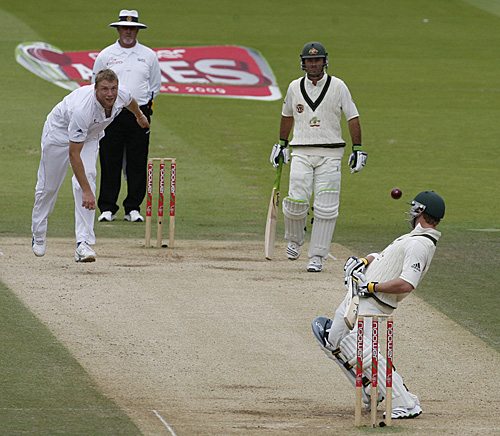
It could be argued that Hughes clearly has immense talent and potential and the Australian selectors have been overly hasty in dropping him after two poor matches. Such things can severely dent a player’s confidence and I hope that he can rebound from this set-back. However for me the real story is not the unfortunate Hughes being dropped but the manner in which it was announced.
As a 20-year-old it is not perhaps surprising that Phillip Hughes has a twitter account – @PH408. What is surprising is that he used this to announce his axing from the Australian team today as follows:
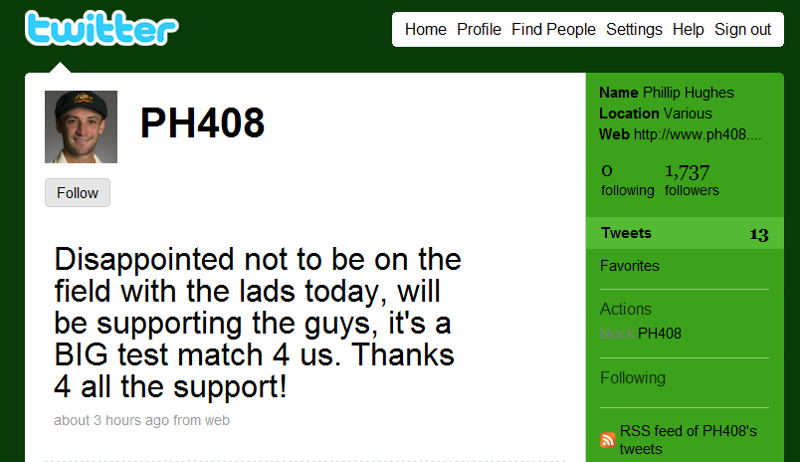
The general media had been speculating about what might be Hughes’ fate for this match ever since he failed twice in the preceding game. Articles suggesting that he may have been dropped began to appear last night, but his tweet preceded any official announcement about the make up of today’s Australian team.
A case of Twitter beating “old media”, of public figures interacting with the rest of us via social media and of nothing beating getting news straight from the horse’s mouth.
The two images of actual cricket matches above are drawn from the excellent cricinfo.com web-site and are copyright Getty Images and AFP respectively.

Introduction
This is a proverb with quite some history to it. Indeed its lineage has been traced to 13th Century France in: mauvés ovriers ne trovera ja bon hostill (les mauvais ouvriers ne trouveront jamais un bon outil being a rendition in more contemporary French). To me this timeless observation is applicable to present-day Business Intelligence projects. Browsing through on-line forums, it is all too typical to see discussions that start “What is the best BI software available on the market?”, “Who are the leaders in SaaS BI?” and (rather poignantly in my opinion) “Please help me to pick the best technology for a dashboard.” I feel that these are all rather missing the point. Before I explain why, I am going to offer another of my sporting analogies, which I believe is pertinent. Indeed sporting performace is an area to which the aphorism appearing in the title is frequently applied.
If you would like to skip the sporting analogy and cut to the chase, please click here.
The importance of having the right shoes
Rock climbing is a sport that certainly has its share of machismo; any climbing magazine or web-site will feature images of testosterone-infused youths whose improbable physiques (often displayed to full advantage by the de rigueur absence of any torso-encumbering clothing) propel them to the top of equally improbable climbs.
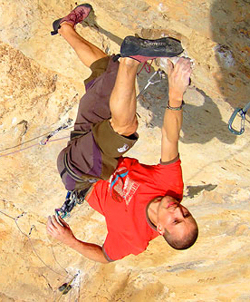
Given this, many commentators have noted the irony of climbing being conducted by people wearing the equivalent of rubber-covered ballet slippers. The fact that one of the most iconic rock climbing shoes of all time was a fetching shade of pink merely adds piquancy to this observation. Examples of these, the classic FiveTen Anasazi Lace-ups, are featured in the following photo of top British climber, Steve McClure (yes it is the right way up).
When I started rock climbing, my first pair of shoes were Zephyrs from Spanish climbing firm Boreal. They looked something like this:

Although it might not be apparent from the above image, these are intended to be comfortable shoes. Ones to be worn by more experienced climbers on long mountain days, or suitable for beginners, like myself at the time, on shorter climbs. Although not exactly cheap, they are not prohibitively expensive and the rubber on the soles is quite hard-wearing as well.
The Zephyrs worked well for me, but inevitably over time you begin to notice the shoes worn by better climbers at the crag or at the wall. You also cannot fail to miss the much sexier shoes worn by professional climbers in films, climbing magazine articles and (no coincidence here) advertisements. These other shoes also cost more (again no coincidence) and promise better performance. When you are looking to get better at something, it is tempting to take any advantage that you can get. Also, perhaps especially when you are looking to break into a new area, there is some pressure to conform, to look like the “in-crowd”, maybe even simply to distance yourself from the beginner that you were only a few months previously.
This is very shallow behaviour of course, but it is also the rock on which the advertising industry is founded. I wanted to get better as a climber, but would have to admit that other, less noble, motives also drove me to wanting to purchase new rock shoes.

The Galileos shown above are made by US company FiveTen and are representative of the type of shoes that I have worn for most my climbing career. FiveTen shoes have been worn by many top climbers over the years (though there have recently been some quite high-profile defections to start-up brand Evolv, who can never seem to decide whether to append a final ‘e’ to their name or not).
Amongst other things, FiveTens are noted for the stickiness of their rubber, which is provided by an organisation called Stealth Rubber and appears on no other rock climbing shoes. Generally the greater the adhesion between your foot and the rock, the greater the force that you can bring to bear on it to drive yourself upwards. Also it helps to have confidence that your foot has a good chance of staying in place, no matter how glassy the rock may be (and no matter how long the fall may be should this not happen). I have worn FiveTen shoes on all of my hardest climbs (none of which have actually been very hard in the grand scheme of things sad to say).

Nevertheless, with what I admit was rather a sense of guilt, I have recently embarked on a dalliance with another rock shoe manufacturer, La Sportiva of Italy. The Sportiva Solutions which are shown above are both the most expensive rock shoes I have ever owned and the most technical. If NASA made a rock shoe, they would probably not be a million miles away from the Solutions. The radical nature of their design can perhaps best be appreciated in three dimensions and you can do this by clicking on the above image.
The Solutions are very, very good rock shoes. I recently had the opportunity to carry out a before and after comparison on the following climb, A Miller’s Tale:

My partner, who appears in the photo (incidentally sporting FiveTen shoes), climbed this on her second go. By contrast, I had many fruitless attempts wearing my own pair of FiveTens (that, to be fair to FiveTen, were much less technical than the Galileo’s above and were also probably past the end of their useful life). I frequently found my feet skittering off of the highly polished limestone, which resulted in me rapidly returning to terra firma.
A couple of weeks later, equipped with my shiny new Sportivas, my feet did not slip once. Of course the perfect end to this story would have been to say that I then climbed the problem (for an explanation of why some types of climbs are called problems see my earlier article Perseverance). Sadly, though I made much more progress during my second session, I need to go back to finally tick it off of my list.
So here surely is an example of the tool making a difference, or is it? My partner had climbed A Miller’s Tale quite happily without having the advantage of my new footwear. She is 5’3″ (160cm) compared to my 5’11” (180cm) and the taller you are the easier it is to reach the next hold. Strength is a factor in climbing and I am also stronger in absolute terms than she is. The reason that she succeeded where I failed is simply that she is a better climber than I am. It is an oft-repeated truism in the climbing world that many females have better techniques than men. This, together with the “unfair” advantage of smaller fingers, is the excuse often offered by muscle-bound men who fail to complete a climb that a female then dances her way up. However in my partner’s case, she is also very strong, with her power-to-weight ratio being the key factor. You don’t need to lift massive weights in climbing, just your own body.
So I didn’t really need better rock shoes to prevent my feet from slipping. If I got my body into a better balanced position, then this would have had the same impact. Equally, if my abdominal muscles were stronger, I could have squeezed my feet harder onto the rock, increasing their adhesion (this type of strength, known as core strength for obvious reasons, is crucial to progressing in many types of climbing). What the Solutions did was not to make me a better climber, but to make up for some of my inadequacies. In this way, by allowing me the luxury of not focussing on increasing my strength or improving my technique, you could even argue that they might be bad for my climbing in the long run. I probably protest too much in this last comment, but hopefully the reader can appreciate the point that I am trying to make.

In order to become a better climber I need to do lots of things. I need to strengthen the tendons in my fingers (or at least in nine of them as I ruptured the tendon in my right ring finger playing rugby years ago) so that I can hold on to smaller edges and grasp larger ones for longer. I need to develop my abdominal muscles to hold me onto the rock face better and put more pressure on my feet; particularly when the climb is overhanging. I need to build up muscles in my back, shoulders and arms to be able to move more assuredly between holds that are widely spaced. I must work on my endurance, so that I do not fail climbs because I am worn out by a long series of lower moves. Finally I need to improve my technique: making my footwork more precise; paying more attention to the shape of my body and how this affects my centre of gravity and the purchase I have on holds; getting more comfortable with the tricks of the trade such as heel- and toe-hooks; learning when to be aggressive in my climbing and when to be slow and deliberate; and finally better visualising how my body fits against the rock and the best way to flow economically from one position to the next.
If I can get better in all of these areas, then maybe I will have earned my new technical rock shoes and I will be able to take advantage of the benefits that they offer. Having the right shoes can undoubtedly improve your climbing, but it is no substitute for focussing on the long list in the previous paragraph. There is no real short-cut to becoming a better climber, it just takes an awful lot of work.
A final thing to add in this section is that the Solutions offer advantages to the climber on certain types of climbs. On any overhanging, pocketed rock, they are brilliant. But the way that they shape your foot into a down-turned claw would be a positive disadvantage when trying to pad up a slab. In this second scenario, something like my worn out FiveTens (now sadly consigned to the rubbish tip) would be the tool of choice. It is important to realise that the right tool is often dictated by the task in hand and one that excels in area A may be an also-ran in area B.
Notes:
|
The role of technology in Business Intelligence
I hope that I have established that at least in the world of rock climbing, the technology that you have at your disposal is only one of many factors necessary for success; indeed it is some way from being the most important factor.
Having really poor, or worn out, rock shoes can dent your confidence and even get you into bad habits (such as not using your feet enough). Having really good rock shoes can bring some incremental benefits, but these are not as great as those to be gained by training and experience. Most of the technologically-related benefits will be realised by having reasonably good and reasonably new shoes.
While the level of a professional rock climber’s performance will be undoubtedly be improved by using the best equipment available, a bad climber with $150 rock shoes will still be a bad climber (note this is not intended to be a self-referential comment).

Returning to another of my passions, Business Intelligence, I see some pertinent parallels. In a series of previous articles (including BI implementations are like icebergs, “All that glisters is not gold” – some thoughts on dashboards and Short-term “Trouble for Big Business Intelligence Vendors” may lead to longer-term advantage) , I have laid out my framework for BI success and explained why I feel that technology is not the most important part of a BI programme.
My recommended approach is based on four pillars:
Obviously good BI technology has a role to play across all of these areas, but it is not the primary concern in any of them. Let us consider what is often one of the most difficult areas to get right, embedding BI in an organisation’s DNA. What is the role of the BI tool here?
Well if you want people to actually use the BI system, it helps if the way that the BI technology operates is not a hindrance to this. Ideally the ease-of-use and intuitiveness of the BI technology deployed should be a plus point for you. However, if you have the ultimate in BI technology, but your BI system does not highlight areas that business people are interested in, does not provide information that influences actual decision-making, or contains numbers that are inaccurate, out-of-date, or unreconciled, then it will not be used. I put this a little more succinctly in a recent article: Using multiple business intelligence tools in an implementation – Part II (an inspired title I realise), which I finished by saying:
If your systems do not have credibility with your users, then all is already lost and no amount of flashy functionality will save you.
Similar points can be made about all of the other pillars. Great BI technology should be the icing on your BI cake, not one of the main ingredients.
The historical perspective

Ajay Ohri from the DecisionStats web-site recently interviewed me in some depth about a range of issues. He specifically asked me about what differentiated the various BI tools and I reproduce my reply here:
The really important question in BI is not which tool is best, but how to make BI projects successful. While many an unsuccessful BI manager may blame the tool or its vendor, this is not where the real issues lie. I firmly believe that successful BI rests on four mutually reinforcing pillars: understand the questions the business needs to answer, understand the data available, transform the data to meet the business needs and embed the use of BI in the organisation’s culture. If you get these things right then you can be successful with almost any of the excellent BI tools available in the marketplace. If you get any one of them wrong, then using the paragon of BI tools is not going to offer you salvation.
I think about BI tools in the same way as I do the car market. Not so many years ago there were major differences between manufacturers. The Japanese offered ultimate reliability, but maybe didn’t often engage the spirit. The Germans prided themselves on engineering excellence, slanted either in the direction of performance or luxury, but were not quite as dependable as the Japanese. The Italians offered out-and-out romance and theatre, with mechanical integrity an afterthought. The French seemed to think that bizarrely shaped cars with wheels as thin as dinner plates were the way forward, but at least they were distinctive. The Swedes majored on a mixture of safety and aerospace cachet, but sometimes struggled to shift their image of being boring. The Americans were still in the middle of their love affair with the large and the rugged, at the expense of convenience and value-for-money. Stereotypically, my fellow-countrymen majored on agricultural charm, or wooden-panelled nostalgia, but struggled with the demands of electronics.
Nowadays, the quality and reliability of cars are much closer to each other. Most manufacturers have products with similar features and performance and economy ratings. If we take financial issues to one side, differences are more likely to related to design, or how people perceive a brand. Today the quality of a Ford is not far behind that of a Toyota. The styling of a Honda can be as dramatic as an Alfa Romeo. Lexus and Audi are playing in areas previously the preserve of BMW and Mercedes and so on. To me this is also where the market for BI tools is at present. It is relatively mature and the differences between product sets are less than before.
Of course this doesn’t mean that the BI field will not be shaken up by some new technology or approach (in-memory BI or SaaS come to mind). This would be the equivalent of the impact that the first hybrid cars had on the auto market. However, from the point of view of implementations, most BI tools will do at least an adequate job and picking one should not be your primary concern in a BI project.
If you are interested, you can read the full interview here.
The current reality

As my comments to Ajay suggest, maybe in past times there were greater differences between BI vendors and the tools that they supplied. One benefit of the massive consolidation that has occurred in recent years is that the five biggest players: IBM/Cognos, Oracle/Hyperion, SAP/BusinessObjects, Microsoft and (the as yet still independent) SAS all have product portfolios that are both wide and deep. If there is something that you want your BI tool to do, it is likely that any of these organisations can provide you with the software; assuming that your wallet allows it. Both the functionality and scope of offerings from smaller vendors operating in the BI arena have also increased greatly in recent times. Finding a technology that fits your specific needs for functionality, ease-of-use, scalability and reliability should not be a problem.
This general landscape is one against which it is interesting to view the recent acquisition of business analytics firm SPSS by IBM. According to Reuters, IBM’s motivations are as follows:
IBM plans to buy business analytics company SPSS Inc for $1.2 billion in cash to better compete with Oracle Corp and SAP AG in the growing field of business intelligence
Full story here.
As an aside, should both Microsoft and SAS be worried that they are omitted from this list?
Whatever the corporate logic for IBM, to me this is simply more evidence that BI technology is becoming a utility (it should however be noted that this is not the same as BI itself becoming a utility). I believe that this trend will lead to a greater focus on the use of BI technology as part of broad-based BI programmes that drive business value. Though BI has the potential of releasing massive benefits for organisations, the track record has been somewhat patchy. Hopefully as people start to worry less about BI technology and more about the factors that really drive success in BI programmes, this will begin to change.

As with any technical innovation over the centuries, it is only when the technology itself becomes invisible that the real benefits flow.

Well virtual home anyway.
The primary address for this blog is now:
http://www.peterjamesthomas.com
However, the blog is still hosted on WordPress.com and the previous address of:
https://peterthomas.wordpress.com
should still work perfectly well.
If anyone experiences any problems with this change, then please tell me about it, either by posting a comment, or via the Contact Page.
Peter
My Keynote Articles page gathers together links to my more substantial blog posts in one place and groups them into broad areas of interest. When I first created this, the four areas were as follows:
| 1. | Business Intelligence |
| 2. | Cultural Transformation |
| 3. | IT / Business Alignment and IT Strategy |
| 4. | General Articles |
Back in April 2009, at the height of the Oracle / Sun fervour, I added a new section to reflect the number of articles I was writing about general technology issues such as these and also BI industry news. This was as follows:
| 5. | Industry Commentary |
In a similar vein, I have recently been writing more about issues in Social Media (very self-referential for a blog of course). I have also had my artciles syndicated on SmartDataCollective.com for many months.

The thing that finally decided me to have a section dedicated to Social Media was joining SmartDataCollective’s parent site, SocialMediaToday.com, who were recently kind enough to syndicate the first of my series of articles on Social Media: New Adventures in Wi-Fi – Track 1: Blogging (the original article may be viewed here).
My thinking was, if I am having my articles posted on a site devoted to Social Media, then the time has come to recognise this by creating a new section. This is what I have done with:
| 6. | Social Media |
As with the other sections, I will keep this list up-to-date as I add new content. In particular my forthcoming pieces on micro-blogging with Twitter.com and professional networking on LinkedIn.com will have a shiny new home.

Introduction
I established this blog back in November 2008 – shortly after this I joined twitter.com in December 2008 – I had already been a member of LinkedIn.com since July 2005. However, my involvement with what is now collectively called social media goes back a lot further than this. Back then we tended to use the phrase on-line communities to describe what we were engaged in.
My first foray into this new world was in 1998/99 when I joined a, now defunct, discussion forum (then known as a Bulletin Board). This was focused on computer games. I wasn’t terribly in to such games at the time, I didn’t own a console and my PC was used for more prosaic purposes. Nevertheless, for reasons that I will not bore the reader with, I signed up. Since then I have been a member of a number of on-line forums, mostly with some sporting element, for example rock climbing.

In May 1999, my forum activities led me to creating my first web-site (again now also defunct). I started on Geocities (another chance to use the word “defunct”) and then moved to having my own domain and an agreement with a hosting company. I even ended up jointly running a very successful forum with an on-line friend from Australia. Back then the men were real men, the women were real women and the HTML was real HTML. However this article is not about ancient history, but rather about my more recent experiences in social media.
Nowadays, nobody seems to think of it as being odd that you regularly “speak” to people you have never met and who inhabit countries on the other side of the world. People do not slowly back away from you at parties if you drop the fact that you have your own web-site into a conversation (though maybe one reason that the portmanteau of web-log became socially acceptable is that its abridgement to blog sounds the opposite of technological). It was not always thus and maybe I retain something of the spirit of those pioneering days. For example, I am currently typing these words into the HTML pane of WordPress.com. Old habits die hard and WYSIYWG is for softies!
Social media is now mainstream – in fact you could argue that it is real life that has become a minority activity – and things are a lot easier. Although I doggedly insist on still cutting HTML, you can be up and running with a fairly professional-looking blog on WordPress in minutes and without having to know much about any of the technical underpinnings. Software as a Service certainly works really well as an approach to blogging.
Over a number of articles, I am going to touch upon my recent experience of Social Media in the three areas that I first mentioned at the beginning: blogging, micro-blogging and professional networking. Without fully revealing the denouement of this series, I will state now that one of the most interesting things is how well these three areas work in combination and how mutually reinforcing they have become for me. The sequence starts with my thoughts on blogging.
WordPress and Motivation

I suppose I have to thank my partner for getting me in to this area as she started her blog long before any of mine. However, having suffered a couple of climbing-related injuries I started my own training blog, both to chart my recovery and to act as a motivational tool.
I started out using Blogger as that was what my partner had used, but got rather frustrated with its lack of support for some basic HTML constructs (e.g. tables). A friend suggested WordPress instead and this became the venue for my training blog. Somewhat amazingly this is not defunct. However, after a period when I religiously posted at least once or twice every week, I haven’t updated it in a long while.
When I wanted to start a professional blog, WordPress seemed the way to go and I have been mostly happy with my choice. But what were my motivations for blogging about business-related issues? I guess that there were a few of these, in no particular order:
So I leapt in with both feet and my first article was based on some reflections on attending a Change Management seminar. It was entitled Business is from Mars and IT is from Venus and dealt with what I see as an artificial divide between IT and business groups. I suppose it makes sense to start as you mean to go on and IT / Business alignment has been a theme running through much of what I have written.
Things that I have learnt so far
In a subsequent piece, Recipes for success?, I expressed my scepticism about articles of the type “My Top Ten Tips for Successful Blogging”, so the following is not meant to be a set of precepts to be followed to the last letter. Instead, with the benefit of over 60,000 page views (small beer compared to many blogs), here are some things that have worked for me. If some of these chime with your own experience, then great. If others are not pertinent to you, then this is only to be expected.
Finally I should also stress that these observations relate mostly to professional blogs, for personal blogs there are essentially no constraints on your creativity (assuming that the results of this are legal of course).

When the subject is one in which your own knowledge is less well-developed (for me something like text analytics would fall into this category), then seek out the opinions of experts in the field and quote these (even if you disagree with them). Linking to the places that experts have expressed their thoughts also expands you network and increases the utility of your blog, which becomes part of a wider world.
Passion is not only important because it will hopefully infuse your words, but because it will sustain you returning to write about these areas over a long period of time. There are an awful lot of blogs out there where a bright beginning has petered out because the author had nothing left to say, or has lost interest.

For me this means the presence of strong elliptical and eclectic qualities to my articles. I can do terse and to the point when it is necessary, but circumlocution is more my stock-in-trade. I’m more comfortable being myself and if this means my audience is one composed of people yearning for elliptic, eclectic, circumlocutory writing, then so be it!

This means that my writing tends to resemble the River Amazon in both its meandering nature and length. I appreciate that this narrows my potential audience, but hope that it also means that at least a few people get some more out of it than they would from the CliffsNotes version.
Equally, virtually everything that I write has been inspired to some degree by other people: co-workers, authors, the people that I come into contact with on the Internet and in real life on a daily basis and so on. I try to explicitly acknowledge (and link to) what has inspired me when I write, but I am sure that thousands of unconscious influencers go un-credited.

In this area I also try to avoid deleting comments that are derogatory about my ideas. The approach I take is rather to either seek further clarification on why the contributor thinks this way, or to politely argue why I still believe that the points that I have made are valid. Of course I have not always 100% lived up to this aspiration!
Better still, augment what they have written with your own ideas – either on their blog or in a piece on your own site that links back to their article. Even in this day and age, it is amazing how far being nice to people can get you. For the same reason, try to be as polite on-line as you would be in your more traditional professional life.
Finally, I mentioned the Narcissistic tendencies that can either be a cause or effect of blogging. I think that trying to not take yourself too seriously is a must as an antidote to this. Both the medium and my prose can veer towards the preachy sometimes, so some well-placed self-deprecation to balance this never goes amiss.
I hope that some readers will have been interested in my observations and that they will have helped a further subset of these in their blogging. For those who are pondering whether to join the blogosphre, my simple advice is give it a go. You will either hate it or love it, but at least you won’t die wondering “what if?”
The New Adventures in Wi-Fi series of articles on Social Media continues by discussing the relatively new world of micro-blogging and the phenomenon that is Twitter here.
 |
Tweet this article on twitter.com |
| Bookmark this article with: | |||||
|  Facebook Facebook |
|  del.icio.us del.icio.us |
|  digg digg |
|  Reddit Reddit |
|  Stumble Stumble |
|

This seems to be just another of those annoying facts of life. I should be used to it by now, after all “Akismet has protected your site from 2,607 spam comments already.” However it seems to me that the spammers could perhaps do a better job of targeting their work. Maybe this is a breakthrough area for text analytics.
Saying that, what prompted me to refer to this rather sad phenomenon today was a recent spamvert (in English) for “on-line English classes.” I’m not sure if this was placed in reference to the author, or his readers. Either way I somehow feel diminished today.
Last week I was being interviewed by a journalist about Business Analytics amongst other things. I found myself speaking about the perils faced in extrapolation that are significantly less scary when merely interpolating.
Serendipity had led to the following cartoon appearing on the web-site of that doyen of scientific humour Randall Munroe, namely xkcd.com.

I’m sure this drawing must have appeared on some other BI blogs, but what the hell, it merits posting again in my opinion.
As an experiment, I am enabling WordPress.com’s rating widget on my blog posts. A graphic like the one below now appears under the title of each article (indeed you should spy one directly above as well).

I will be interested to see whether this feature is used and what the actual feedback proves to be.
Peter
PS Please note that the stars only appear when you select an article by clicking on its title, not when many articles appear on the main page, or as the result of a search.

 Peter James Thomas