Patterns patterns everywhere

Look at the beautiful shapes!

Introduction

A lot of human scientific and technological progress over the span of recorded history has been related to discerning patterns. People noticed that the Sun and Moon both had regular periodicity to their movements, leading to models that ultimately changed our view of our place in the Universe. The apparently wandering trails swept out by the planets were later regularised by the work of Johannes Kepler and Tycho Brahe; an outstanding example of a simple idea explaining more complex observations.

In general Mathematics has provided a framework for understanding the world around us; perhaps most elegantly (at least in work that is generally accessible to the non-professional) in Newton’s Laws of Motion (which explained why Kepler and Brahe’s models for planetary movement worked). The simple formulae employed by Newton seemed to offer a precise set of rules governing everything from the trajectory of an arrow to the orbits of the planets and indeed galaxies; a triumph for the application of Mathematics to the natural world and surely one of humankind’s greatest achievements.

The Antikythera mechanism

For centuries it appeared that natural phenomena seemed to have simple principles underlying them, which were susceptible to description in the language of Mathematics. Sometimes (actually much more often than you might think) the Mathematics became complicated and precision was dropped in favour of – generally more than good enough – estimation; but philosophically Mathematics and the nature of things appeared to be inextricably interlinked. The Physicist and Nobel Laureate E.P. Wigner put this rather more eloquently:

The miracle of the appropriateness of the language of mathematics for the formulation of the laws of physics is a wonderful gift which we neither understand nor deserve.
Dihedral Group 3

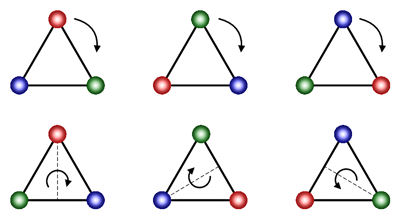
In my youth I studied Group Theory, a branch of mathematics concerned with patterns and symmetry. The historical roots (no pun intended[1]) of Group Theory are in the solvability of polynomial equations, but the relation with symmetry emerged over time; revealing an important linkage between geometry and algebra. While Group Theory is a part of Pure Mathematics (supposedly studied for its own intrinsic worth, rather than any real-world applications), its applications are actually manifold. Just one example is that groups lie (again no pun intended[2]) at the heart of the Standard Model of Particle Physics.

However, two major challenges to this happy symbiosis between Mathematics and the Natural Sciences arose. One was an abrupt earthquake caused by Kurt Gödel in 1931. The other was more of a slowly rising flood, beginning in the 1880s with Henri Poincaré and (arguably) culminating with Ruelle, May and Yorke in 1977 (though with many other notables contributing both before and after 1977). The linkage between Mathematics and Science persists, but maybe some of the chains that form it have been weakened.
 
 
Potentially fallacious patterns

However, rather than this article becoming a dissertation on incompleteness theorems or (the rather misleadingly named) chaos theory, I wanted to return to something more visceral that probably underpins at least the beginnings of the long association of Mathematics and Science. Here I refer to people’s general view that things tend to behave the same way as they have in the past. As mentioned at the beginning of this article, the sun comes up each morning, the moon waxes and wanes each month, summer becomes autumn (fall) becomes winter becomes spring and so on. When you knock your coffee cup over it reliably falls to the ground and the contents spill everywhere. These observations about genuine patterns have served us well over the centuries.

It seems a very common human trait to look for patterns. Given the ubiquity of this, it is likely to have had some evolutionary benefit. Indeed patterns are often there and are often useful – there is indeed normally more traffic on the roads at 5pm on Fridays than on other days of the week. Government spending does (with the possible exception of current circumstances) generally go up in advance of an election. However such patterns may be less useful in other areas. While winter is generally colder than summer (in the Northern hemisphere), the average temperature and average rainfall in any given month varies a lot year-on-year. Nevertheless, even within this variability, we try to discern patterns to changes that occur in the weather.

Brrrrrrrrrrrrrrrrrrrrrrrrr

We may come to the conclusion that winters are less severe than when we were younger and thus impute a trend in gradually moderating winters; perhaps punctuated by some years that don’t fit what we assume is an underlying curve. We may take rolling averages to try to iron out local “noise” in various phenomena such as stock prices. This technique relies on the assumption that things change gradually. If the average July temperature has increased by 2°C in the last 100 years, then it maybe makes sense to assume that it will increase by the same 2°C ±0.2°C in the next 100 years. Some of the work I described earlier has rigorously proved that a lot of these human precepts are untrue in many important fields, not least weather prediction. The phrase long-term forecast has been 100% shown to be an oxymoron. Many systems – even the simplest, even those which are apparently stable[3] – can change rapidly and unpredictably and weather is one of them.

Of course the rules state that you must have a picture of a strange attractor in any article referencing chaos theory - I do however get points for not using the word 'fractal' anywhere in the text!

For the avoidance of doubt I am not leaping into the general Climate Change debate here – except in the most general sense. Instead I am highlighting the often erroneous human tendency to believe that when things change they do so smoothly and predictably. That when a pattern shifts, it does so to something quite like the previous pattern. While this assumed smoothness is at the foundation of many of our most powerful models and techniques (for example the grand edifice of The Calculus), in many circumstances it is not a good fit for the choppiness seen in nature.
 
 
Obligatory topical section on volcanoes

First published in September 1843 to take part in 'a severe contest between intelligence, which presses forward, and an unworthy, timid ignorance obstructing our progress' [nice use of the Oxford / Harvard comma BTW]

The above observations about the occasionally illusory nature of patterns lead us to more current matters. I was recently reading an article about the Eyjafjallajokull eruption in The Economist. This is suffused with a search for patterns in the history of volcanic eruptions. Here are just a few examples:

  1. Last time Eyjafjallajokull erupted, from late 1821 to early 1823, it also had quite viscous lava. But that does not mean it produced fine ash continuously all the time. The activity settled into a pattern of flaring up every now and then before dying back down to a grumble. If this eruption continues for a similar length of time, it would seem fair to expect something similar.
  2. Previous eruptions of Eyjafjallajokull seem to have acted as harbingers of a subsequent Katla [a nearby volcano] eruptions.
  3. [However] Only two or three […] of the 23 eruptions of Katla over historical times (which in Iceland means the past 1,200 years or so) have been preceded by eruptions of Eyjafjallajokull.
  4. Katla does seem to erupt on a semi-regular basis, with typical periods between eruptions of between 30 and 80 years. The last eruption was in 1918, which makes the next overdue.

Planes beware!

To be fair, The Economist did lace their piece with various caveats, for example the above-quoted “it would seem fair to expect”, but not all publications are so scrupulous. There is perhaps something comforting in all this numerology, maybe it gives us the illusion that we can make meaningful predictions about what a volcano will do next. Modern geologists have used a number of techniques to warn of imminent eruptions and these approaches have been successful and saved lives. However this is not the same thing as predicting that an eruption is likely in the next ten years solely because they normally occur every century and it is 90 years since the last one. Long-term forecasts of volcanic activity are as chimerical as long-term weather forecasts.
 
 
A little light analysis

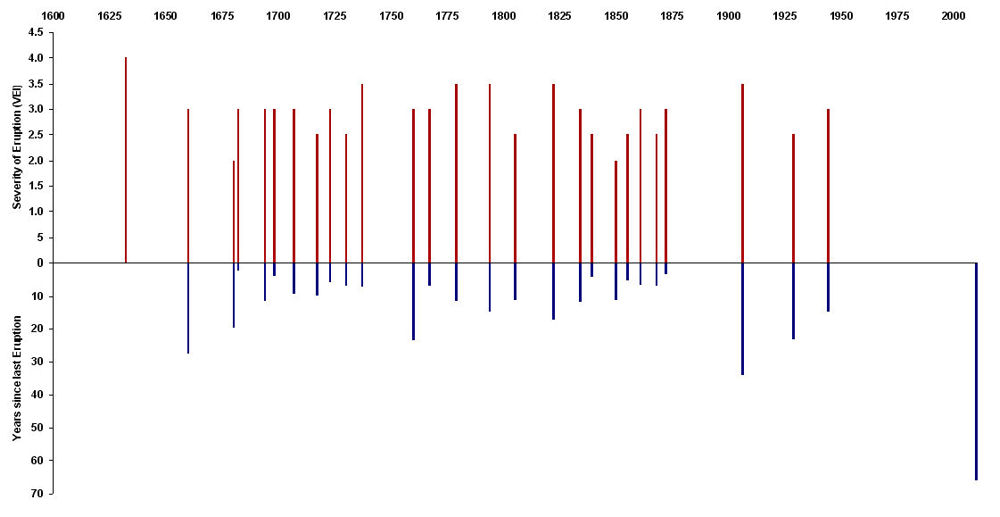
Looking at another famous volcano, Vesuvius, I have put together the following simple chart.
Spot the pattern?

The average period between eruptions is just shy of 14 years, but the pattern is anything but regular. If we expand our range a bit, we might ask how many eruptions occurred between 10 and 20 years after the previous one. The answer is just 9 of the 26[4], or about 35%. Even if we expand our range to periods of calm lasting between 5 and 25 years (so 10 years of leeway on either side), we only capture 77% of eruptions. The standard deviation of the periods between recorded eruptions is a whopping 12.5; eruptions of Vesuvius are not regular events.

One aspect of truly random distributions at first seems counterfactual, this is their lumpiness. It might seem reasonable to assume that a random set of events would lead to a nicely spaced out distribution; maybe not a set of evenly-spaced points, but a close approximation to one. In fact the opposite is generally true; random distributions will have clusters of events close to each other and large gaps between them.

Pseudo-random and truly random

The above exhibit (a non-wrapped version of which may be viewed by clicking on it) illustrates this point. It compares a set of pseudo-random numbers (the upper points) with a set of truly random numbers (the lower points)[5]. There are some gaps in the upper distribution, but none are large and the spread is pretty even. By contrast in the lower set there are many large gaps (some of the more major ones being tagged a, … ,h) and significant clumping[6]. Which of these two distributions more closely matches the eruptions of Vesuvius? What does this tell us about the predictability of its eruptions?
 
 
The predictive analytics angle
 
As always in closing I will bring these discussions back to a business focus. The above observations should give people involved in applying statistical techniques to make predictions about the future some pause for thought. Here I am not targeting the professional statistician; I assume such people will be more than aware of potential pitfalls and possess much greater depth of knowledge than myself about how to avoid them. However many users of numbers will not have this background and we are all genetically programmed to seek patterns, even where none may exist. Predictive analytics is a very useful tool when applied correctly and when its findings are presented as a potential range of outcomes, complete with associated probabilities. Unfortunately this is not always the case.

It is worth noting that many business events can be just as unpredictable as volcanic eruptions. Trying to foresee the future with too much precision is going to lead to disappointment; to say nothing of being engulfed by lava flows.

But the model said…


Explanatory notes

 
[1] The solvability of polynomials is of course equivalent to whether or not roots of them exist.
 
[2] Lie groups lie at the heart of quantum field theory – a interesting lexicographical symmetry in itself
 
[3] Indeed it has been argued that non-linear systems are more robust in response to external stimuli than classical ones. The latter tend to respond to “jolts” in a smooth manner leading to a change in state. The former often will revert to their previous strange attractor. It has been postulated that evolution has taken advantage of this fact in demonstrably chaotic systems such as the human heart.
 
[4] Here I include the – to date – 66 years since Vesuvius’ last eruption in 1944 and exclude the eruption in 1631 as there is no record of the preceding one.
 
[5] For anyone interested, the upper set of numbers were generated using Excel’s RAND() function and the lower are successive triplets of the decimal expansion of pi, e.g. 141, 592, 653 etc.
 
[6] Again for those interested the average gap in the upper set is 10.1 with a standard deviation of 4.3; the figures for the lower set are 9.7 and 9.6 respectively.


No-fooling: A new blog-tagging meme – by Curt Monash

Software Memories - a Curt Monash blog

By way of [very necessary] explanation, this post is a response to an idea started on the blog of Curt Monash (@CurtMonash), doyen of software industry analysts. You can read the full article here. This is intended as an early April Fools celebration.

A summary:

[…] the Rules of the No-Fooling Meme are:

Rule 1: Post on your blog 1 or more surprisingly true things about you,* plus their explanations. I’m starting off with 10, but it’s OK to be a lot less wordy than I’m being. I suggest the following format:

  • A noteworthy capsule sentence. (Example: “I was not of mortal woman born.”)
  • A perfectly reasonable explanation. (Example: “I was untimely ripped from my mother’s womb. In modern parlance, she had a C-section.”)

Rule 2: Link back to this post. That explains what you’re doing.
Rule 3: Drop a link to your post into the comment thread. That will let people who check here know that you’ve contributed too.
Rule 4: Ping 1 or more other people encouraging them to join in the meme with posts of their own.

*If you want to relax the “about you” part, that’s fine too.

I won’t be as dramatic as Curt, nor will I drop any names (they have been changed to protect the guilty). I also think that my list is closer to a “things you didn’t know about me” than Curt’s original intention, but hopefully it is in the spirit of his original post. I have relaxed the “about me” part for one fact as well, but claim extenuating circumstances.

My “no-fooling” facts are, in (broadly) reverse chronological order:

  1. I have recently corrected a Physics paper in Science – and please bear in mind that I was a Mathematician not a Physicist; I’m not linking to the paper as the error was Science’s fault not the scientists’ and the lead author was very nice about it.
  2. My partner is shortly going to be working with one of last year’s Nobel Laureates at one of the world’s premier research institues – I’m proud, so sue me!
  3. My partner, my eldest son and I have all attended (or are attending) the same University – though separated by over 20 years.
  4. The same University awarded me 120% in my MSc. Number Theory exam – the irony of this appeals to me to this day; I was taught Number Theory by a Fields Medalist; by way of contrast, I got a gamma minus in second year Applied Mathematics.
  5. Not only did I used to own a fan-site for a computer game character, I co-administered a universal bulletin board (yes I am that old) dedicated to the same character – even more amazingly, there were female members!
  6. As far as I can tell, my code is still part of the core of software that is used rather widely in the UK and elsewhere – though I suspect that a high percentage of it has succumbed to evolutionary pressures.
  7. I have recorded an eagle playing golf – despite not being very good at it and not playing at all now.
  8. I have played cricket against the national teams of both Zimbabwe (in less traumatic times) and the Netherlands – Under 15s and Under 19s respectively; I have also played both with and against an England cricketer and against a West Indies cricketer (who also got me out), but I said that I wasn’t going to name drop.
  9. [Unlike Curt] I only competed in one chess tournament – I came fourth, but only after being threatened with expulsion over an argument to do with whether I had let go of a bishop for a nanosecond; I think I was 11 at the time.
  10. At least allegedly, one of my antecedents was one of the last hangmen in England – I’m not sure how you would go about substantiating this fact as they were meant to be sworn to secrecy; equally I’m not sure that I would want to substantiate it.
  11. And a bonus fact (which could also be seen as oneupmanship vis à vis Curt):

  12. One of the articles that I wrote for the UK climbing press has had substantially more unique views than any of my business-related articles on here (save for the home page itself) – sad, but true, if you don’t believe me, the proof is here.


Other Monash-related posts on this site:


The Business Intelligence / Data Quality symbiosis

The possible product of endosymbiosis of proteobacteria and eukaryots

As well as sounding like the title of an episode of The Big Bang Theory, the above phrase is one I just used when commenting on an article from the Data and Process Advantage Blog.

I rather like it and think it encapsulates the points that I have tried to make in my earlier post, Using BI to drive improvements in data quality.


I’m not sure whether Google evidence would stand up in court, but I may have coined a new phrase here:

Search google.com for “Business Intelligence Data Quality symbiosis”
 

An in-depth interview with the author – by Ajay Ohri at DecisionStats.com

DecisionStats

I have been following DecisionStat’s excellent series of interviews with leading figures in the IT industry who have a focus on Business Intelligence, Analytics and Data Management. So I was delighted when I received the invitation to be interviewed by Ajay myself.

This turned into a wide-ranging discussion on a number of areas including the perception of science in society, but most of the content refers to Business Intelligence, analytics, cloud computing, data quality and related areas. You can read the interview in full by clicking on the image or text below.

DecisionStats.com Interview

DecisionStats.com Interview

Thanks to Ajay for taking the time to talk to me.


Ajay Ohri established DecisionStats in 2007 to focus on a number of areas pertinent to business an technology. These include: India, The Internet, Analytics, Company Analysis and Interviews. Ajay is also principal of SwanPLC, who are in the business of helping customers with advanced analytical solutions including recommendations of products and services.
 

A single version of the truth?

linkedin The Data Warehousing Institute The Data Warehousing Institute (TDWI™) 2.0

As is frequently the case, I was moved to write this piece by a discussion on LinkedIn.com. This time round, the group involved was The Data Warehousing Institute (TDWI™) 2.0 and the thread, entitled Is one version of the truth attainable?, was started by J. Piscioneri. I should however make a nod in the direction of an article on Jim Harris’ excellent Obsessive-Compulsive Data Quality Blog called The Data Information Continuum; Jim also contributed to the LinkedIn.com thread.

Standard note: You need to be a member of both LinkedIn.com and the group mentioned to view the discussions.
 
 
Introduction

A Calabi–Yau manifold

Here are a couple of sections from the original poster’s starting comments:

I’ve been thinking: is one version of the truth attainable or is it a bit of snake oil? Is it a helpful concept that powerfully communicates a way out of spreadmart purgatory? Or does the idea of one version of the truth gloss over the fact that context or point of view are an inherent part of any statement about data, which effectively makes truth relative? I’m leaning toward the latter position.

[…]

There can only be one version of the truth if everyone speaks the same language and has a common point of view. I’m not sure this is attainable. To the extent that it is, it’s definitely not a technology exercise. It’s organizational change management. It’s about changing the culture of an organization and potentially breaking down longstanding barriers.

Please join the group if you would like to read the whole post and the subsequent discussions, which were very lively. Here I am only going to refer to these tangentially and instead focus on the concept of a single version of the truth itself.

Readers who are not interested in the ellipitcal section of this article and who would instead like to cut to the chase are invited to click here (warning there are still some ellipses in the latter sections).
 
 
A [very] brief and occasionally accurate history of truth

The demise of a cherry tree

I have discovered a truly marvellous proof of the nature of truth, which this column is too narrow to contain.

— Pierre de Tomas (1637)

Instead of trying to rediscover M. Tomas’ proof, I’ll simply catalogue some of the disciplines that have been associated (rightly or wrongly) with trying to grapple with the area:

  • Various branches of Philosophy, including:
    • Metaphysics
    • Epistemology
    • Ethics
    • Logic
  • History
  • Religion (or more perhaps more generally spirituality)
  • Natural Science
  • Mathematics
  • and of course Polygraphism

Lie algebra

Given my background in Pure Mathematics the reader might expect me to trumpet the claims of this discipline to be the sole arbiter of truth; I would reply yes and no. Mathematics does indeed deal in absolute truth, but only of the type: if we assume A and B, it then follows that C is true. This is known as the axiomatic approach. Mathematics makes no claim for the veracity of axioms themselves (though clearly many axioms would be regarded as self-evidently true to the non-professional). I will also manfully resist the temptation to refer to the wrecking ball that Kurt Gödel’s took to axiomatic systems in 1931.

Physical science

I have also made reference (admittedly often rather obliquely) to various branches of science on this blog, so perhaps this is another place to search for truth. However the Physical sciences do not really deal in anything as absolute as truth. Instead they develop models that approximate observations, these are called scientific theories. A good theory will both explain aspects of currently observed phenomena and offer predictions for yet-to-be-observed behaviour (what use is a model if it doesn’t tell us things that we don’t already know?). In this way scientific theories are rather like Business Analytics.

Unlike mathematical theories, the scientific versions are rather resistant to proof. Somewhat unfairly, while a mountain of experiments that are consistent with a scientific theory do not prove it, it takes only one incompatible data point to disprove it. When such an inconvenient fact rears its head, the theory will need to be revised to accommodate the new data, or entirely discarded and replaced by a new theory. This is of course an iterative process and precisely how our scientific learning increases. Warning bells generally start to ring when a scientist starts to talk about their theory being true, as opposed to a useful tool. The same observation could be made of those who begin to view their Business Analytics models as being true, but that is perhaps a story for another time.

The Thinker

I am going to come back to Physical science (or more specifically Physics) a little later, but for now let’s agree that this area is not going to result in defining truth either. Some people would argue that truth is the preserve of one of the other subjects listed above, either Philosophy or Religion. I’m not going to get into a debate on the merits of either of these views, but I will state that perhaps the latter is more concerned with personal truth than supra-individual truth (otherwise why do so many religious people disagree with each other?).

Discussing religion on a blog is also a certain way to start a fire, so I’ll move quickly on. I’m a little more relaxed about criticising some aspects of Philosophy; to me this can all too easily descend into solipism (sometimes even quicker than artificial intelligence and cognitive science do). Although Philosophy could be described as the search for truth, I’m not convinced that this is the same as finding it. Maybe truth itself doesn’t really exist, so attempting to create a single version of it is doomed to failure. However, perhaps there is hope.
 
 
Trusting your GUT feeling

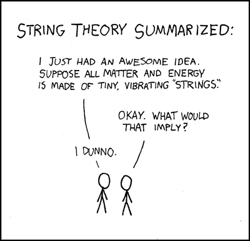
Physicists have a sense of humour too you know...
© xkcd.com

After the preceding divertimento, it is time to return to the more prosaic world of Business Intelligence. However there is first room for the promised reference to Physics. For me, the phrase “a single version of the truth” always has echoes of the search for a Grand Unified Theory (GUT). Analogous to our discussions about truth, there are some (minor) definitional issues with GUT as well.

Some hold that GUT applies to a unification of the electromagnetic, weak nuclear and strong nuclear forces at very high energy levels (the first two having already been paired in the electroweak force). Others that GUT refers to a merging of the particles and forces covered by the Standard Model of Quantum Mechanics (which works well for the very small) with General Relativity (which works well for the very big). People in the first camp might refer to this second unification as a ToE (Theory of Everything), but there is sometimes a limit to how much Douglas Adams’ esteemed work applies to reality.

For the purposes of this article, I’ll perform the standard scientific trick of a simplifying assumption and use GUT in the grander sense of the term.

Scientists have striven to find a GUT for decades, if not centuries, and several candidates have been proposed. GUT has proved to be something of a Holy Grail for Physicists. Work in this area, while not as yet having been successful (at least at the time of writing), has undeniably helped to shed a light on many other areas where our understanding was previously rather dim.

This is where the connection with a single version of the truth comes in. Not so much that either concept is guaranteed to be achievable, but that a lot of good and useful things can be accomplished on a journey towards both of them. If, in a given organisation, the journey to a single version of the truth reaches its ultimate destination, then great. However if, in an another company, a single version of the truth remains eternally just over the next hill, or round the next corner, then this is hardly disastrous and maybe it is the journey itself (and the aspirations with which it is commenced on) that matters more than the destination.

Before I begin to sound too philosophical (cf. above) let me try to make this more concrete by going back to our starting point with some Mathematics and considering some Venn diagrams.
 
 
Ordo ab chao

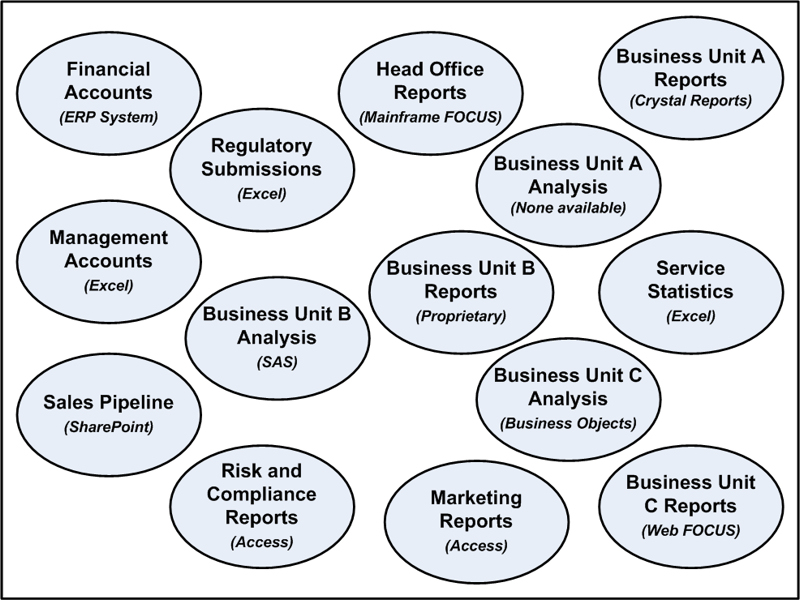
In my experience the following is the type of situation that a good Business Intelligence programme should address:

Fragmentation

The problems here are manifold:

  1. Although the various report systems are shown as separate, the real situation is probably much worse. Each of the reporting and analysis systems will overlap, perhaps substantially, with one or more or the other ones. Indeed the overlapping may be so convoluted that it would be difficult to represent this in two dimensions and I am not going to try. This means that you can invariably ask the same question (how much have we sold this month) of different systems and get different answers. It may be difficult to tell which of these is correct, indeed none of them may be a true reflection of business reality.
  2. There are a whole set of things that may be treated differently in the different ellipses. I’ll mention just two for now: date and currency. In one system a transaction may be recorded in a month when it is entered into the system. In another it may be allocated to the month when the event actually occurred (sometimes quite a while before it is entered). In a third perhaps the transaction is only dated once it has been authorised by a supervisor.

    In a multi-currency environment reports may be in the transactional currency, rolled-up to the currency of the country in which they occurred, or perhaps aggregated across many countries in a number of “corporate” currencies. Which rate to use (rate on the day, average for the month, rolling average for the last year, a rate tied to some earlier business transaction etc.) may be different in different systems, equally the rate may well vary according to the date of the transaction (making the last set of comments about which date is used even more pertinent).

  3. A whole set of other issues arise when you begin to consider things such as taxation (are figures nett or gross), discounts, commissions to other parties, phased transactions and financial estimates. Some reports may totally ignore these, others my take account of some but not others. A mist of misunderstanding is likely to arise.
  4. Something that is not drawn on the above diagram is the flow of data between systems. Typically there will be a spaghetti-like flow of bits and bytes between the different areas. What is also not that uncommon is that there is both bifurcation and merging in these flows. For example, some sorts of transactions from Business Unit A may end up in the Marketing database, whereas others do not. Perhaps transactions carried out on behalf of another company in the group appear in Business Unit B’s reports, but must be excluded from the local P&L. The combinations are almost limitless.

    Interfaces can also do interesting things to data, re-labelling it, correcting (or so their authors hope) errors in source data and generally twisting the input to form output that may be radically different. Also, when interfaces are anything other than real-time, they introduce a whole new arena in which dates can get muddled. For instance, what if a business transaction occurred in a front-end system on the last day of a year, but was not interfaced to a corporate database until the first day of the next one – which year does it get allocated to in the two places?

  5. Finally, the above says nothing about the costs (staff and software) of maintaining a heterogeneous reporting landscape; or indeed the costs of wasted time arguing about which numbers are right, or attempting to perform tortuous (and ultimately fruitless) reconciliations.

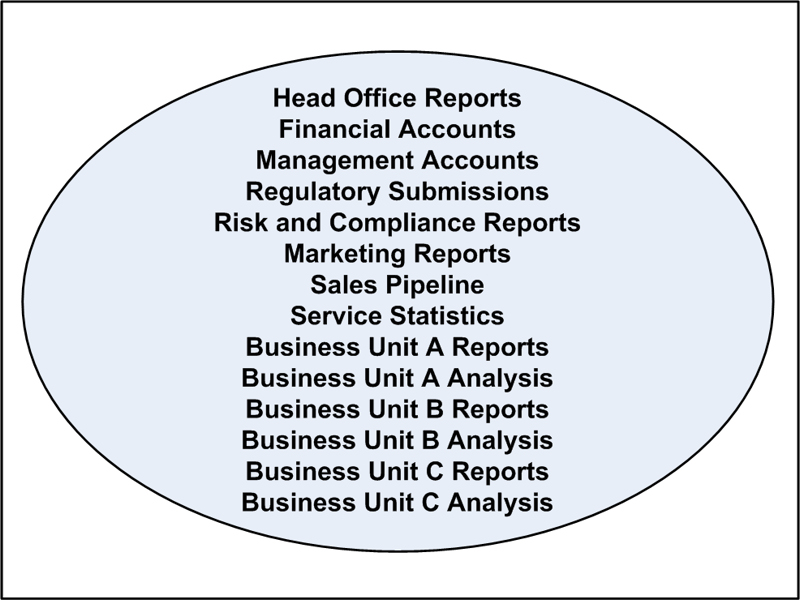
Now the ideal situation is that we move to the following diagram:

De-fragmentation

This looks all very nice and tidy, but there are still two major problems.

  1. A full realisation of this transformation may be prohibitively expensive, or time-consuming.
  2. Having brought everything together into one place offers an opportunity to standardise terminology and to eliminate the confusion caused by redundancy. However, it doesn’t per se address the other points made from 2. onwards above.

The need to focus on what is possible in a reasonable time-frame and at a reasonable cost may lead to a more pragmatic approach where the number of reporting and analysis systems is reduced, but to a number greater than one. Good project management may indeed dictate a rolling programme of consolidation, with opportunities to review what has worked and what has not and to ascertain whether business value is indeed being generated by the programme.

Nevertheless, I would argue that it is beneficial to envisage a final state for the information architecture, even if there is a tacit acceptance that this may not be realised for years, if at all. Such a framework helps to guide work in a way that making it up as we go along does not. I cover this area in more detail in both Holistic vs Incremental approaches to BI and Tactical Meandering for those who are interested.

It is also inevitable that even in a single BI system data will need to be presented in different ways for different purposes. To take just one example, if you goal is to see how the make up of a book of business has varied over time, then it is eminently sensible to use a current exchange rate for all transactions; thereby removing any skewing of the figures caused by forex fluctuations. This is particularly the case when trying to assess the profitability of business where revenue occurs at a discrete point in the past, but costs may be spread out over time.

However, if it is necessary to look at how the organisation’s cash-flow is changing over time, then the impact of fluctuations in foreign exchange rates must be taken into account. Sadly if an American company wants to report how much revenue it has from its French subsidiary then the figures must reflect real-life euro / dollar rates (unrealised and realised foreign currency gains and losses notwithstanding).

What is important here is labelling. Ideally each report should show the assumptions under which it has been compiled at the top. This would include the exchange rate strategy used, the method by which transactions are allocated to dates, whether figures are nett or gross and which transactions (if any) have been excluded. Under this approach, while it is inevitable that the totals on some reports will not agree, at least the reports themselves will explain why this is the case.

So this is my take on a single version of the truth. It is both a) an aspirational description of the ideal situation and something that is worth striving for and b) a convenient marketing term – a sound-bite if you will – that presents a palatable way of describing a complex set of concepts. I tried to capture this essence in my reply to the LinkedIn.com thread, which was as follows:

To me, the (extremely hackneyed) phrase “a single version of the truth” means a few things:

  1. One place to go to run reports and perform analysis (as opposed to several different, unreconciled, overlapping systems and local spreadsheets / Access DBs)
  2. When something, say “growth” appears on a report, cube, or dashboard, it is always calculated the same way and means the same thing (e.g. if you have growth in dollar terms and growth excluding the impact of currency fluctuations, then these are two measures and should be clearly tagged as such).
  3. More importantly, that the organisation buys into there being just one set of figures that will be used and self-polices attempts to subvert this with roll-your-own data.

Of course none of this equates to anything to do with truth in the normal sense of the word. However life is full of imprecise terminology, which nevertheless manages to convey meaning better than overly precise alternatives.

More’s Utopia was never intended to depict a realistic place or system of government. These facts have not stopped generations of thinkers and doers from aspiring to make the world a better place, while realising that the ultimate goal may remain out of reach. In my opinion neither should the unlikelihood of achieving a perfect single version of the truth deter Business Intelligence professionals from aspiring to this Utopian vision.

I have come pretty close to achieving a single version of the truth in a large, complex organisation. Pretty close is not 100%, but in Business Intelligence anything above 80% is certainly more than worth the effort.
 

Synthesis

RNA Polymerase producing mRNA from a double-stranded DNA template

  synthesis /sinthisiss/ n. (pl. syntheses /-seez/) 1 the process of building up separate elements, esp. ideas, into a connected whole, esp. a theory or system. (O.E.D.)  

Yesterday’s post entitled Recipes for success? seems to have generated quite a bit of feedback. In particular I had a couple of DMs from people I know on twitter.com (that’s direct messages for the uninitiated) and some e-mails, each of which asked me why I was so against business books. One person even made the assumption that I was anti-books and anti-learning in general.

I guess I need to go on a course designed to help people to express themselves more clearly. I am a bibliophile and would describe myself as fanatically pro-learning. As I mentioned in a comment on the earlier article, I was employing hyperbole yesterday. I would even go so far as to unequivocally state that some business books occasionally contain a certain amount of mildly valuable information.

Of course, when someone approaches a new area, I would certainly recommend that they start by researching what others have already tried and that they attempt to learn from what has previously worked and what has not. Instead, the nub of my problem is when people never graduate beyond this stage. More specifically, I worry when someone finds a web-article listing “10 steps that, if repeated in the correct sequence, will automatically lead to success” and then uncritically applies this approach to whatever activity they are about to embark on.

Assuming that the activity is something more complicated than assembling Ikea furniture, I think it pays to do two further things: a) cast your net a little wider to gather a range of opinions and approaches, and b) assemble your own approach, based borrowing pieces from different sources and sprinkling this with your own new ideas, or maybe things that have worked for you in the past (even if these were in slightly different areas). My recommendation is thus not to find the methodology or design that most closely matches your requirements, but rather to roll your own, hopefully creating something that is a closer fit.

This act of creating something new – based on research, on leveraging appropriate bits of other people’s ideas, but importantly adding your own perspective and tweaking things to suit your own situation – is what I mean by synthesis.

Of course maybe what you come up with is not a million miles from one of the existing prêt-à-porter approaches, but it may be an improvement for you in your circumstances. Also, even if your new approach proves to be suboptimal, you have acquired something important; experience. Experience will guide you in your next attempt, where you may well do better. As the saying maybe ought to go – you learn more from your own mistakes than other people’s recipes for success.


Addendum

The WordPress theme I use for this blog – Contempt – was written by Michael Heilemann a self-styled “Interface Designer, Web Developer, former Computer Game Developer and Film Lover”. Michael also writes a blog, Binary Bonsai and I felt that his article, George Lucas stole Chewbacca, but it’s OK, summed up (if you can apply the concept of summation to so detailed a piece of writing) a lot of what I am trying to cover in this piece. I’d recommend giving it a read, even if you aren’t a Star Wars fan-boy.
 

Recipes for success?

I should acknowledge that I am indebted to a conversation that I had with John Collins on his blog, Views from the Bridge, for some of the themes I discuss in this article.
 
Recipe for Success?
 
Introduction

Towards the end of a recent article on perseverance I referred to people’s desire to find recipes for success. Here’s what I said:

Sometimes we want to find a magic recipe for success, or – to mix the metaphor – a silver bullet. We want to discover a series of defined steps to take that, if repeated religiously, will guarantee that we get to the desired goal each and every time. That’s why articles entitled “The 5 ways to […]” and “My top tips for […]” are so well-read on the web.

As well as my examples of internet top tips (see any number of articles claiming to tell you how to use twitter successfully to get the idea), this phenomenon is also a major factor behind the enduring popularity of celebrity business books. As far as I can see, these fall into two categories.
 
 
1. The Ex-CEO

This is where the extremely successful and well-known Mr Brown (and sadly it is still mostly Mr, rather than Ms Brown), now retired but previously President and CEO of Big Company Inc., writes (or more likely has some one ghost-write) a memoir explaining the secrets of his success. While the book may dwell on their upbringing, education, role models, or character-forming events in their lives, much of the work will probably focus on them just being much smarter, more risk-taking, or having greater insight than the competition (most likely all of these). Of course there may well be some interesting tit-bits amongst the reams of self-aggrandisement, but it is worth questioning just how applicable these might be to your own situation.

Are the things that Mr Brown ascribes his success to really what led to his glittering career? Are there perhaps other factors that are not captured in the memoir, but which, if absent in another organisation, would render implementing Mr Brown’s explicit recommendations valueless? Did Mr Brown’s greatest achievements actually have a big slice of luck attached to them (stumbling upon a market or a product by accident, a major competitor losing their way, events beyond anyone’s control shaping matters and so on)? Would the things that Big Company Inc. did under Mr Brown’s esteemed leadership actually work in another company, in a different market or country and with a distinctive business culture?

Put it this way, if you work in Financial Services, would copying what worked in Retail be a good idea? Alternatively, if two companies are both in Retail, does it make sense for a less successful company to slavishly adopt the strategy of the market leader – wouldn’t it be more sensible if they tried to develop a different strategy in order to differentiate their brand?

Of course there is always value in learning from the mistakes and successes of others, but surely there is a limit to how useful a business memoir can be in forming a business strategy.
 
 
2. The Academic Expert

Here Professor Green (probably still male), has a long and distinguished career in academia, reading and deconstructing the memoirs of Mr Brown and his peers, identifying common themes between them, doing primary research and constructing recherché models of business strategy development and execution. If there is a new management fad out there, Professor Green is sure to know about it – in fact it may well be based on an article of his that appeared in HBR.

Well there is certainly some value in trying to tease out commonalities between successful companies, but this is probably a lot harder than it might seem. While there may be some recurring themes, maybe many of our champions of business are one offs, successful for reasons other than their business models or strategies. In fact they may well be as unique as the people who lead them. Maybe there is no equivalent of the standard model of quantum mechanics (to say nothing of a deeper grand unified theory) that underpins business success – perhaps the science of business is different from the more reductionist sciences, such as physics. Maybe there isn’t a formula for business success; perhaps it is more like Darwinian natural selection (I’ll come back to this idea later).

Whichever way you look at it, again there is probably a limit to how much insight you can glean from this type of book.
 
 
Other genres

Of course this phenomenon extends into many other areas of human activity. As a youth I can remember only too well poring over cricket manuals in an (ultimately fruitless) attempt to improve my batting or wicket-keeping. My father, at the age of 72, still does the same with golf manuals.

The endless array of cooking books also in the same category and where would we be without the panoply of self-help books such as The Seven Habits of Annoyingly Organised People? All of which goes to show that reliance on recipes for success is a deeply ingrained human trait.
 
 
Recipes for success in IT

Having established that people like turning to both “My top tips for […]” and “Mr Brown’s Glittering Career” (available at all good booksellers) how does this aspect of human nature impinge on one of my main areas of endeavour, IT?

Well it has a major impact in my opinion. In fact it is difficult to think of an area of life more obsessed with frameworks, blue-prints, road-maps, procedures, best practices and methodologies (to say nothing of ontologies and taxonomies). All of these are intended to take the risk out of activities – well at least to provide the people following them with the ability to say “well I did what the methodology told me to do”. Of course IT projects and IT development are very complex things and standards of design, coding and behaviour of systems are of paramount importance; but it still seems that IT people have a more visceral relationship with the above-stated areas than would be dictated solely by ticking the necessary boxes.

Nevertheless, having been personally responsible for instigating a thoroughgoing process of standardisation and quality control in a software house (and thereby obtaining an ISO accreditation), it would be churlish of me to argue that that there is no benefit in rigorously applying methodologies in IT.

When it comes to some aspects of project management and to change management in particular, some of the scepticism that I exhibited about celebrity business books returns. It’s not so much that a methodology or even a list of items to tick is not valuable, but that it cannot be an end in itself. The important thing is the thinking that goes into drawing up what you need to do and how you are going to do it, not the method that you use to record these and monitor progress. Sometimes these crucial ingredients get lost. Indeed there does seem to be an entire class of people who focus just on managing lists, rather than the ideas behind them, or the people actually doing the work.
 
 
The benefits of a Darwinian approach

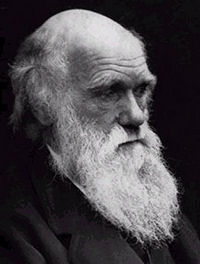
Charles Darwin

I raised the idea of a Darwinian approach to business strategy earlier in this article. There do seem to be some crossovers with how we observe businesses in operation. We are familiar with the image of companies competing with each other for limited resources (our wallets, mine being very limited at present). We understand the pressure that organisations are under to come up with better, cheaper, more functional and sexier products (that are now carbon neutral and ethically-sourced as well).

The language of business is suffused by jungle analogies. The adaptation of Tennyson’s “Nature, red in tooth and claw” to capitalism being just one of the most well-known examples. The companies that are best at this game survive and thrive, those that are not fail and are forgotten. Companies in more mature markets are even often referred to as dinosaurs or fossils. The idea of never-ending refinement and progress pushing on is an essential part of business.

However, perhaps this evolutionary approach, so evident at the macro-level can also work on a micro-scale. Maybe, rather than relying on the thoughts of Mr Brown or Professor Green, a better approach would be come up with some ideas of our own, test them, discard the bad ones and nurture the less bad ones. In time, with appropriate development and alteration, the less bad may become good and then even great (hang on, I seem to have found my way back to business books with that phrase!).

To me, such an approach is more likely to result in something novel and valuable. Following a recipe for success can only ever be as good as the recipe itself. Thinking for yourself can transcend these limitations and I would argue that the downside is no greater than attempting to ape someone else’s ideas. In both cases the worst that can happen is only extinction.
 
 
Disclaimer – sort of

Of course this article has a degree of self reference. Relying upon your own intellect (hopefully refined and improved by other people’s input) is of course another recipe for success. However I hope it is a less proscriptive one. I recommend giving it a try.


Continue reading about this area in: Synthesis.