Limitations of Business Intelligence

My predictive analytics model didn't foresee this outcome, therefore it can't be happening. With apologies to the makers of 2012.

Introduction

“So how come Business Intelligence didn’t predict the World Economic Crisis?”

I have seen countless variants of the above question posted all over the Internet. Mostly it is posed on community forums and can often be a case of someone playing Devil’s Advocate, or simply wanting to stir up a conversation. However I came across reference to this question recently in the supposedly more sober columns of The British Computer Society (now very modishly re branded as BCS – The Chartered Institute for IT). According to the font of all human knowledge, the BCS is:

“a professional body and a learned society that represents those working in Information Technology. Established in 1957, it is the largest United Kingdom-based professional body for computing”

The specific article was entitled Data quality issues ‘to blame for financial crises’ (I’m not sure whether the BCS is saying that data quality issues are responsible for more than one financial crisis, or whether there is a typo in the last word). The use of quotation marks is also apt as the BCS seem to be reliant for the content of this article on both the opinions of the owner of a on-line community and a piece of commercial research finding that:

“more than 75 per cent of top financial services firms are to increase the amount of money they allocate to combating data quality and consistency issues”

and

“a further 44 per cent said clarity of data would be their ‘key focus'”

How this adds up to the conclusion appearing in the title is perhaps something of a mystery. The process is not exactly a shining example of how to turn source data into actionable information.
 
 
Lessons from Lehmans

Theirs not to reason why,  Theirs but to do & die,  Into the valley of Death  Rode the six hundred

It is arguable (though maybe not on the evidence presented in the BCS article) that poor data quality may have contributed to the demise of say Lehman Brothers. However the following line of argument is a bit of a reach:

  1. Poor data quality [arguably] contributed to the failure of Lehman Brothers
  2. Lehman Brothers’ failure was a trigger for a broader collapse of the world economy
  3. Therefore Lehman’s collapse was solely to blame for the crisis
  4. Thus (as per the BCS): Data quality issues [are] ‘to blame for financial crises’ [sic.]

There are a number of problems with this logic. To address just one, the failure of Lehmans did not cause the recession, it precipitated problems that were much larger, had been building up for years and which would have been triggered by something sooner or later (all balloons either deflate or pop eventually, even if not pierced by a needle).

By way of analogy, thinking that the assassination of Archduke Ferdinand was the sole reason for the outbreak of The Great War would be an over-simplification of history; greater forces were at work. Does a dropped match [proximate cause] lead to a massive forest fire, or are the preceding months of drought [distal cause] more to blame, with the fire an accident waiting to happen?

To most observers the distal causes of the recession were separate bubbles that had built up in a variety of asset classes (e.g. residential property) that were either going to deflate slowly, or go bang! Leverage created by certain classes of financial instruments made a bang more likely, but these instruments themselves did not create the initial problems either.

Extending our earlier analogy, if the asset bubbles were a lack of rain, then maybe the use of financial instruments – such as collateralised debt obligations – was a drying wind. In this scenario, Lehman Brothers was the dropped match, nothing more. If it wasn’t them, it would have been another event. So for causes of the World Economic crisis, we need to look more broadly.
 
 
Cui culpa?

First published in September 1843 to take part in 'a severe contest between intelligence, which presses forward, and an unworthy, timid ignorance obstructing our progress' [nice use of the Oxford / Harvard comma BTW]

Before I explore whether BI should have performed better in predicting the most severe recession since the 1930s, it is perhaps worth asking a more pertinent question, namely, “so how come macroeconomics didn’t predict the World Economic Crisis?” Again according to the font:

macroeconomics is a branch of economics that deals with the performance, structure, behavior and decision-making of the entire economy, be that a national, regional, or the global economy

so surely it should have had something to say in advance about this subject. However at least according to The Economist (who one would assume should know something about the area):

[Certain leading economists] argue that [other] economists missed the origins of the crisis; failed to appreciate its worst symptoms; and cannot now agree about the cure. In other words, economists misread the economy on the way up, misread it on the way down and now mistake the right way out.

On the way up, macroeconomists were not wholly complacent. Many of them thought the housing bubble would pop or the dollar would fall. But they did not expect the financial system to break. Even after the seizure in interbank markets in August 2007, macroeconomists misread the danger. Most were quite sanguine about the prospect of Lehman Brothers going bust in September 2008.

Source: The Economist – 16th July 2009

[Note: a subscription to the magazine is required to view this article]

In a later article in the same journal, Robert Lucas, Professor of Economics at the University of Chicago, rebutted the above critique, stating:

One thing we are not going to have, now or ever, is a set of models that forecasts sudden falls in the value of financial assets, like the declines that followed the failure of Lehman Brothers in September. This is nothing new. It has been known for more than 40 years and is one of the main implications of Eugene Fama’s “efficient-market hypothesis”, which states that the price of a financial asset reflects all relevant, generally available information. If an economist had a formula that could reliably forecast crises a week in advance, say, then that formula would become part of generally available information and prices would fall a week earlier.

Source: The Economist – 6th August 2009

[Note: a subscription to the magazine is required to view this article]

So if economists had at best a mixed track record in predicting the crisis (and can’t seem to agree amongst themselves about the merits of different ways of analysing economies), then it seems to me that Business Intelligence has its work cut out for it. As I put it in an earlier article, The scope of IT’s responsibility when businesses go bad:

My general take is that if the people who were committing organisations to collateralised debt obligations and other even more esoteric asset-backed securities were unable (or unwilling) to understand precisely the nature of the exposure that they were taking on, then how could this be reflected in BI systems. Good BI systems reflect business realities and risk is one of those realities. However if risk is as ill-understood as it appears to have been in many financial organisations, then it is difficult to see how BI (or indeed it’s sister area of business analytics) could have shed light where the layers of cobwebs were so dense.

As an aside, the above-referenced article argues that IT professionals should not try to distance themselves too much from business problems. My basic thesis being that if IT is shy about taking any responsibility in bad times, it should not be surprised when its contributions are under-valued in good ones. However this way lies a more philosophical discussion.

My opinion on why questions about whether or not business intelligence predicted the recession continue to be asked is that they relate to BI being oversold. Oversold in a way that I believe is unhealthy and actually discredits the many benefits of the field.
 
 
Crystal Ball Gazing

One of these things is not like the others,  One of these things just doesn't belong,  Can you tell which thing is not like the others  By the time I finish my song?

The above slide is taken from my current deck. My challenge to the audience is to pick the odd-one-out from the list. Assuming that you buy into my Rubik’s Cube analogy for business intelligence, hopefully this is not an overly onerous task.

Business Intelligence is not a crystal ball, Predictive Analytics is not a crystal ball either. They are extremely useful tools – indeed I have argued many times before that BI projects can have the largest payback of any IT project – but they are not universal panaceas.

The Old Lady of Threadneedle Street is clearly not a witch
An inflation prediction from The Bank of England
Illustrating the fairly obvious fact that uncertainty increases in proportion to time from now.

Business Intelligence will never warn you of every eventuality – if something is wholly unexpected, how can you design tools to predict it? Statistical models will never give you precise answers to what will happen in the future – a range of outcomes, together with probabilities associated with each is the best you can hope for (see above). Predictive Analytics will not make you prescient, instead it can provide you with useful guidance, so long as you remember it is an prediction, not fact.

It is amazing the things that people find to do in their spare time, isn't it?

However, in most circumstances, the fact that your Swiss Army knife doesn’t have the highly-desirable “tool for removing stones from horses hooves” does not preclude it from fulfilling its more quotidian functions well. The fact that your car can’t do 0-60 mph (0-95 kph, or 0-26 ms-1 if you insist) in less than 4 seconds, does not mean that it is incapable of getting you around town perfectly happily. Tools should be fit-for-purpose, not all-purpose.

Unfortunately, sometimes business intelligence can be presented as capable of achieving the impossible; this is only going to lead to disillusionment with the area and to the real benefits not being seized. Also it is increasingly common for vendors and consultancies to claim that amazing results can be obtained with BI quickly, effortlessly and (most intoxicatingly) with minimum corporate pain. My view is that these claims are essentially bogus. Like most things in life, what you get out of business intelligence is highly connected with what you put it.

If you want some pretty pictures showing some easy to derive figures, then progress in days rather than months is entirely feasible. But if you want useful insights into your organisation’s performance that can lead to informed decision making, then time is required to work out what makes the company tick, how to best measure this to drive action and – a part that is often missed – to provide the necessary business and technical training to allow users to get the best out of tools. Here my experience is that there are few meaningful short-cuts.
 
 
Crystallising BI benefits

Adopting a more positive tone, if done well, then I believe that business intelligence can do a lot of great things for organisations. A brief selection of these includes:

  1. Dissect corporate performance in ways that enable underlying drivers to be made more plain (our drop-off in profitability is due to pricing pressures in Subsidiary A and poor retention of mid-sized accounts in Territory B, compounded by a fall in the rate of new business acquisition in Industry Segment C).
  2. Amalgamate data from disparate sources, allowing connections to be made between different, but related, areas (high turnover of staff in our customer services centre has coincided with both increased lead times for shipments and greater incidence of customer complaints)
  3. Give insights as to how customers are behaving and how they react to corporate initiatives (our smaller customers appear to be favouring bundled services, which include Feature W, however there was increased uptake of unbundled Service Z following on from our recently published video extolling its virtues)
  4. Measure the efficacy of business initiatives (was the launch of Product X successful? did our drive to improve service levels lead to better business retention?)
  5. Transparently monitor business unit achievement (Countries P, Q and R are all meeting their sales and profitability targets, howvever Country Q is achieving this with 2 fewer staff per $1m revenue)
  6. Provide indications (not guarantees) of future trends (sales of Service K are down 10% on this time last year and fell on a seasonally-adjusted basis for four of the last six months)
  7. Isolate hard-to-find relations (the biggest correlation with repeat business is the speed with which reported problems are addressed, not the number of problems that occur)

It is worth pointing out that a lot of the above is internally focussed, about the organisation itself and only tangentially related to the external environment in which it is operating. Some companies are successfully blending their internal BI with external market information, either derived from specialist companies, or sometimes from industry associations. However few companies are incorporating macroeconomic trends into their BI systems. Maybe that’s because of the confusion endemic in Economics that was referenced above.

However there is another reason why BI is not really in the business of predicting overall economic trends. In the preceding paragraphs, I have stressed that it takes lot of effort to get BI working well for a company. To have the same degree of benefit for a nation’s economy, you would have to aggregate across thousands of companies and deal with the same sort of inconsistency in data definitions and calculation methodologies that are hard enough to fight within an organisation; but orders of magnitude worse.

Nationwide (let alone global) BI would be a Herculean (and essentially impossible) task. Instead simplifying assumptions have to be made, and such assumptions do not generally lead to high-quality BI implementations; which are typically highly-tuned to the characteristics of individual organisations.
 
 
Leverage
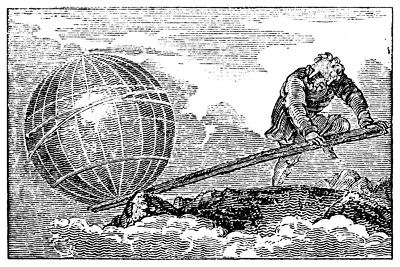
"Give me a place to stand, and I shall move the earth"

There are of course organisations whose general profitability exceptionally depends on broad economic trends. These include the much maligned banks of varying flavours. The unique problem that many of these face is of leverage. While a 1% fall in economic activity might have a 1% impact on the revenues of a manufacturing company (in fact seldom is the relationship so simple), it might have a catastrophic impact on a bank, depending on how their portfolio is structured.

To look at the simplest form of option, which pays out the differential between the market price and a floor of £50. If conditions in the economy drive the share price from £55 to £50, the regular shareholder has lost 9% of their investment; the option holder has lost 100%. So while both the shareholder and option-holder will have an equal chance of experiencing such a price-fall, the impact on them will be radically different (in this case by 91%). Like BI, derivatives are a very useful tool, however they also need to be used appropriately.
 
 
Closing thoughts

You will notice an absent of fortune-telling from the above list of BI benefits. As indispensable as I believe good BI is to organisations of all shapes and sizes, if fortune-telling is your desire then my advice is to forswear BI and wait until this lady is next in town…

...though of course you may not be able to foretell when this will be


For readers who are interested in this area, I recommend Neil Raden’s artcile: Wherefore Analytics on Wall Street? An Homage to Hy Minsky.



The Business Intelligence / Data Quality symbiosis

The possible product of endosymbiosis of proteobacteria and eukaryots

As well as sounding like the title of an episode of The Big Bang Theory, the above phrase is one I just used when commenting on an article from the Data and Process Advantage Blog.

I rather like it and think it encapsulates the points that I have tried to make in my earlier post, Using BI to drive improvements in data quality.


I’m not sure whether Google evidence would stand up in court, but I may have coined a new phrase here:

Search google.com for “Business Intelligence Data Quality symbiosis”
 

Business logic

The dot product of the original sketch and my plagiarism of it is 0

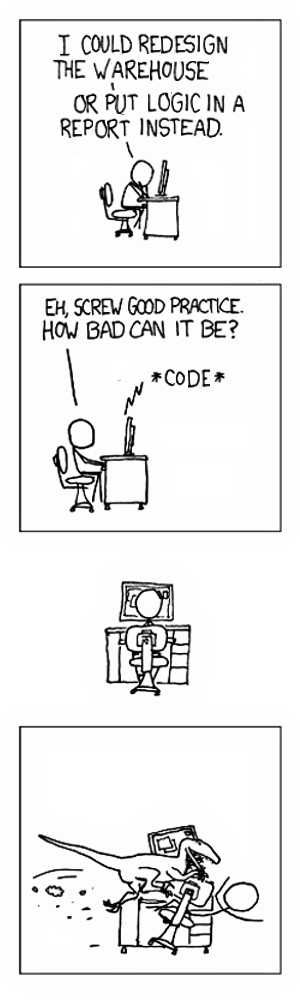
With enormous apologies to Randall Munroe of xkcd.com fame; from whose much funnier, and obviously more original, sketch entitled “GOTO” the above was shamelessly adapted.


Comic strip adapted with the kind permission of the copyright holder.
 

Who should be accountable for data quality?

The cardinality of a countable set - ex-mathematicians are allowed the occasional pun

linkedin CIO Magazine CIO Magazine forum

Asking the wrong question

Once more this post is inspired by a conversation on LinkedIn.com, this time the CIO Magazine forum and a thread entitled BI tool[s] can not deliver the expected results unless the company focuses on quality of data posted by Caroline Smith (normal caveat: you must be a member of LinkedIn.com and the group to view the actual thread).

The discussion included the predictable references to GIGO, but conversation then moved on to who has responsibility for data quality, IT or the business.

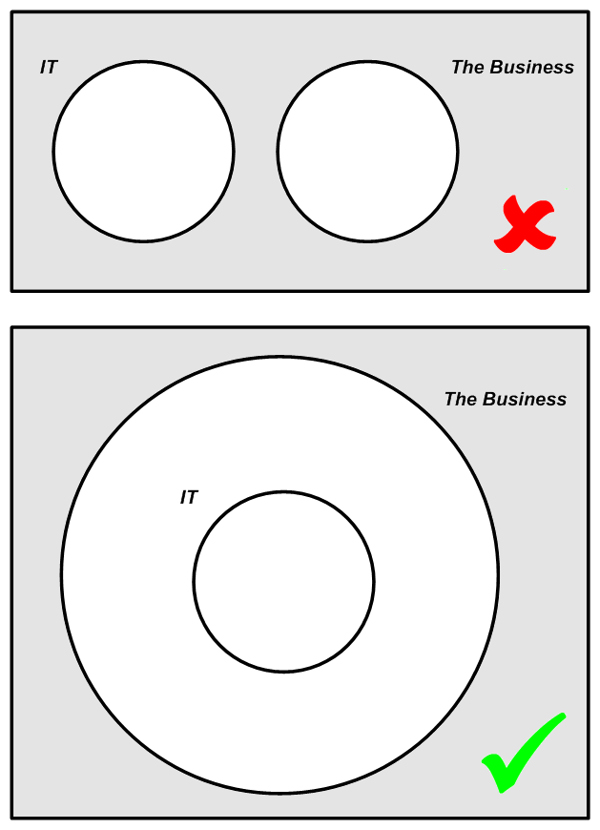
My view on how IT and The Business should be aligned

As regular readers of this column will know, I view this as an unhelpful distinction. My belief is that IT is a type of business department, with specific skills, but engaged in business work and, in this, essentially no different to say the sales department or the strategy department. Looking at the question through this prism, it becomes tautological. However, if we ignore my peccadillo about this issue, we could instead ask whether responsibility for data quality should reside in IT or not-IT (I will manfully resist the temptation to write ~IT or indeed IT’); with such a change, I accept that this is now a reasonable question.
 
 
Answering a modified version of the question

In information technology, telecommunications, and related fields, handshaking is an automated process of negotiation that dynamically sets parameters of a communications channel established between two entities before normal communication over the channel begins. It follows the physical establishment of the channel and precedes normal information transfer.

My basic answer is that both groups will bring specific skills to the party and a partnership approach is the one that is most likely to end in success. There are however some strong arguments for IT playing a pivotal role and my aim is to expand on these in the rest of this article.

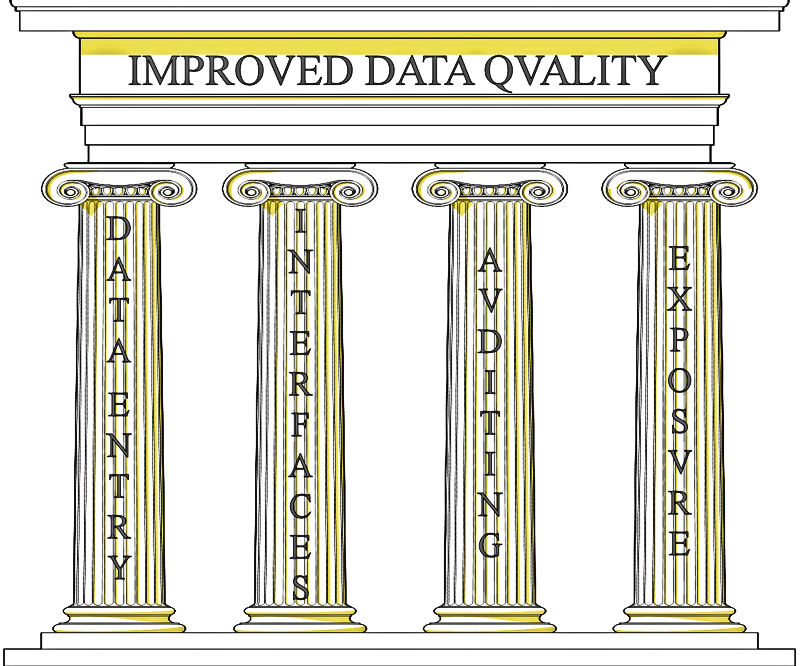
The four pillars of improved data quality

Before I enumerate these, one thing that I think is very important is that data quality is seen as a broad issue that requires a broad approach to remedy it. I laid out what I see as the four pillars of improving data quality in an earlier post: Using BI to drive improvements in data quality. This previous article goes into much more detail about the elements of a successful data quality improvement programme and its title provides a big clue as to what I see as the fourth pillar. More on this later.
 
 
1. The change management angle

Again, as with virtually all IT projects, the aim of a data quality initiative is to drive different behaviours. This means that change management skills are just as important in these types projects as in the business intelligence work that they complement. This is a factor to consider when taking decisions about who takes the lead in looking to improve data quality; who amongst the available resources have established and honed change management skills? The best IT departments will have a number of individuals who fit this bill, if not-IT has them as well, then the organisation is spoilt for choice.
 
 
2. The pan-organisational angle

Elsewhere I have argued that BI adds greatest value when it is all-pervasive. The same observations apply to data quality. If we assume that an organisation has a number of divisions, each with their own systems (due to the nature of their business and maybe also history), but also maybe sharing some enterprise applications. While it would undeniably be beneficial for Division A to get their customer files in order, it would be of even greater value if all divisions did this at the same time and with a consistent purpose. This would allow the dealings of Customer X across all parts of the business to be calculated and analysed. It could also drive cross-selling opportunities in particular market segments.

While it is likely that a number of corporate staff of different sorts will have a very good understanding about the high-level operations of each of the divisions, it is at least probable that only IT staff (specifically those engaged in collating detailed data from each division for BI purposes) will have an in-depth understanding of how transactions and master data are stored in different ways across the enterprise. This knowledge is a by-product of running a best practice BI project and the collateral intellectual property built up can be of substantial business value.
 
 
3. The BI angle

It was this area that formed the backbone of the earlier data quality article that I referenced above. My thesis was that you could turn the good data quality => good BI relationship on its head and use the BI tool to drive data quality improvements. The key here was not to sanitise data problems, but instead to expose them, also leveraging standard BI functionality like drill through to allow people to identify what was causing an issue.

One of the most pernicious data quality issues is of the valid, but wrong entry. For example a transaction is allocated a category code of X, which is valid, but the business event demands the value Y. Sometimes it is possible to guard against this eventuality by business rules, e.g. Product A can only be sold by Business Unit W, but this will not be possible for all such data. A variant of this issue is data being entered in the wrong field. Having spent a while in the Insurance industry, it was not atypical for a policy number to be entered as a claim value for example. Sometimes there is no easy systematic way to detect this type of occurrence, but exposing issues in a well-designed BI system is one way of noticing odd figures and then – crucially – being able to determine what is causing them.
 
 
4. The IT character angle

I was searching round for a way to put this nicely and then realised that Jim Harris had done the job for me in naming his excellent Obsessive-Compulsive Data Quality blog (OCDQ Blog). I’m an IT person, I may have general management experience and a reasonable understanding of many parts of business, but I remain essentially an IT person. Before that, I was a Mathematician. People in both of those lines of work tend to have a certain reputation; to put it positively, the ability to focus extremely hard on something for long periods is a common characteristic.

  Aside: for the avoidance of doubt, as I pointed out in Pigeonholing – A tragedy, the fact that someone is good at the details does not necessarily preclude them from also excelling at seeing the big picture – in fact without a grasp on the details the danger of painting a Daliesque big picture is perhaps all too real!  

Improving data quality is one of the areas where this personality trait pays dividends. I’m sure that there are some marketing people out there who have relentless attention to detail and whose middle name is “thoroughness”, however I suspect there are rather less of them than among the ranks of my IT colleagues. While leadership from the pertinent parts of not-IT is very important, a lot of the hard yards are going to be done by IT people; therefore it makes sense if they have a degree of accountability in this area.
 
 
In closing

Much like most business projects, improving data quality is going to require a cross-functional approach to achieve its goals. While you often hear the platitudinous statement that “the business must be responsible for the quality of its own data”, this ostensible truism hides the fact that one of the best ways for not-IT to improve the quality of an organisation’s data is to get IT heavily involved in all aspects of this work.

IT for its part can leverage both its role as one of the supra-business unit departments and its knowledge of how business transactions are recorded and move from one system to another to become an effective champion of data quality.
 

Aphorism of the week

“Just because Jeffrey Archer exists, it doesn’t follow that Joseph Conrad can’t have existed”

Jeffrey Archer Joseph Conrad

Introduction

The context of the above bon mot was – as is often the case – a discussion on LinkedIn.com. I have been rather absent from the LinkedIn.com discussion groups for the same reasons that I have not been blogging and tweeting. In this case, my attention was drawn to the debate by a colleague.

linkedin CIOs.com: Chief Information Officer Network

The particular thread was posted by Andy McKnight and is entitled What’s missing from Business Intelligence? and at the time of writing has attracted nearly 60 responses (you have to be a member of the group to view the discussion). It referred to an article published by EMC2 which has the strap-line How CIOs can Reap the Benefits of BI Technology (note: this is a PDF document). Here is a pertinent quote:

The bad news is that only twenty-seven percent of respondents [to a survey of CIOs carried out by IDG Research] who use a BI solution report being extremely successful or very successful with it. Forty-five percent report being only somewhat successful, while seventeen percent say that they are not very, or not at all successful.

I’m not sure what happened to the other 11% of respondents, maybe they just hung up the ‘phone.
 
 
Blaming the users

"Users are the root of all evil" - anonymous [failed] BI Project Manager

Having stated that “BI has, too often, not lived up to expectations”, the paper goes on to list some reasons why. First on the list is the following:

  • lack of adoption by users

You don’t have to be Einstein to realise that this is the result of a BI project failing, not the cause of it. The equivalent in athletics terms would be to say that you came last in the race because everyone else was faster than you. While obviously true this observation doesn’t help a lot with how to do better next time.

Of course hidden in the comment is the plaintive whine heard emanating from many an unsuccessful project (or indeed product launch), “the problem is the users”. This is arrant nonsense, returning to the start of article if you write a book that is panned by the critics and not bought by the public, then there is at least some chance that the fault lies with you and not them. It is the job of the IT professional to know their users, understand their needs and provide systems that cause delight, not disillusion.

A more interesting observation later on is:

Many BI initiatives falter because the analytics capabilities that are at the core of the system aren’t even used. Many users simply pull data from the warehouse and dump it in a spreadsheet. […] A true BI implementation includes both reporting and analytics. CIOs indicate a much higher success rate with BI when users embrace both.

I think that there is some truth in this. Some of the BI failures I have seen have gone to the bother of building a warehouse only to front it with flat reports that are only marginally better than what they replaced.

In my career I have taken the opposite approach. While many people warn against analysis paralysis, I have deployed OLAP tools to all users, with fixed format reports de-emphasised, or used mostly for external purposes. This does mean that more effort needs to be put into training, but this is necessary anyway if you want your BI system to be an agent of change (and why else would you be building one if this is not the case?). I cover my general approach to driving user adoption in a series of three articles as follows:

This approach was very successful and we achieved user adoption of 92% – i.e. of those people who attended training, 92% remained active users (defined as using the BI system on average for at least two extended periods each week). We actually felt that the OLAP tools we were implementing were pretty intuitive and easy-to-use and so focussed mostly on how to use them in specific business scenarios. Overall we felt that training was 25% technical and 75% business-related.
 
 
Aiming for simplicity

Simplicity - with apologies to whoever thought of the image first

Related to the above point, the EMC2 article also mentions the following reason for failure:

  • limited functionality/hard to use

This seems a little oxymoronic as normally it is depth of functionality that confuses people. I think I would disagree with both parts of this point. Out of the box, most BI tools have rich functionality and a reasonably intuitive to use. In one response to the LinkedIn.com thread I said the following:

I have been successful in getting users […] weaned […] off ad hoc reports, it wasn’t an easy process and required persistence and selling, but this paid off. […] It is illuminating seeing business managers (some of whom still dictate memos for their secretaries to type) “slicing and dicing”, drilling down/through and generally interacting away merrily and stating that if all IT was this easy to use and informative, they might have taken to it earlier.

My view here is that you can make the tool as complicated or a simple as you choose. Going back to my first warehouse project, in our somewhat naive early attempts at prototype cubes, we had all available dimensions and all available measures included. I think our idea is that the users could help us sift out the ones that were most important. Instead this approach caused the negative reactions that the article refers to.

We subsequently adopted a rule of having as few dimensions and measures as possible in a cube, without compromising the business need that the cube was trying to address. The second part of this rule was that every cube had to be focussed on answering business questions in at least one area and at most two.

Rather than having a small number of monolithic cubes, we went with the option of a slightly larger number of significantly clearer and simpler ones. I think that this was a factor in our success in driving business adoption.
 
 
Should the fact that some BI projects fail dissuade you from BI?

I won’t attempt to dissect the rest of the article, the areas that I comment on above are representative. There are some good points and some less good ones – just like any article, including of course my own. Take a look yourself and see whether the findings and recommendations chime with your own experience of success and failure. What I did want to do was to return to the context of the aphorism that starts this post.

The thesis of the original LinkedIn.com post was that because a significant number of organisations had failed to get enormous benefit from BI, BI itself was therefore somehow flawed. I think this is wrong-headed reasoning. If 1,000 people write a book, how many are likely to become acknowledged as great authors? How many are likely to have the lesser accolade of commercial success? The answer in both cases is “not many”. This is because writing well is a very difficult thing to do (I prove this myself with every blog post!). Not everyone who tries it will be successful. BI is also difficult to do well and a major cause of problems is underestimating this difficulty.

Maybe this is too recherché and example, and maybe if the chances of success with BI are as slim as winning the Purlitzer Prize then it is not worth the effort. So I’ll instead I’ll resort to my favourite area of the sporting analogy. Let’s take the same 1,000 people and say that they all take up a new sport – it is mostly immaterial what the sport is, let’s say tennis. How many of them will go on to become proficient in it? By this I don’t mean that they are the next Roger Federer, just that they become competent enough to serve adequately, master the dark arts of the backhand and sustain a few rallies. My feeling is that the stats would look something like those in the EMC2 report.
 
 
Is the prize worth it?

Alfred's gong

Given this, does it mean that some companies are just not cut out for BI and should ignore the area? Well the answer is “it depends”. Going back to tennis, if some one wants to be good, and has the determination to succeed, that is a necessary (though sadly not sufficient) condition. What may drive such a person on is the objective of achieving a goal, or maybe the pleasure of being able to perform at a certain level.

Focussing on business outcomes, I believe that BI can deliver substantial benefits. In fact I have argued elsewhere that BI can have the greatest payback of any IT project. Of course this presupposes that the BI project is done well. If the prize is potentially that great then maybe – like the aspiring tennis player who wants to become better – trying again makes sense. In recent recruitment I have heard frequent mention of organisations that were building their second warehouse as they didn’t get the first one quite right.

However the comparison with tennis breaks down in that business is a team game. If an organisation as a whole has struggled with BI, then this is not a question of simply accepting your genetic limitations. Companies can “evolve” capabilities by hiring people who have been successful in a field. They can also get benefit from targeted consultancy from practitioners who have a track record of success; this can help them to build an internal capability. This is an approach that I took advantage of myself in the initial six months of my first BI project [note: although I often seem to get mistaken for a BI consultant, I am not touting for business here!].

This means that if a company’s BI architecture is currently the equivalent of a Jeffrey Archer novel, it is still possible to transform it into Heart of Darkness. It will not be easy and will take time and effort, but there are people out there who have been successful and can act as guides.

Not the ideal end of a BI journey

In closing I should also mention that, if you take appropriate precautions, it is far from inevitable that the end of a BI journey will be finding your own version of Kurtz!
 

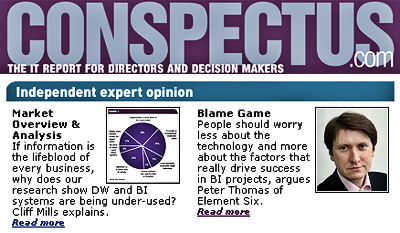
Playing the BI Blame Game – Conspectus.com

An abridged and reworked version of my earlier blog post – A bad workman blames his [Business Intelligence] tools – was published on the National Computer Centre’s Evaluation Centre site last October and also appears in print form in February 2010’s Conspectus magazine (pages 18 – 19) and is also available to subscribers on the Conspectus site. 


Conspectus is a report, published by The National Computing Centre (NCC) Ltd, which keeps UK decision makers abreast of the key issues in the IT marketplace. It is a regular publication available online as a PDF. Each subject is published annually to ensure its continuing relevance and accuracy. Conspectus has a UK registered readership of 22,500.
 

A bad workman blames his [Business Intelligence] tools

Tools
 
Introduction

This is a proverb with quite some history to it. Indeed its lineage has been traced to 13th Century France in: mauvés ovriers ne trovera ja bon hostill (les mauvais ouvriers ne trouveront jamais un bon outil being a rendition in more contemporary French). To me this timeless observation is applicable to present-day Business Intelligence projects. Browsing through on-line forums, it is all too typical to see discussions that start “What is the best BI software available on the market?”, “Who are the leaders in SaaS BI?” and (rather poignantly in my opinion) “Please help me to pick the best technology for a dashboard.” I feel that these are all rather missing the point. Before I explain why, I am going to offer another of my sporting analogies, which I believe is pertinent. Indeed sporting performace is an area to which the aphorism appearing in the title is frequently applied.

If you would like to skip the sporting analogy and cut to the chase, please click here.
 
 
The importance of having the right shoes

Rock climbing is a sport that certainly has its share of machismo; any climbing magazine or web-site will feature images of testosterone-infused youths whose improbable physiques (often displayed to full advantage by the de rigueur absence of any torso-encumbering clothing) propel them to the top of equally improbable climbs.

Given this, many commentators have noted the irony of climbing being conducted by people wearing the equivalent of rubber-covered ballet slippers. The fact that one of the most iconic rock climbing shoes of all time was a fetching shade of pink merely adds piquancy to this observation. Examples of these, the classic FiveTen Anasazi Lace-ups, are featured in the following photo of top British climber, Steve McClure (yes it is the right way up).

The UK's finest sport climer - Steve McClure - sports the Pink'uns

When I started rock climbing, my first pair of shoes were Zephyrs from Spanish climbing firm Boreal. They looked something like this:

The Zephyr by Boreal - $87 - £67

Although it might not be apparent from the above image, these are intended to be comfortable shoes. Ones to be worn by more experienced climbers on long mountain days, or suitable for beginners, like myself at the time, on shorter climbs. Although not exactly cheap, they are not prohibitively expensive and the rubber on the soles is quite hard-wearing as well.

The Zephyrs worked well for me, but inevitably over time you begin to notice the shoes worn by better climbers at the crag or at the wall. You also cannot fail to miss the much sexier shoes worn by professional climbers in films, climbing magazine articles and (no coincidence here) advertisements. These other shoes also cost more (again no coincidence) and promise better performance. When you are looking to get better at something, it is tempting to take any advantage that you can get. Also, perhaps especially when you are looking to break into a new area, there is some pressure to conform, to look like the “in-crowd”, maybe even simply to distance yourself from the beginner that you were only a few months previously.

This is very shallow behaviour of course, but it is also the rock on which the advertising industry is founded. I wanted to get better as a climber, but would have to admit that other, less noble, motives also drove me to wanting to purchase new rock shoes.

The Galileo by FiveTen - $130 - £85

The Galileos shown above are made by US company FiveTen and are representative of the type of shoes that I have worn for most my climbing career. FiveTen shoes have been worn by many top climbers over the years (though there have recently been some quite high-profile defections to start-up brand Evolv, who can never seem to decide whether to append a final ‘e’ to their name or not).

Amongst other things, FiveTens are noted for the stickiness of their rubber, which is provided by an organisation called Stealth Rubber and appears on no other rock climbing shoes. Generally the greater the adhesion between your foot and the rock, the greater the force that you can bring to bear on it to drive yourself upwards. Also it helps to have confidence that your foot has a good chance of staying in place, no matter how glassy the rock may be (and no matter how long the fall may be should this not happen). I have worn FiveTen shoes on all of my hardest climbs (none of which have actually been very hard in the grand scheme of things sad to say).

The Solution by La Sportiva - $155 - £120 (link goes to the Sportiva site)
The Solution by La Sportiva - $155 - £120
(the link loads a Flash page on the Sportiva site)

Nevertheless, with what I admit was rather a sense of guilt, I have recently embarked on a dalliance with another rock shoe manufacturer, La Sportiva of Italy. The Sportiva Solutions which are shown above are both the most expensive rock shoes I have ever owned and the most technical. If NASA made a rock shoe, they would probably not be a million miles away from the Solutions. The radical nature of their design can perhaps best be appreciated in three dimensions and you can do this by clicking on the above image.

The Solutions are very, very good rock shoes. I recently had the opportunity to carry out a before and after comparison on the following climb, A Miller’s Tale:

A Miller's Tale (V4/Font 6b+) - Rubicon Wall, Derbyshire, England
A Miller's Tale (V4/Font 6b+)
Rubicon Wall, Derbyshire, England
© http://77jenn.blogspot.com

My partner, who appears in the photo (incidentally sporting FiveTen shoes), climbed this on her second go. By contrast, I had many fruitless attempts wearing my own pair of FiveTens (that, to be fair to FiveTen, were much less technical than the Galileo’s above and were also probably past the end of their useful life). I frequently found my feet skittering off of the highly polished limestone, which resulted in me rapidly returning to terra firma.

A couple of weeks later, equipped with my shiny new Sportivas, my feet did not slip once. Of course the perfect end to this story would have been to say that I then climbed the problem (for an explanation of why some types of climbs are called problems see my earlier article Perseverance). Sadly, though I made much more progress during my second session, I need to go back to finally tick it off of my list.

So here surely is an example of the tool making a difference, or is it? My partner had climbed A Miller’s Tale quite happily without having the advantage of my new footwear. She is 5’3″ (160cm) compared to my 5’11” (180cm) and the taller you are the easier it is to reach the next hold. Strength is a factor in climbing and I am also stronger in absolute terms than she is. The reason that she succeeded where I failed is simply that she is a better climber than I am. It is an oft-repeated truism in the climbing world that many females have better techniques than men. This, together with the “unfair” advantage of smaller fingers, is the excuse often offered by muscle-bound men who fail to complete a climb that a female then dances her way up. However in my partner’s case, she is also very strong, with her power-to-weight ratio being the key factor. You don’t need to lift massive weights in climbing, just your own body.

So I didn’t really need better rock shoes to prevent my feet from slipping. If I got my body into a better balanced position, then this would have had the same impact. Equally, if my abdominal muscles were stronger, I could have squeezed my feet harder onto the rock, increasing their adhesion (this type of strength, known as core strength for obvious reasons, is crucial to progressing in many types of climbing). What the Solutions did was not to make me a better climber, but to make up for some of my inadequacies. In this way, by allowing me the luxury of not focussing on increasing my strength or improving my technique, you could even argue that they might be bad for my climbing in the long run. I probably protest too much in this last comment, but hopefully the reader can appreciate the point that I am trying to make.

Campus board training

In order to become a better climber I need to do lots of things. I need to strengthen the tendons in my fingers (or at least in nine of them as I ruptured the tendon in my right ring finger playing rugby years ago) so that I can hold on to smaller edges and grasp larger ones for longer. I need to develop my abdominal muscles to hold me onto the rock face better and put more pressure on my feet; particularly when the climb is overhanging. I need to build up muscles in my back, shoulders and arms to be able to move more assuredly between holds that are widely spaced. I must work on my endurance, so that I do not fail climbs because I am worn out by a long series of lower moves. Finally I need to improve my technique: making my footwork more precise; paying more attention to the shape of my body and how this affects my centre of gravity and the purchase I have on holds; getting more comfortable with the tricks of the trade such as heel- and toe-hooks; learning when to be aggressive in my climbing and when to be slow and deliberate; and finally better visualising how my body fits against the rock and the best way to flow economically from one position to the next.

If I can get better in all of these areas, then maybe I will have earned my new technical rock shoes and I will be able to take advantage of the benefits that they offer. Having the right shoes can undoubtedly improve your climbing, but it is no substitute for focussing on the long list in the previous paragraph. There is no real short-cut to becoming a better climber, it just takes an awful lot of work.

A final thing to add in this section is that the Solutions offer advantages to the climber on certain types of climbs. On any overhanging, pocketed rock, they are brilliant. But the way that they shape your foot into a down-turned claw would be a positive disadvantage when trying to pad up a slab. In this second scenario, something like my worn out FiveTens (now sadly consigned to the rubbish tip) would be the tool of choice. It is important to realise that the right tool is often dictated by the task in hand and one that excels in area A may be an also-ran in area B.

Notes:

  1. Lest it be thought that the above manufacturers play only in narrow niches, I should explain that each of Boreal, FiveTen and La Sportiva produce a wide range of rock shoes catering to virtuially every type of climber from the neophyte to the world’s best.
  2. If you think that the pound dollar rates are rather strange in the above exhibits, then a few things are at play. Some are genuine differences, but others are because they are historical rates. for example, I struggled to find a US web-site that still sells Boreal Zephyrs.
  3. If you are interested in finding out more about my adventures in rock climbing, then take a look at my partner’s blog.


The role of technology in Business Intelligence

I hope that I have established that at least in the world of rock climbing, the technology that you have at your disposal is only one of many factors necessary for success; indeed it is some way from being the most important factor.

Having really poor, or worn out, rock shoes can dent your confidence and even get you into bad habits (such as not using your feet enough). Having really good rock shoes can bring some incremental benefits, but these are not as great as those to be gained by training and experience. Most of the technologically-related benefits will be realised by having reasonably good and reasonably new shoes.

While the level of a professional rock climber’s performance will be undoubtedly be improved by using the best equipment available, a bad climber with $150 rock shoes will still be a bad climber (note this is not intended to be a self-referential comment).

Requirements - Data Analysis - Information - Manage Change

Returning to another of my passions, Business Intelligence, I see some pertinent parallels. In a series of previous articles (including BI implementations are like icebergs, “All that glisters is not gold” – some thoughts on dashboards and Short-term “Trouble for Big Business Intelligence Vendors” may lead to longer-term advantage) , I have laid out my framework for BI success and explained why I feel that technology is not the most important part of a BI programme.

My recommended approach is based on four pillars:

  1. Determine what information is necessary to drive key business decisions.
  2. Understand the various data sources that are available and how they relate to each other.
  3. Transform the data to meet the information needs.
  4. Manage the embedding of BI in the corporate culture.

Obviously good BI technology has a role to play across all of these areas, but it is not the primary concern in any of them. Let us consider what is often one of the most difficult areas to get right, embedding BI in an organisation’s DNA. What is the role of the BI tool here?

Well if you want people to actually use the BI system, it helps if the way that the BI technology operates is not a hindrance to this. Ideally the ease-of-use and intuitiveness of the BI technology deployed should be a plus point for you. However, if you have the ultimate in BI technology, but your BI system does not highlight areas that business people are interested in, does not provide information that influences actual decision-making, or contains numbers that are inaccurate, out-of-date, or unreconciled, then it will not be used. I put this a little more succinctly in a recent article: Using multiple business intelligence tools in an implementation – Part II (an inspired title I realise), which I finished by saying:

If your systems do not have credibility with your users, then all is already lost and no amount of flashy functionality will save you.

Similar points can be made about all of the other pillars. Great BI technology should be the icing on your BI cake, not one of the main ingredients.
 
 
The historical perspective

What Car?

Ajay Ohri from the DecisionStats web-site recently interviewed me in some depth about a range of issues. He specifically asked me about what differentiated the various BI tools and I reproduce my reply here:

The really important question in BI is not which tool is best, but how to make BI projects successful. While many an unsuccessful BI manager may blame the tool or its vendor, this is not where the real issues lie. I firmly believe that successful BI rests on four mutually reinforcing pillars: understand the questions the business needs to answer, understand the data available, transform the data to meet the business needs and embed the use of BI in the organisation’s culture. If you get these things right then you can be successful with almost any of the excellent BI tools available in the marketplace. If you get any one of them wrong, then using the paragon of BI tools is not going to offer you salvation.

I think about BI tools in the same way as I do the car market. Not so many years ago there were major differences between manufacturers. The Japanese offered ultimate reliability, but maybe didn’t often engage the spirit. The Germans prided themselves on engineering excellence, slanted either in the direction of performance or luxury, but were not quite as dependable as the Japanese. The Italians offered out-and-out romance and theatre, with mechanical integrity an afterthought. The French seemed to think that bizarrely shaped cars with wheels as thin as dinner plates were the way forward, but at least they were distinctive. The Swedes majored on a mixture of safety and aerospace cachet, but sometimes struggled to shift their image of being boring. The Americans were still in the middle of their love affair with the large and the rugged, at the expense of convenience and value-for-money. Stereotypically, my fellow-countrymen majored on agricultural charm, or wooden-panelled nostalgia, but struggled with the demands of electronics.

Nowadays, the quality and reliability of cars are much closer to each other. Most manufacturers have products with similar features and performance and economy ratings. If we take financial issues to one side, differences are more likely to related to design, or how people perceive a brand. Today the quality of a Ford is not far behind that of a Toyota. The styling of a Honda can be as dramatic as an Alfa Romeo. Lexus and Audi are playing in areas previously the preserve of BMW and Mercedes and so on. To me this is also where the market for BI tools is at present. It is relatively mature and the differences between product sets are less than before.

Of course this doesn’t mean that the BI field will not be shaken up by some new technology or approach (in-memory BI or SaaS come to mind). This would be the equivalent of the impact that the first hybrid cars had on the auto market. However, from the point of view of implementations, most BI tools will do at least an adequate job and picking one should not be your primary concern in a BI project.

If you are interested, you can read the full interview here.
 
 
The current reality

IBM to acquire SPSS

As my comments to Ajay suggest, maybe in past times there were greater differences between BI vendors and the tools that they supplied. One benefit of the massive consolidation that has occurred in recent years is that the five biggest players: IBM/Cognos, Oracle/Hyperion, SAP/BusinessObjects, Microsoft and (the as yet still independent) SAS all have product portfolios that are both wide and deep. If there is something that you want your BI tool to do, it is likely that any of these organisations can provide you with the software; assuming that your wallet allows it. Both the functionality and scope of offerings from smaller vendors operating in the BI arena have also increased greatly in recent times. Finding a technology that fits your specific needs for functionality, ease-of-use, scalability and reliability should not be a problem.

This general landscape is one against which it is interesting to view the recent acquisition of business analytics firm SPSS by IBM. According to Reuters, IBM’s motivations are as follows:

IBM plans to buy business analytics company SPSS Inc for $1.2 billion in cash to better compete with Oracle Corp and SAP AG in the growing field of business intelligence

Full story here.

As an aside, should both Microsoft and SAS be worried that they are omitted from this list?

Whatever the corporate logic for IBM, to me this is simply more evidence that BI technology is becoming a utility (it should however be noted that this is not the same as BI itself becoming a utility). I believe that this trend will lead to a greater focus on the use of BI technology as part of broad-based BI programmes that drive business value. Though BI has the potential of releasing massive benefits for organisations, the track record has been somewhat patchy. Hopefully as people start to worry less about BI technology and more about the factors that really drive success in BI programmes, this will begin to change.

A precursor to Business Intelligence

As with any technical innovation over the centuries, it is only when the technology itself becomes invisible that the real benefits flow.
 

Especially for all Business Analytics professionals out there

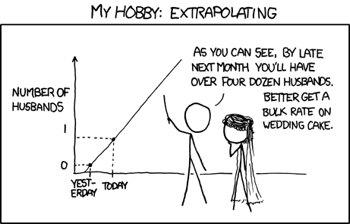
Last week I was being interviewed by a journalist about Business Analytics amongst other things. I found myself speaking about the perils faced in extrapolation that are significantly less scary when merely interpolating.

Serendipity had led to the following cartoon appearing on the web-site of that doyen of scientific humour Randall Munroe, namely xkcd.com.

By the third trimester, there will be hundreds of babies inside you.
A lesson for us all - © xkcd.com

I’m sure this drawing must have appeared on some other BI blogs, but what the hell, it merits posting again in my opinion.
 

Is the time ripe for appointing a Chief Business Intelligence Officer?

linkedin Business Intelligence Business Intelligence

Once more I have decided to pen this article based on a question that was raised on LinkedIn.com. The group in question on this occasion was Business Intelligence and the thread was entitled Is it time that the CBIO (Chief Business Intelligence Officer) position and organization become commonplace in today’s corporate structure? This was posted by John Thielman.

Standard note: You need to be a member of both LinkedIn.com and the group mentioned to view the discussions.
 
 
The case for a CBIO

The Office of the CBIO

I won’t republish all of John’s initial post, but for those who cannot access the thread these are the essential points that he raised:

  1. There is an ever-increasing need for more and better information in organisations
  2. Increasingly Business Intelligence is seen as a major source of competitive advantage
  3. A CBIO would bring focus and (more importantly) accountability to this area
  4. The CBIO should report directly to the CEO, with strong relations with the rest of the executive team
  5. The CBIO’s team would be a hybrid business / technical one (as I strongly believe the best BI teams should be)
  6. This team should also be at the forefront of driving change, based on the metrics that it generates

Now obviously creating a senior role with a portfolio spanning BI and change is going to be music that falls sweetly on my ears. I did however attempt to be objective in my response, which I reproduce in full below:

As someone who is (primarily) a BI professional, then of course my response could be viewed as entirely self-serving. Nevertheless, I’ll offer my thoughts.

In the BI programmes that I have run, I have had reporting lines into people such as the CIO, CFO or sometimes a combined IT / Operations lead. However (and I think that this is a big however), I have always had programme accountability to the CEO and have always had the entire senior leadership team (business and service departments) as my stakeholders. Generally my direction has come more from these dotted lines than from the solid ones – as you would hope would be the case in any customer-centric IT area.

I have run lots of different IT projects over the years. Things such as: building accounting, purchasing and sales systems; configuring and implementing ERP systems; building front-end systems for underwriters, marketing and executive teams; and so on. Given this background, there is definitely something about BI that makes it different.

Any IT system must be aligned to its users’ needs, that much is obvious. However with BI it goes a long way beyond alignment. In a very real sense, BI systems need to be the business. They are not there to facilitate business transactions, they are there to monitor the heartbeat of the organisation, to help it navigate the best way forward, to get early warning of problems, to check the efficacy of strategies and provide key input to developing them.

In short a good BI system should be focussed on precisely the things that the senior leadership team is focussed on, and in particular what the CEO is focussed on. In order to achieve this you need to understand what makes the business tick and you need to move very close to it. This proximity, coupled with the fact that good BI should drip business value means that I have often felt closer to the overall business leadership team than the IT team.

Please don’t misunderstand my point here. I have been an IT person for 20 years and I am not saying that BI should not be fully integrated with the overall IT strategy – indeed in my book it should be central to it as a major function of all IT systems is to gather information (as well as to support transactions and facilitate interactions with customers). However, there is something of a sense in which BI straddles the IT and business arenas (arenas that I have long argued should be much less distinct from each other than they are in many organisations).

The potentially massive impact of BI, the fact that it speaks the language of business leaders, the need for it to be aligned with driving cultural change and that the fact that the skills required for success in BI are slightly different for those necessary in normal IT projects all argue that something like a CBIO position is maybe not such a bad idea.

Indeed I have begun to see quite a few BI roles that are part of change directorates, or the office of the CEO or CFO. There are also some stand-alone BI roles out there, reporting directing to the board. Clearly there will always be a strong interaction with IT, but perhaps you have detected an emerging trend.

I suppose a shorter version of the above would run something like: my de facto reporting line in BI programmes has always been into the CEO and senior management team, so why not recognise this by making it a de jura reporting line.

BI is a weird combination of being both a specialist and generalist area. Generalist in needing to play a major role in running all aspects of the business, specialist in the techniques and technologies that are key to achieving this.
 
 
Over to the jury

Maybe the idea of a CBIO is one whose time has come. I would be interested in people’s views on this.


Accuracy

Micropipette

As might be inferred from my last post, certain sporting matters have been on my mind of late. However, as is becoming rather a theme on this blog, these have also generated some business-related thoughts.
 
 
Introduction

On Friday evening, the Australian cricket team finished the second day of the second Test Match on a score of 152 runs for the loss of 8 (out of 10) first innings wickets. This was still 269 runs behind the England team‘s total of 425.

In scanning what I realise must have been a hastily assembled end-of-day report on the web-site of one of the UK’s leading quality newspapers, a couple are glaring errors stood out. First, the Australian number 4 batsman Michael Hussey was described as having “played-on” to a delivery from England’s shy-and-retiring Andrew Flintoff. Second, the journalist wrote that Australia’s number six batsman, Marcus North, had been “clean-bowled” by James Anderson.

I appreciate that not all readers of this blog will be cricket aficionados and also that the mysteries of this most complex of games are unlikely to be made plain by a few brief words from me. However, “played on” means that the ball has hit the batsman’s bat and deflected to break his wicket (or her wicket – as I feel I should mention as a staunch supporter of the all-conquering England Women’s team, a group that I ended up meeting at a motorway service station just recently).

By contrast, “clean-bowled” means that the ball broke the batsman’s wicket without hitting anything else. If you are interested in learning more about the arcane rules of cricket (and let’s face it, how could you not be interested) then I suggest taking a quick look here. The reason for me bothering to go into this level of detail is that, having watched the two dismissals live myself, I immediately thought that the journalist was wrong in both cases.

It may be argued that the camera sometimes lies, but the cricinfo.com caption (whence these images are drawn) hardly ever does. The following two photographs show what actually happened:

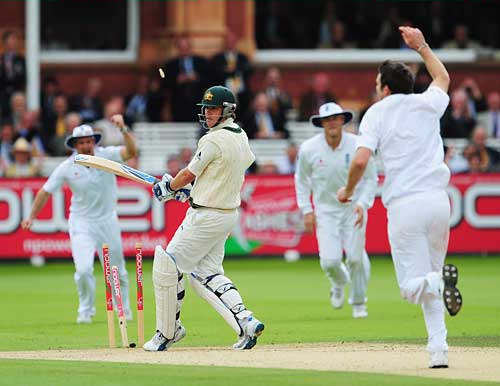
Michael Hussey leaves one and is bowled, England v Australia, 2nd Test, Lord's, 2nd day, July 17, 2009
Marcus North drags James Anderson into his stumps, England v Australia, 2nd Test, Lord's, 2nd day, July 17, 2009

As hopefully many readers will be able to ascertain, Hussey raised his bat aloft, a defensive technique employed to avoid edging the ball to surrounding fielders, but misjudged its direction. It would be hard to “play on” from a position such as he adopted. The ball arced in towards him and clipped the top of his wicket. So, in fact he was the one who was “clean-bowled”; a dismissal that was qualified by him having not attempted to play a stroke.

North on the other hand had been at the wicket for some time and had already faced 13 balls without scoring. Perhaps in frustration at this, he played an overly-ambitious attacking shot (one not a million miles from a baseball swing), the ball hit the under-edge of his horizontal bat and deflected down into his wicket. So it was North, not Hussey, who “played on” on this occasion.

So, aside from saying that Hussey had been adjudged out “handled the ball” and North dismissed “obstructed the field” (two of the ten ways in which a batsman’s innings can end – see here for a full explanation), the journalist in question could not have been more wrong.

As I said, the piece was no doubt composed quickly in order to “go to press” shortly after play had stopped for the day. Maybe these are minor slips, but surely the core competency of a sports journalist is to record what happened accurately. If they can bring insights and colour to their writing, so much the better, but at a minimum they should be able to provide a correct description of events.

Everyone makes mistakes. Most of my blog articles contain at least one typographical or grammatical error. Some of them may include errors of fact, though I do my best to avoid these. Where I offer my opinions, it is possible that some of these may be erroneous, or that they may not apply in different situations. However, we tend to expect professionals in certain fields to be held to a higher standard.

Auditors

For a molecular biologist, the difference between a 0.20 micro-molar solution and a 0.19 one may be massive. For a team of experimental physicists, unbelievably small quantities may mean the difference between confirming the existence of the Higgs Boson and just some background noise.

In business, it would be unfortunate (to say the least) if auditors overlooked major assets or liabilities. One would expect that law-enforcement agents did not perjure themselves in court. Equally politicians should never dissemble, prevaricate or mislead. OK, maybe I am a little off track with the last one. But surely it is not unreasonable to expect that a cricket journalist should accurately record how a batsman got out.
 
 
Twitter and Truth

twitter.com

I made something of a leap from these sporting events to the more tragic news of Michael Jackson’s recent demise. I recall first “hearing” rumours of this on twitter.com. At this point, no news sites had much to say about the matter. As the evening progressed, the self-styled celebrity gossip site TMZ was the first to announce Jackson’s death. Other news outlets either said “Jackson taken to hospital” or (perhaps hedging their bets) “US web-site reports Jackson dead”.

By this time the twitterverse was experiencing a cosmic storm of tweets about the “fact” of Jackson’s passing. A comparably large number of comments lamented how slow “old media” was to acknowledge this “fact”. Eventually of course the dinosaurs of traditional news and reporting lumbered to the same conclusion as the more agile mammals of Twitter.

In this case social media was proved to be both quick and accurate, so why am I now going to offer a defence of the world’s news organisations? Well I’ll start with a passage from one of my all-time favourite satires, Yes Minister, together with its sequel Yes Prime Minister.

In the following brief excerpt Sir Geoffrey Hastings (the head of MI5, the British domestic intelligence service) is speaking to The Right Honourable James Hacker (the British Prime Minister). Their topic of conversation is the recently revealed news that a senior British Civil Servant had in fact been a Russian spy:

Yes Prime Minister

Hastings: Things might get out. We don’t want any more irresponsible ill-informed press speculation.
Hacker: Even if it’s accurate?
Hastings: Especially if it’s accurate. There is nothing worse than accurate irresponsible ill-informed press speculation.

Yes Prime Minister, Vol. I by J. Lynn and A. Jay

Was the twitter noise about Jackson’s death simply accurate ill-informed speculation? It is difficult to ask this question as, sadly, the tweets (and TMZ) proved to be correct. However, before we garland new media with too many wreaths, it is perhaps salutary to recall that there was a second rumour of a celebrity death circulating in the febrile atmosphere of Twitter on that day. As far as I am aware, Pittsburgh’s finest – Jeff Goldblum – is alive and well as we speak. Rumours of his death (in an accident on a New Zealand movie set) proved to be greatly exaggerated.

The difference between a reputable news outlet and hordes of twitterers is that the former has a reputation to defend. While the average tweep will simply shrug their shoulders at RTing what they later learn is inaccurate information, misrepresenting the facts is a cardinal sin for the best news organisations. Indeed reputation is the main thing that news outlets have going for them. This inevitably includes annoying and time-consuming things such as checking facts and validating sources before you publish.

With due respect to Mr Jackson, an even more tragic set of events also sparked some similar discussions; the aftermath of the Iranian election. The Economist published an interesting artilce comparing old and new media responses to this entitiled: Twitter 1, CNN 0. Their final comments on this area were:

[…]the much-ballyhooed Twitter swiftly degraded into pointlessness. By deluging threads like Iranelection with cries of support for the protesters, Americans and Britons rendered the site almost useless as a source of information—something that Iran’s government had tried and failed to do. Even at its best the site gave a partial, one-sided view of events. Both Twitter and YouTube are hobbled as sources of news by their clumsy search engines.

Much more impressive were the desk-bound bloggers. Nico Pitney of the Huffington Post, Andrew Sullivan of the Atlantic and Robert Mackey of the New York Times waded into a morass of information and pulled out the most useful bits. Their websites turned into a mish-mash of tweets, psephological studies, videos and links to newspaper and television reports. It was not pretty, and some of it turned out to be inaccurate. But it was by far the most comprehensive coverage available in English. The winner of the Iranian protests was neither old media nor new media, but a hybrid of the two.

Aside from the IT person in me noticing the opportunity to increase the value of Twitter via improved text analytics (see my earlier article, Literary calculus?), these types of issues raise concerns in my mind. To balance this slightly negative perspective it is worth noting that both accurate and informed tweets have preceded several business events, notably the recent closure of BI start-up LucidEra.

Also main stream media seem to have swallowed the line that Google has developed its own operating system in Chrome OS (rather than lashing the pre-existing Linux kernel on to its browser); maybe it just makes a better story. Blogs and Twitter were far more incisive in their commentary about this development.

Considering the pros and cons, on balance the author remains something of a doubting Thomas (by name as well as nature) about placing too much reliance on Twitter for news; at least as yet.
 
 
Accuracy an Business Intelligence

A balancing act

Some business thoughts leaked into the final paragraph of the Introduction above, but I am interested more in the concept of accuracy as it pertains to one of my core areas of competence – business intelligence. Here there are different views expressed. Some authorities feel that the most important thing in BI is to be quick with information that is good-enough; the time taken to achieve undue precision being the enemy of crisp decision-making. Others insist that small changes can tip finely-balanced decisions one way or another and so precision is paramount. In a way that is undoubtedly familiar to regular readers, I straddle these two opinions. With my dislike for hard-and-fast recipes for success, I feel that circumstances should generally dictate the approach.

There are of course different types of accuracy. There is that which insists that business information reflects actual business events (often more a case for work in front-end business systems rather than BI). There is also that which dictates that BI systems reconcile to the penny to perhaps less functional, but pre-existing scorecards (e.g. the financial results of an organisation).

A number of things can impact accuracy, including, but not limited to: how data has been entered into systems; how that data is transformed by interfaces; differences between terminology and calculation methods in different data sources; misunderstandings by IT people about the meaning of business data; errors in the extract transform and load logic that builds BI solutions; and sometimes even the decisions about how information is portrayed in BI tools themselves. I cover some of these in my previous piece Using BI to drive improvements in data quality.

However, one thing that I think differentiates enterprise BI from departmental BI (or indeed predictive models or other types of analytics), is a greater emphasis on accuracy. If enterprise BI is to aspire to becoming the single version of the truth for an organisation, then much more emphasis needs to be placed on accuracy. For information that is intended to be the yardstick by which a business is measured, good enough may fall short of the mark. This is particularly the case where a series of good enough solutions are merged together; the whole may be even less than the sum of its parts.

A focus on accuracy in BI also achieves something else. It stresses an aspiration to excellence in the BI team. Such aspirations tend to be positive for groups of people in business, just as they are for sporting teams. Not everyone who dreams of winning an Olympic gold medal will do so, but trying to make such dreams a reality generally leads to improved performance. If the central goal of BI is to improve corporate performance, then raising the bar for the BI team’s own performance is a great place to start and aiming for accuracy is a great way to move forward.


A final thought: England went on to beat Australia by precisely 115 runs in the second Test at Lord’s; the final result coming today at precisely 12:42 pm British Summer Time. The accuracy of England’s bowling was a major factor. Maybe there is something to learn here.