New Industry Commentary section

Over the past few months, I have found myself increasingly commenting on topics within the business intelligence space and also technology industry issues in general. Given this, I thought that maybe it was time to better delineate these posts.

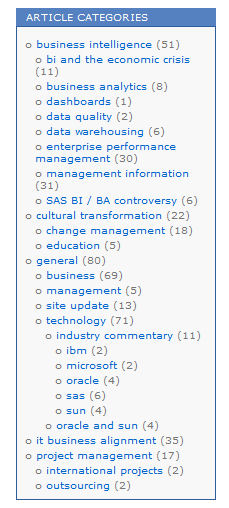
I now have a category for Industry Commentary that appears in the sidebar to the right of the blog, currently this looks something like the following image:

Categories

As you can see, this category is itself split out by vendor, with the list currently consisting of IBM, Microsoft, Oracle, SAS and Sun. Over time, as I write further pieces, this list will expand.

You can also access this type of information from the Industry Commentary section of my Keynote Articles page.
 

The Register’s take on Microsoft and Oracle / Sun

The Register

Today I read an article on The Register by Gavin Clarke. This was about Microsoft’s potential response to Oracle’s proposed acquisition of Sun Microsystems and was entitled (rather cryptically in my opinion) Microsoft’s DNA won’t permit Oracle-Sun deal – Ballmer knows his knitting.

Gavin quotes Steve Ballmer, Microsoft CEO, as saying that his corporation will be “sticking to the knitting” in response to Oracle‘s swoop on Sun. He goes on to cover some aspects of the Oracle / Sun link-up; specifically referring to the idea of “BI in a box” that seems to be gaining credence as one rationale for the deal. In his words, this trend is about:

storing, serving, and understanding information […]: the trend for getting fast access to huge quantities of data on massive networks and making sense of it.

However mention is then made of co-offerings that Oracle and HP have teamed up to make in this space – surely something that would be potentially jeopardised by the Sun acquisition:

Oracle last year announced the HP Oracle Exadata Storage Server and HP Oracle Database Machine, a box from Hewlett-Packard featuring a stack of pre-configured Exadata Storage Servers all running Oracle’s database and its Enterprise Linux.

Returning to Microsoft’s response, the article stresses their modus operandi of focussing on software components and then collaborating with others on hardware. Refernce is also made to Kilimanjaro, Microsoft’s forthcoming SQL Server version that will further emphasise business intelligence capabilities.

In closing Gavin states that:

Acquisition of a hardware company would break the DNA sequence and fundamentally change Microsoft in the way that owning Sun’s hardware business will change Oracle.

It’s tempting to note that DNA is broken (and then recombined) millions of times by RNA Polymerase, that is after all how proteins are synthesised in cells; one characteristic of Microsoft’s success (notwithstanding its recent announcement of its first ever dip in sales) has been a willingness to reinvent parts of its business (else where did the XBox come from), while relying on a steady income stream from others. When it comes to the idea of Microsoft acquiring a major hardware vendor, I agree it seems far-fetched at present, but never say never.


The Register is the one of the world’s biggest online tech publications and is headquartered in London and San Francisco. It has more than five million unique users worldwide. The US and the UK account for more than 1.5 million readers each a month.Most Register readers are IT professionals – software engineers, database administrators, sysadmins, networking managers and so on, all the way up to CIOs. The Register covers the issues they face at work every day – in software, hardware, networking and IT security. The Register is also known for its “off-duty” articles, on science, tech culture, and cult columnists such as BOFH and Verity Stob, which reflect our readers’ many personal interests.
 

My thoughts on Oracle / Sun quoted by Computerworld UK and computing.co.uk

Computerworld UK

I was recently contacted by the UK arm of Computerworld asking whether they could quote from my thoughts on Oracle’s proposed acquisition of Sun Microsystems. I was delighted to accept and the resulting article has now been publsihed: Oracle’s Sun merger raises questions over MySQL, antitrust (my comments are on page 2).

computing.co.uk

Also, earlier my initial reaction to the news was also featured in Computing.co.uk coverage. I have had a long relationship with Computing and VNUNet in general. Other Computing articles referencing my work and opinions may be viewed on the Press Case Studies and Interviews page of the Public Presence section of this site.

This Public Presence section also features Vendor Case Studies, Videos (including one with Computing and Accountancy Age) and details of Seminars at which I have presented.


Computerworld, the world’s most successful media brand for IT managers, was originally launched in the US in 1969. Since then it has earned a world-class reputation by maintaining a sharp focus on IT management. Today there are 57 editions of Computerworld around the globe serving a combined audience of over 14 million IT professionals.Computerworld and Computerworld.com and the respective logos are trademarks of International Data Group Inc.


Computing and Computing.co.uk are published in the UK by Incisive Media and provide insight for IT leaders. Computing editor Bryan Glick tweets at http://twitter.com/bryanglick.


Combinatorics

The smallest bridgeless cubic graph with no three-edge colouring

Some of the furore following on from the announcement of the proposed acquisition of Sun Microsystems by Oracle appears to have died down today. However, taking a look round the blogosphere and various on-line discussion forums1, there does not seem to be much of a consensus about Oracle’s motivations, or future plans for Sun. There are a number of moving parts to this:

  1. Sun’s hardware platforms
  2. Solaris
  3. Java
  4. MySQL
  5. OpenOffice.org

One area that people seem agreed upon is the importance of Java to Oracle’s application strategy, so it makes sense – as a defensive move if nothing else – for them to seek to prevent influence over its future direction falling into the hands of a competitor (which in turn raises the question of when exactly Oracle and Sun started talking and how much overlap there was with the IBM negotiations).

The future of MySQL seems less clear. Some commentators feel that Oracle will support it and allow it to continue to thrive as one of their products. At the other extreme, I have seen suggestions that it will be killed off. Of course as an open source database, this might be easier said than done. There seems to have been a steady trickle of MySQL people out of Sun, pre-acquisition and I would have thought that there is enough expertise and ownership outside of Oracle/Sun for MySQL to have some sort of future regardless of Oracle’s strategy for it.

A bit of a dark horse is OpenOffice.org. A lot of commentary has focused on Oracle positioning themselves to compete with IBM via the acquisition. Perhaps OpenOffice.org offers Larry Ellison another chance to cross swords with his old adversaries at Microsoft.

Moving from software to operating systems, Sun’s Solaris has probably suffered more than most from the rise of Linux, but there have been rumours about Solaris offering Oracle a better route to the current technology Nirvana of cloud computing. Whether this is really the case, I’ll leave to more technically competent authorities to discuss.

But beneath Solaris beats the SPARC chips and other components of Sun’s hardware. Is Oracle’s real aim to offer a complete solution: ERP, CRM, BI and DW in a box? Sun’s hardware has not exactly been flying off the shelf in recent months, but perhaps the sales team at Oracle have other ideas. Maybe their feeling is that all that Sun’s boxes need is to be part of a more alluring overall package. Leveraging Sun’s hardware and operating system is what many people assume is behind Oracle’s strategy. This is certainly the path that would lead to challenging IBM as a company that can meet many of an organisation’s needs as a one-stop-shop.

However, this segues into another observation. If Oracle really has IBM in its sights, then it lacks one crucial piece of ammunition, a global services organisation; the sort of outfit that IBM acquired from the hiving off of PwC’s consulting arm. Maybe now is a good time to but stock in CSC?

But to return to some of the points I made earlier, there is a further possibility. Perhaps Oracle don’t want to move into the fiercely competitive and low-margin arena of hardware sales after all. Perhaps it was Sun’s software assets that were the real goal. Does Oracle really want to position itself as a hardware vendor, no doubt poisoning strong relationships with people such as HP in the process? Maybe not. If this is indeed the case then maybe there will be a spin-off of Sun’s hardware assets, or indeed a sale to someone like HP – assuming that they wanted them.

One of the most intriguing aspects of Oracle’s proposed acquisition of Sun is just how many balls have been thrown up into the air by it. It will be really interesting to see how they fall over the next few months.


1. Some of the blogs that I have read on this subject are acknowledged at the end of my earlier article.

A further main source has been comments on various LinkedIn.com groups, notably: CIO Forum (CIO.com and CIO Magazine), CIOs.com: Chief Information Officer Network and The IT Architect Network. As always, membership of LinkedIn.com and the group is required to view these.

Finally, you can sometimes glean a lot from 140 characters, so various comments on Twitter have also been influential.


Mergers and value

and they all lived happily ever after?

Today’s big news is of course that Oracle and Sun Microsystems “have entered into a definitive agreement under which Oracle will acquire Sun common stock for $9.50 per share in cash.”

As Sun’s press release goes on to say, “the transaction is valued at approximately $7.4 billion”. At the time of writing, Sun’s stock was up nearly 36% and Oracle‘s was down just over 1%. The price Oracle is paying represents a 42% premium over Sun’s closing stock price on Friday – that’s a big premium.

What is interesting is that the previous mooted IBM / Sun deal appears to have foundered at least partly on issues of price (though potential antitrust issues were also a concern). IBM was rumoured to have offered a price identical to what Oracle will now be paying. So what, taking Larry Ellison’s deep pockets to one side, was the difference?

Well while there seemed to be some synergies for IBM in the earlier deal (a big say in the future of Java obviously being one that would have attracted both suitors), the acquisition of Sun is unarguably a much more transformational event for Oracle. Despite Sun’s recent problems in shifting big iron (funny how UNIX platforms are now viewed that way isn’t it?), Oracle post-acquisition will have a product set ,matched by few companies. In fact it will probably be matched by only one: IBM. So, while buying Sun might have made business sense for IBM, it would not have changed the nature of the organisation overnight. Oracle’s announcement today would appear to have done just that, positioning them as the other big beast in the “buy everything from us” jungle. Whether this deal proves successful for all concerned (and not just Sun’s shareholders) is a question whose answer will probably not be clear for a long time.

A comparisson of Oracle and Sun's positions with key competitors in the Forbes Global 2000

Stepping back from all this IT fervour for a moment, it is perhaps instructive to compare the merger madness that seems to have taken over the sector with trends outside the technology industry. Here the picture is very different. Over the last 10 years the majority of sprawling conglomerates have been split up; previously cherished businesses have been spun off, or sold to competitors. This has all been in homage to the business school orthodoxy of focus and core competencies. Many an internationally renowned name now sells just a fifth of its previous product set, with other assets now owned by those who can presumably generate greater profit from them and who feel that they are more compatible with their own core strategy. Deals where two similar companies have swapped assets and businesses to create two more distinctive entities have been common. While it is always notoriously difficult to assess the impact of such trends, general opinion seems to be that this phenomenon has generated greater value (or at least destroyed less value) than the previous focus on mergers and acquisitions.

So where does this leave IT with its rash of mega mergers over the last couple of years? Well it could of course be argued that IT itself is a single sector (and thus an area of focus and core competency) and that mergers within the technology sector are not the same as say a consumer electronics firm taking over a Hollywood studio (Sony / Colombia TriStar) or old media taking over new (TimeWarner / AOL). But many elements of Sun and Oracle’s businesses are quite different from each other. Ellison must believe that he can run a more diverse stable and still breed winners. The track record of Oracle successfully managing acquisitions is mostly impressive, so he may have a point. Perhaps bucking the trend towards being highly focussed is a masterstroke. The merger may prove to be a Waterloo for the world’s third biggest software and services firm; but whether they are playing the role of Wellingtion or Napoleon remains to be seen.


Continue reading about this area in: Combinatorics.
 
Much of the following was originally conatained in a comment, but I then thought that it was more appropriate to add this to the main article.

Some thoughts on this area from bloggers that I follow:

I will add more as I come across them.

Also here is an interesting graphic from MySQL.com, which (if you believe it) shows the impact of the Sun acquistion on Oracle’s market share:

UPDATE: The above chart reflects: “According to the recent JoinVision study ‘Open Source in the Fast Lane’, IT specialists indicated they deploy MySQL 30% more frequently than Oracle, SQL Server or DB2.” Not quite the same thing as market share.
 

The latest and greatest versus the valuable

A World of Bytes by Curt Monash

This article expands on some comments I made on Curt Monash‘s latest blog posting: Why the basically good choice of Aneesh Chopra for US CTO scares the bejeesus out of me. In this, Curt argues that:

[the new US government CIO and CTO may be] so focused on shiny new technologies that they won’t address some of the devastatingly critical challenges of government IT.

Curt then goes on to list some of the important areas that he is concerned will not recieve enough attention. Although Curt’s piece was directed at a very specific area, I think that it raises some general questions. Here are the comments that I made on his blog:

“As you allude to, one of the main problems that IT faces is its focus on the new and shiny, sometimes to the exclusion of the older, but more worthy. I’m by no means a technology Luddite, progress is to be desired, but there has to be some reason for it; something beyond just being neat.

This is a double-headed monster in my opinion. First IT types like me are often drawn to the new and sexy – maybe that’s why we got into the business in the first place. Second, the flashy – particularly when it makes it to general business publications, can generate a “me too” attitude in senior executives, sometimes deflecting IT attention from less glamorous, but more necessary work.

As with most things in life, a balance between both elements of IT is probably what is most necessary.”

I have touched on this area already a couple of times. It was one of the issues that I identified in Problems associated with the IT cycle, where I said:

“On top of this we can add some attributes of IT staff which, although generally desirable, can have a downside as well. Many IT people want to be involved in the latest and greatest technology – this is not always what is going to add most value to the business.”

Also, much of my article about dashboards relates to this issue, as may be deduced by the title: “All that glisters is not gold” – some thoughts on dashboards. In this I comment:

“[…] echoing my comments on BI tools in general, I think an attractive looking dashboard is really only the icing on the cake. The cake itself has two main other ingredients:

  1. The actual figures that it presents (and how well they have been chosen) and
  2. The Information Architecture that underpins them”

Making what I realise is something of a bold leap here, I think that this fascination with the new and technically cool is one reason that IT managers sometimes feel left out of the inner circle of executives of an organisation. In some people’s minds (sometimes those of influential people) IT is too readily associated with Sci-Fi conventions, comic books and and pocket protectors (with of course my apologies in advance to devotees of each of these). This may seem a trivial point, but such associations sometimes run deep; everyone loves a good stereotype.

Of course there are many business-focussed IT managers out there striving to deliver value for their organisations, to boost sales, or reach new customers, or reduce costs; I have been one of them myself. But these industrious individuals are sometimes still seen through the “geek” prism I have described above. Maybe it is only by focsuing more established technologies, ones that demonstrably add business value, that the profession will be able to throw off this yoke.

Although I am rather fond of using quotations on this blog, it is not typical for me to cite religious texts. However, maybe St. Paul had IT in mind when he wrote:

“When I was a child, I spake as a child, I understood as a child, I thought as a child: but when I became a man, I put away childish things.”

While the IT leads of the US government can be accused of too great a focus on what many might view as childish things, then it seems that we still have some way to go.
 

Synthesis

RNA Polymerase producing mRNA from a double-stranded DNA template

  synthesis /sinthisiss/ n. (pl. syntheses /-seez/) 1 the process of building up separate elements, esp. ideas, into a connected whole, esp. a theory or system. (O.E.D.)  

Yesterday’s post entitled Recipes for success? seems to have generated quite a bit of feedback. In particular I had a couple of DMs from people I know on twitter.com (that’s direct messages for the uninitiated) and some e-mails, each of which asked me why I was so against business books. One person even made the assumption that I was anti-books and anti-learning in general.

I guess I need to go on a course designed to help people to express themselves more clearly. I am a bibliophile and would describe myself as fanatically pro-learning. As I mentioned in a comment on the earlier article, I was employing hyperbole yesterday. I would even go so far as to unequivocally state that some business books occasionally contain a certain amount of mildly valuable information.

Of course, when someone approaches a new area, I would certainly recommend that they start by researching what others have already tried and that they attempt to learn from what has previously worked and what has not. Instead, the nub of my problem is when people never graduate beyond this stage. More specifically, I worry when someone finds a web-article listing “10 steps that, if repeated in the correct sequence, will automatically lead to success” and then uncritically applies this approach to whatever activity they are about to embark on.

Assuming that the activity is something more complicated than assembling Ikea furniture, I think it pays to do two further things: a) cast your net a little wider to gather a range of opinions and approaches, and b) assemble your own approach, based borrowing pieces from different sources and sprinkling this with your own new ideas, or maybe things that have worked for you in the past (even if these were in slightly different areas). My recommendation is thus not to find the methodology or design that most closely matches your requirements, but rather to roll your own, hopefully creating something that is a closer fit.

This act of creating something new – based on research, on leveraging appropriate bits of other people’s ideas, but importantly adding your own perspective and tweaking things to suit your own situation – is what I mean by synthesis.

Of course maybe what you come up with is not a million miles from one of the existing prêt-à-porter approaches, but it may be an improvement for you in your circumstances. Also, even if your new approach proves to be suboptimal, you have acquired something important; experience. Experience will guide you in your next attempt, where you may well do better. As the saying maybe ought to go – you learn more from your own mistakes than other people’s recipes for success.


Addendum

The WordPress theme I use for this blog – Contempt – was written by Michael Heilemann a self-styled “Interface Designer, Web Developer, former Computer Game Developer and Film Lover”. Michael also writes a blog, Binary Bonsai and I felt that his article, George Lucas stole Chewbacca, but it’s OK, summed up (if you can apply the concept of summation to so detailed a piece of writing) a lot of what I am trying to cover in this piece. I’d recommend giving it a read, even if you aren’t a Star Wars fan-boy.
 

Recipes for success?

I should acknowledge that I am indebted to a conversation that I had with John Collins on his blog, Views from the Bridge, for some of the themes I discuss in this article.
 
Recipe for Success?
 
Introduction

Towards the end of a recent article on perseverance I referred to people’s desire to find recipes for success. Here’s what I said:

Sometimes we want to find a magic recipe for success, or – to mix the metaphor – a silver bullet. We want to discover a series of defined steps to take that, if repeated religiously, will guarantee that we get to the desired goal each and every time. That’s why articles entitled “The 5 ways to […]” and “My top tips for […]” are so well-read on the web.

As well as my examples of internet top tips (see any number of articles claiming to tell you how to use twitter successfully to get the idea), this phenomenon is also a major factor behind the enduring popularity of celebrity business books. As far as I can see, these fall into two categories.
 
 
1. The Ex-CEO

This is where the extremely successful and well-known Mr Brown (and sadly it is still mostly Mr, rather than Ms Brown), now retired but previously President and CEO of Big Company Inc., writes (or more likely has some one ghost-write) a memoir explaining the secrets of his success. While the book may dwell on their upbringing, education, role models, or character-forming events in their lives, much of the work will probably focus on them just being much smarter, more risk-taking, or having greater insight than the competition (most likely all of these). Of course there may well be some interesting tit-bits amongst the reams of self-aggrandisement, but it is worth questioning just how applicable these might be to your own situation.

Are the things that Mr Brown ascribes his success to really what led to his glittering career? Are there perhaps other factors that are not captured in the memoir, but which, if absent in another organisation, would render implementing Mr Brown’s explicit recommendations valueless? Did Mr Brown’s greatest achievements actually have a big slice of luck attached to them (stumbling upon a market or a product by accident, a major competitor losing their way, events beyond anyone’s control shaping matters and so on)? Would the things that Big Company Inc. did under Mr Brown’s esteemed leadership actually work in another company, in a different market or country and with a distinctive business culture?

Put it this way, if you work in Financial Services, would copying what worked in Retail be a good idea? Alternatively, if two companies are both in Retail, does it make sense for a less successful company to slavishly adopt the strategy of the market leader – wouldn’t it be more sensible if they tried to develop a different strategy in order to differentiate their brand?

Of course there is always value in learning from the mistakes and successes of others, but surely there is a limit to how useful a business memoir can be in forming a business strategy.
 
 
2. The Academic Expert

Here Professor Green (probably still male), has a long and distinguished career in academia, reading and deconstructing the memoirs of Mr Brown and his peers, identifying common themes between them, doing primary research and constructing recherché models of business strategy development and execution. If there is a new management fad out there, Professor Green is sure to know about it – in fact it may well be based on an article of his that appeared in HBR.

Well there is certainly some value in trying to tease out commonalities between successful companies, but this is probably a lot harder than it might seem. While there may be some recurring themes, maybe many of our champions of business are one offs, successful for reasons other than their business models or strategies. In fact they may well be as unique as the people who lead them. Maybe there is no equivalent of the standard model of quantum mechanics (to say nothing of a deeper grand unified theory) that underpins business success – perhaps the science of business is different from the more reductionist sciences, such as physics. Maybe there isn’t a formula for business success; perhaps it is more like Darwinian natural selection (I’ll come back to this idea later).

Whichever way you look at it, again there is probably a limit to how much insight you can glean from this type of book.
 
 
Other genres

Of course this phenomenon extends into many other areas of human activity. As a youth I can remember only too well poring over cricket manuals in an (ultimately fruitless) attempt to improve my batting or wicket-keeping. My father, at the age of 72, still does the same with golf manuals.

The endless array of cooking books also in the same category and where would we be without the panoply of self-help books such as The Seven Habits of Annoyingly Organised People? All of which goes to show that reliance on recipes for success is a deeply ingrained human trait.
 
 
Recipes for success in IT

Having established that people like turning to both “My top tips for […]” and “Mr Brown’s Glittering Career” (available at all good booksellers) how does this aspect of human nature impinge on one of my main areas of endeavour, IT?

Well it has a major impact in my opinion. In fact it is difficult to think of an area of life more obsessed with frameworks, blue-prints, road-maps, procedures, best practices and methodologies (to say nothing of ontologies and taxonomies). All of these are intended to take the risk out of activities – well at least to provide the people following them with the ability to say “well I did what the methodology told me to do”. Of course IT projects and IT development are very complex things and standards of design, coding and behaviour of systems are of paramount importance; but it still seems that IT people have a more visceral relationship with the above-stated areas than would be dictated solely by ticking the necessary boxes.

Nevertheless, having been personally responsible for instigating a thoroughgoing process of standardisation and quality control in a software house (and thereby obtaining an ISO accreditation), it would be churlish of me to argue that that there is no benefit in rigorously applying methodologies in IT.

When it comes to some aspects of project management and to change management in particular, some of the scepticism that I exhibited about celebrity business books returns. It’s not so much that a methodology or even a list of items to tick is not valuable, but that it cannot be an end in itself. The important thing is the thinking that goes into drawing up what you need to do and how you are going to do it, not the method that you use to record these and monitor progress. Sometimes these crucial ingredients get lost. Indeed there does seem to be an entire class of people who focus just on managing lists, rather than the ideas behind them, or the people actually doing the work.
 
 
The benefits of a Darwinian approach

Charles Darwin

I raised the idea of a Darwinian approach to business strategy earlier in this article. There do seem to be some crossovers with how we observe businesses in operation. We are familiar with the image of companies competing with each other for limited resources (our wallets, mine being very limited at present). We understand the pressure that organisations are under to come up with better, cheaper, more functional and sexier products (that are now carbon neutral and ethically-sourced as well).

The language of business is suffused by jungle analogies. The adaptation of Tennyson’s “Nature, red in tooth and claw” to capitalism being just one of the most well-known examples. The companies that are best at this game survive and thrive, those that are not fail and are forgotten. Companies in more mature markets are even often referred to as dinosaurs or fossils. The idea of never-ending refinement and progress pushing on is an essential part of business.

However, perhaps this evolutionary approach, so evident at the macro-level can also work on a micro-scale. Maybe, rather than relying on the thoughts of Mr Brown or Professor Green, a better approach would be come up with some ideas of our own, test them, discard the bad ones and nurture the less bad ones. In time, with appropriate development and alteration, the less bad may become good and then even great (hang on, I seem to have found my way back to business books with that phrase!).

To me, such an approach is more likely to result in something novel and valuable. Following a recipe for success can only ever be as good as the recipe itself. Thinking for yourself can transcend these limitations and I would argue that the downside is no greater than attempting to ape someone else’s ideas. In both cases the worst that can happen is only extinction.
 
 
Disclaimer – sort of

Of course this article has a degree of self reference. Relying upon your own intellect (hopefully refined and improved by other people’s input) is of course another recipe for success. However I hope it is a less proscriptive one. I recommend giving it a try.


Continue reading about this area in: Synthesis.
 

A note to people who subscribe to this site via e-mail

Oops!

The latest e-mail containing content from the site (specifically My “all-time” most-read 5 articles) seems to have got rather mangled, with the text bunched up to one side.

It looks like a problem with the use of <table>, but I’m not quite sure what the precise issue is as the HTML appears to be well-formed. Hopefully this problem will not recur and, in the meantime, please accept my apologies for the glitch.

Peter


PS it is a bit odd as the article appears fine when syndicated on SmartDataCollective.com here.
 

My “all-time” most-read 5 articles

WordPress.com provides a handy widget that shows the articles (and pages) on this blog that have had the most hits over the last 24-48 hours. This appears as the second box from the top of my sidebar, just beneath the RSS subscription options. However this time-period is a little too short to assess the true popularity of articles. In order to remedy this, I have used WordPress.com’s own tracking stats to produce the following list, which covers the brief life of this site since November 2008.

There is clear water between the top five and the chasing pack. The next most popular article, The Top Business Issues facing CIOs / IT Directors – Results, is 176 hits back on 694. Of course one might assume that an “all-time” list would favour the earliest posts on this site. It is therefore interesting to note that the list instead features a number of more recent pieces and that the only really “old” piece is my first article plagiarising John Gray’s famous book.

I should also note that I have removed Keynote Articles (1,073 hits) from the list as this page aggregates all of my other posts, rather than being an article in its own right.

Of course this is merely a snap-shot of today’s figures and the list is already out of date as I write. I may look to update the figures occasionally, perhaps every three to six months.

1. Measuring the benefits of Business Intelligence 1,161
2. Business is from Mars and IT is from Venus 1,154
3. Trends in Business Intelligence 1,039
4. A review of “The History of Business Intelligence” by Nic Smith 894
5. Business Analytics vs Business Intelligence 880