“Can You Really Manage What You Measure?” by Neil Raden

beyenetwork2

I have to say that BeyeNETWORK is becoming the go to place for intelligent BI insights.

In this recent article, Neil Raden challenges the received wisdom that, if you can measure something, managing it follows as a natural corollary. This is a problem that I have seen in a number of BI implementations. It can be characterised as the Field of Dreams problem, if we build it, they will come!

One way to better align BI provision with the management of an organisation is to make sure that any BI element that you deploy is targeted at answering a specific business question. It is important that answering the question leads to action.

If the reaction to learning that sales in the Philadelphia office are down by 2% is a shrug, then not a lot has been achieved. If instead it is easy to further analyse the drivers behind this (e.g. which part of the sales funnel is suffering from a blockage?, is this a temporary blip, or a trend?, is the phenomenon centred on a specific product, or across the board?, etc.) then we begin to embed the use of information to drive decision-making in the organisation. If this leads to an informed telephone conversation with the Philly branch manager and the creation of an action plan to address the fall-off in sales, then BI is starting to add value. This gets us into the area of Actionable Information that Sarah Burnett writes about.

This is one reason why it is important that business intelligence is considered within a framework of cultural transformation; one of the main themes of this blog.


BeyeNETWORK provides viewers with access to the thought leaders in business intelligence, performance management, business integration, information quality, data warehousing and more.

Neil Raden is an “industry influencer” – followed by technology providers, consultants and even industry analysts. His skill at devising information assets and decision services from mountains of data is the result of thirty years of intensive work. He is the founder of Hired Brains, a provider of consulting and implementation services in business intelligence and analytics to many Global 2000 companies. He began his career as a casualty actuary with AIG in New York before moving into predictive modeling services, software engineering and consulting, with experience in delivering environments for decision making in fields as diverse as health care to nuclear waste management to cosmetics marketing and many others in between. He is the co-author of the book Smart (Enough) Systems and is widely published in magazines and online media. He can be reached at nraden@hiredbrains.com.
 

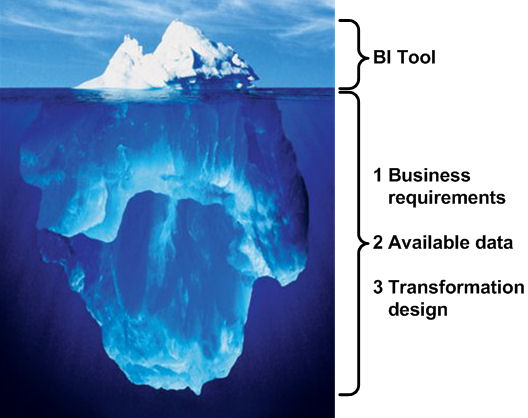
BI implementations are like icebergs

annotated-iceberg-w300

Once again, this article is inspired by a question on one of the many LinkedIn.com groups. As these are only viewable to members, I’ll confine myself to a general link to the site. The subject was what might be the best BI tool for a particular project. I was enormously encouraged by the number of people who said that this was putting the cart before the horse.

My experience is that while having a snazzy BI tool (Cognos PowerPlay being the one I have most often used) in place can win you plaudits, this is only because it is sitting on top of a warehouse that embodies the business information that the organisation needs. The four keys to a successful BI implementation are: –

  1. Forming a deep understanding of the key business questions that need to be answered.
  2. Piecing together the various elements of corporate data that relate to these questions (assuming that they exist) and establishing how they are linked together.
  3. Working out how to transform the data to meet the questions.
  4. Managing the behavioural changes required to ensure that use of BI becomes pervasive.

The above steps (which are typically iterative) form the foundation of a BI initiative that actually adds value. If you have followed them assiduously, then whatever front-end tool you choose, your users will like what they see*. You can argue about the precise figures, but 80-90% of your overall development project will relate to the three steps above and only 10-20% to layering a BI tool on top of your data.

When I presented at the Informatica World 2005 in Washington, DC I tweaked Thomas Alva Edison’s famous aphorism to suggest that: –

Business intelligence is 10% presentation and 90% integration.

Taking my admitted cheesiness to one side, I stand by this observation.


* Before I am accused of being agnostic about different BI tools, I should stress that they are not all the same, some are better than others and it is worth putting in the effort to pick the right one for your organisation. Instead my point is that if you do not have the correct data and business foundations, it is irrelevant how good your BI tool is. Equally, if you do have these underpinnings in place, then most BI tools will at least be adequate.


The Top Business Issues facing CIOs / IT Directors


chase-zander-h78 cio-magazne

I am collaborating with Chase Zander to set up an IT Directors’ Forum for later in the year. Rather than focussing on technology issues, our idea is to focus on the nexus between IT and business, something that I am obviously interested in given my background.

In the IT and change projects I have led, I always prided myself on going an extra mile to understand user requirements. One way in which the group of us organising the seminar is trying to get such user feedback is from LinkedIn.com and specifically the CIO Magazine group (you will need to be a member of LinkedIn.com and the group to view this).

The question that I posed there is as follows: –

I’m looking for business-focussed topics for a CIO / IT Director forum that I am helping to arrange. I would be very interested in what areas are at the top of people’s priority lists.

The forum is for senior IT people, but it is not going to be focussed on technology (there are enough SOA seminars out there already). Instead possible areas would include:

  • Managing the ever increasing pace of business change
  • IT / Business alignment; IT Governance / prioritisation
  • Managing IT in the current economic climate
  • The interplay between IT strategy and shorter-term tactics
  • Increasing the influence of IT at the board level.

Of course some of these overlap. The seminar is meant to be a forum for discussion between delegates, not just presentations. If you were to go to such an event, what topics would you like to discuss? Thank you in advance for your help.

Peter

There has been a lot of very interesting feedback to this question, showing once more how helpful the on-line community can be in addressing issues.


UPDATE: The results of this survey are now available and may be viewed here.
 

Pitching BI in difficult economic circumstances

linkedin EPM Business Intelligence

This brief article simply reprises a response I made to a question on the LinkedIn.com EPM – Business Intelligence group (you will need to be a menber of LinkedIn.com and the group to view the link).

The essence of the question was what key BI-related words would resonate with Executive teams. Here is what I said: –
 

“In an unfavourable economic climate, many companies will be thinking first about survival and defensive measures. Only the very best will consider this environment an opportunity, and the very best will already have established BI that this part of their corporate DNA. Let’s rule these paragons out and think about the rest of the herd.

If you are focussed on survival, then it is probably worth extending the metaphor to think about an animal that is in a daily life-or-death situation. It would want to have as much information about impending threats as possible (what can I see?, what can I hear?, what can I smell?, etc.). It will err on the side of caution assuming that half-glimpsed shapes are potential predators and act accordingly. It will want to understand its current environment (how far am I from a place to hide?, are there other animals around who might also be a target – reducing the risk for me?, what is the terrain like and how fast can I move over it?, are there any blind-spots around me?, etc.).

Translating this into a business arena, maybe you can pitch BI by saying that when every penny is precious, having an in-depth understanding of what you do, what it costs, and what value it generates is crucial. Also understanding trends in your book of business is important; am I starting to lose business, if so, what types and why?, are prices eroding, if so, for what products and in which territories?, where are the pain points?, are there any areas that are still doing well that I could focus on more?, etc.

BI can play a major part in identifying what is going well and what is going badly. It can also track the impact of your current tactics, be these aggressive or defensive. Maybe these are some themes that you could pick up on.

When the seas are very rough, having good navigational equipment becomes essential to avoid running aground. “


My earlier article focusing on whether the economic crisis will be positive for BI may also be of interest in this area.

Since writing this article, I have penned some others in the same area and also found a number of interesting pieces elsewhere on the web. In response to this I have created a WordPress category “BI and the Economic Crisis“, which will hopefully provide a hub for this important area.
 

Mitigating problems with the IT cycle

Introduction
 
This article is the second of two focused on problems arising from the IT cycle. The first piece, which may be viewed here, talked about what can sometimes be the unfortunate aftermath of a successful IT project; the team seeking new work rather than the allocation of resources to the most pressing business needs. As previously explored, the problem is basically one of human nature and therefore addressing it is not straightforward. However here I make some suggestions that could possibly help.
 
It is not possible to totally “solve” the problem of the IT cycle; however there are some steps which can be taken which can reduce its impact. Happily, several of these are also positive for the organisation in their own right.
 
 
The Basic Problem
 
1. Communicate better about projects

A prerequisite to not building up monolithic, inflexible IT departments is awareness of opportunities elsewhere in the organisation. Where people have some perspective of other current and future projects, they may see opportunities for advancing themselves which, in turn, can provide opportunities to mitigate the IT Cycle problem.
 
2. Use similar technologies / development methodologies

The more similar the approach taken in different teams, the easier it will be for people to migrate between them. Obviously using similar development tools is one area; however it is perhaps even more important that teams adopt similar development methodologies. People can adapt much more quickly to doing the same sort of thing in a different development environment than they can adapt to doing something quite different in the same development environment. Having said this, the best case would clearly be to work in a new team in a similar way and with the same tools.

Different tools will always be needed when, for example, development of reporting and transaction processing systems. Even here, it will be helpful to enhancing flexibility if the same databases are used and if the same terminology is adopted for business objects.
 
3. Cross train staff

This is pertinent to development environments where these differ between teams. However, even if all teams share a common development tool-set, cross training can give people an appreciation of systems which they did not develop, both their technical architecture and business purpose. This will stand them in good stead should they be required to work on these systems.

Cross training does not have to be extremely time-consuming and extensive in scope. Much could be learnt by 30 – 60 minute seminars held at lunch time. Such work not only prepares staff for changing teams, finding out more about other systems and projects it may also encourage them to consider other roles within IT.
 
4. Cross train managers

At least of equal importance is making managers aware of what is happening in other teams and how. With the right attitude, such information can be the genesis of a more flexible attitude to staff deployment and career development.
 
5. Make use of temporary secondment

The nature of IT work (or most other kinds of work if it comes to that) is that what was a priority last year may not be one this year, but may become important again in six or twelve months. This volatility argues for some flexibility in resourcing. If department X has a trough in workload which is anticipated to last six months and department Y has a peak which is also anticipated to last six months, then seconding some of department X’s people to department Y may be an answer (this of course assumes that people’s skills are transportable – see the last two points). Of course the peaks and troughs will not always coincide so conveniently. Nevertheless, secondment can be a tool in both increasing the breadth of knowledge of IT staff and in managing fluctuations in demand for people between different departments.
 
6. Make appropriate use of contractors

Particularly when there is a focus on expense, contractors are often seen as a bad thing. They cost a lot, they have little commitment to the company, any intellectual capital which they accumulate during an assignment is not retained by the company when they leave, and so on. However some of these criticisms could also be applied to at least a substantial section of permanent staff. Contractors are expensive because they offer specific skills at short notice and do not require much commitment from the company. Replacing contractors with permanent staff reduces our ability to cope with the IT Cycle (though clearly when managers retain contractors beyond their useful life, this contributes to the IT Cycle problem).
 
 
The Budget Problem
 
7. Build IT budgets from the ground up

Rather than starting with the existing IT staff in their existing departments, a potential approach might be to assess the priorities for each year and then allocate resources accordingly. This might introduce a note of instability to IT, but this could be managed and the process would also better reflect business realities.
 
8. Rank projects by business benefit

If the above is not practicable, it would still be beneficial to rank the business benefits of projects undertaken by different departments. The difference here is that the assessment comes after budget submission, rather than before. However the results might be somewhat similar. If one department’s new projects all ranked lowly, then thought should be given to reallocating some of their staff to higher priorities.
 
9. Have departmental IT budgets vetted in detail by other IT managers

It is difficult and time-consuming for non-IT people to assess the intricacies of projects. However IT professionals are familiar with these. A review of an IT department’s budget by an IT manager who is not part of that department can improve the likelihood of the budget being closely aligned with business value. This need not be an adversarial process if seen as a method by which to enhance the quality of the budget.
 
 
The “Latest and Greatest” Problem
 
10. Identify what new technologies are most applicable to the organisation

As well as exciting IT professionals, the “latest and greatest” technologies may often have solid business benefits. However the state of the art in IT moves forward so fast and in so many simultaneous directions that it would be nigh on impossible to keep apprised of all of them. A better starting point might be to assess what capabilities are the basis of an organisation (e.g. an organisation might decide that the expertise of its staff and the quality of the relationships with its customers are fundamental) and then investigate what technologies best support this. This can lead to a good alignment between employing newer technologies (happy IT people) and focused business benefit (happy profit centre managers).
 
11. Be prepared to let some people go

Ultimately, if people want to be into the latest cool thing then sometimes we will have to let them go a do that elsewhere. It is better to try to build a culture where success rather than use of “cool stuff” is important. IT staff with a strong appreciation of the organisations business and how to support it will ultimately be a more valuable resource than a group of talented technicians.
 
 
A General Suggestion
 
The above problems are all essentially managerial in nature. The final strategy addresses this head on and is perhaps a prerequisite for progress on the other ideas.
 
12. Provide incentives to IT Managers who effectively manage staff numbers

People are after all human and nothing helps quite so much in aligning the goals of the corporation and the individual as targeted incentives. Such incentives can be direct (e.g. bonuses for re-deploying staff) or indirect (e.g. annual objectives including one pertinent to this area or the manager’s attitude to effective use of resource being a criteria for advancement).

If an organisation is suffering from the problems inherent in the IT cycle, then I would recommend this final step as the first one to take.

 

Education and cultural transformation

Back in September of this year, Obis Omni were kind enough to invite me to speak at their Forum 2008, which took place on the outskirts of London and had the theme of “Realising Business Intelligence & Corporate Performance Management Success”.

The strap-line of my presentation was “EMIR – A case study in cultural change”. I have written about some of the themes that I discussed at this seminar elsewhere on this blog (e.g. about the importance of promoting your project in Marketing Change and the strong role to be played by extended business teams in Scaling-up Performance Management). In this article I am going to talk about some aspects of the pivotal area of education.
 
Obis Omni
 
Background on The EMIR Project can be found elsewhere on this site. Briefly it was a business intelligence / data-warehousing project aimed at improving the profitability of the European operations of a multinational insurance organisation.

More importantly, EMIR was always seen as primarily a cultural transformation initiative. The explicit aim of the system was to transform the culture of the organisation into one in which the use of credible, timely and easy-to-use information became as much second nature as picking up the telephone. Of course one initial learning here is that if you are in the business of cultural transformation, it helps an awful lot to tell people that this is the case. Having this element as a public goal was of great assistance.
 
 
Making a good first impression

Having already established a strong extended business team (see the links in the first paragraph above) the project team also realised that there was another important group to win over; our first set of 20 or so training delegates. We felt that if they went back to their offices singing the praises of EMIR then this, supported by the voices of the extended team would give us the necessary momentum to carry us through the first training phase and make a great start to our cultural change work.

It is often said (perhaps sometimes glibly) that as much attention should be paid to the deployment of IT systems as to their development. Many IT managers may not truly believe this in their heart-of-hearts, perhaps an “if I build it, they will come” attitude is sometimes more prevalent. However, with the EMIR project we took the educational aspect extremely seriously.

To start with this we made EMIR training a 3-day event, something that was unprecedented in IT training in the organisation. Second, we insisted that all delegates (the senior managers of the European organisation) travel to London to attend the course*. One reason for the duration was that we wanted to cover a lot of ground, but also we wanted to send a message that this was an important event and merited the devotion of an appropriate amount of time.

A lot of effort and thought went into the presentations that would be made, the different styles of training (some lecture style, more hands-on), the quality of the supporting training materials, the arrangement of the rooms and so on. I assigned one of my senior managers to oversee the training and we also employed an external training consultant to help us design the courses and user guides and achieve the professional look that we were going for.
 
 
The importance of real-life examples

Sometimes training simply explains how to use the technical features of a system, but, again, we were in the business of cultural transformation and so this shifted opur emphasis. Because of this, and also because the system was pretty intuitive and easy to use, in training we focussed on using the system to address real-life business problems. One example of this would be estimating the future profitability of a book of business based on historical trends.

This approach meant that the business value inherent in the system was clearly demonstrated. This was not an IT system, it was a business system. A key first step in changing the behaviour of managers was establishing that there was something in it for them; namely that they could get at information that was previously unavailable, that access to information was quick and easy and that their decision-making would be enhanced. Ticking these boxes through our real-life exercises helped to engage the enthusiasm of delegates and made them more receptive to our other proposals for how to build use of the system into their day-to-day lives.

This business-focussed training was initially carried out by our actuaries, however as demand for training soared in later weeks, I also ran many of these workshops. It was potentially a major challenge for an IT person to be telling insurance underwriters how to run their business, but something that I actually enjoyed very much. While discussing training personnel, we always had at least two people present in the classes as well as the lead trainer. The role of these other people was to check that delegates were keeping up and help anyone who was struggling with an exercise. We did not want anyone to fall so far behind that they became disengaged from the programme.
 
 
Breaking the back of cultural change

Our approach worked and our first twenty delegates became converts to the EMIR cause. Before the first training session, delegates has (understandably) been somewhat reluctant to commit so significant a period of time to the training process. After it an example of the type of message that attendees took back with them to their offices was: –

“This is the best management information I have seen, it represents a big leap forward”

It was not all down-hill from this point and a further article will deal with how we sustained cultural change over the latter stages of this project. However, after this initial success, some things became easier and we had safely negotiated what was probably the largest hurdle in the project.

Given this, I was quite happy to release some project funds for champagne at the end of our first three days, but should stress that the project was brought in under budget nevertheless.


Continue reading about this area in: Sustaining Cultural Change.
 
 
Note: –

* In latter training phases – having succeeded in making our point – training was often carried out in each European country, something I will cover in the future.
 

Problems associated with the IT cycle

Introduction

This article examines an area that is often one of some debate in both IT and business circles; namely issues pertaining to the size of IT teams, the length of IT projects and the ongoing expense associated with both. Here I will attempt to analyse problems associated with the nature of IT work and IT management and to identify the underlying reasons for these. In a forthcoming article I will offer some ideas about how a more flexible approach could lead to more efficient deployment of IT resources and thereby enhanced business value.
 
 
The IT cycle

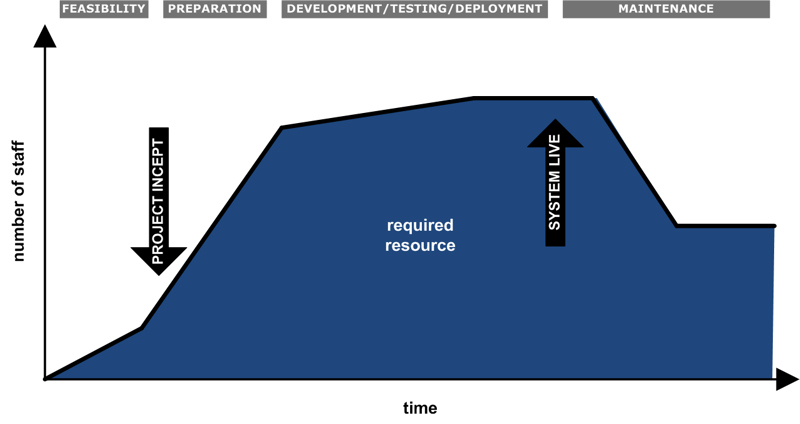
Figure 1 - The IT Cycle

Systems’ development is inherently a cyclical activity. An example of a typical cycle appears in the above diagram. The solid line, bordering the blue area, shows how resource is built up over time in order to develop an application meeting a business need and then requirements for resource fall as the system stabilises and moves into maintenance mode. There are a number of distinct stages: –

1. Feasibility
2. Preparation
3. Development / Testing / Deployment
4. Maintenance
Each of these is stages characterised by, amongst other things, different resource levels (these stages are described in detail in Appendix A – Description of project stages, and the levels of resource required are described in Appendix B – Resources required during different project stages).

The above may be seen as a somewhat idealised – and certainly simplified – view of a project. For example, a project may have more than one phase, the first could roll out basic functionality, the second enhance this with less time-critical (but none-the-less important) functionality, the third could extend use of the system to other business areas or locations. In these cases, the point at which the project first goes live is not the beginning of reducing staff numbers. Instead at this point two teams are needed, the first to support the live, phase one system, the second to continue to build phase two. This would frequently lead to a resource increase at this stage.

Also by the time that the system is deployed, business focus may have changed, leading to substantial requirements for modification or enhancement. This is essentially the same model as phased delivery of fixed requirements, it is just that the planning of the overall project is more fluid.

Nevertheless, such refinements of the model do not change the basic message. At some point (possibly extended by planned or unplanned phased deliveries), the system will meet the majority of the business requirements and new development activity will offer diminishing returns. At this point, the system needs to be put into maintenance mode and less staff will be required. This is the essence of the IT cycle.

I will now consider some problems that the IT cycle can lead to.
 
 
The Basic Problem

Having reviewed some aspects of the IT cycle and explained how this applies to all systems development, regardless of how extended this might be, we can now focus on the basic problem that this model presents.

This basic problem can be seen as one of inertia – the tendency of things to persist in their current state unless impacted by some external force.

Over the first three stages of the IT cycle, focus has been on developing a strategy, building a team to execute it and then realising the vision. Anyone who has been involved in this process will attest to the collective pride and comradeship that develops with the team. A feeling of “us against the world” can take hold, followed by an immense sense of joint achievement when a system is successful. People often also grow through such a process, junior analyst/programmers become senior analyst/programmers. Designers become more experienced. Project managers become battle-hardened. As a result of this, at the beginning of what would be the maintenance phase, the IT organisation is left with a group of people who are creative, successful, focussed on development rather than support and have the mindset of wanting more challenges. Such people have a high value in the market and are more than aware of this.

Therefore, the IT organisation has both a challenge and an opportunity. The successful project has resulted in more experienced and able people being available, but where will their next challenge come from? This situation can be addressed in two ways. The former is harder to achieve and less often practiced, the latter is the path of least resistance and more prevalent than many IT managers would like to admit.

Option A – Assess what the current, pressing business priorities for IT are and devote the best people from the completed project to these.

It is likely that there is more than one area to which they could contribute. Maybe they will be able to take on a more senior position in their next project. This option is not as easy to achieve as it might seem. Consider two projects, X and Y. The former has been very successful but is going into maintenance mode and requires less staff. The latter represents a current business priority. Assuming the goodwill of the managers of both projects, potential obstacles to behaving this was would still include: –

people in Project X have different technical skills to those in Project Y and so cannot simply transfer and start work immediately
people in project X may have a different way of working from those in project Y – this may present cultural difficulties which are disruptive to both new starters and existing staff in Project Y

However, because it is a very positive outcome, I will devote some time to how the obstacles to this option can be negotiated in a later article.

Option B – Try to find more work for the existing project team to do in the same area.

It is a lot simpler to take this approach. People often appreciate continuity more than new challenges. It is generally the case that there will be more work which can be done, the question is rather the value of this work compared to what the same resource could be doing in other areas.

There are some very human factors that can reinforce this approach: –

managerial prestige (or, less kindly, empire building)
rewards and progression being seen as tied to managing bigger and bigger teams
job security of the management of the project moving into maintenance mode
lack of appropriate positions for staff elsewhere in the organisation
the effort involved in building the project team being seen as wasted if it is “broken-up”
the desire not to fire staff, particularly those who have served the company well and just completed a major project successfully
business sponsors wanting to retain “their staff” anticipating further work at some future stage
“rewarding” past work with more work

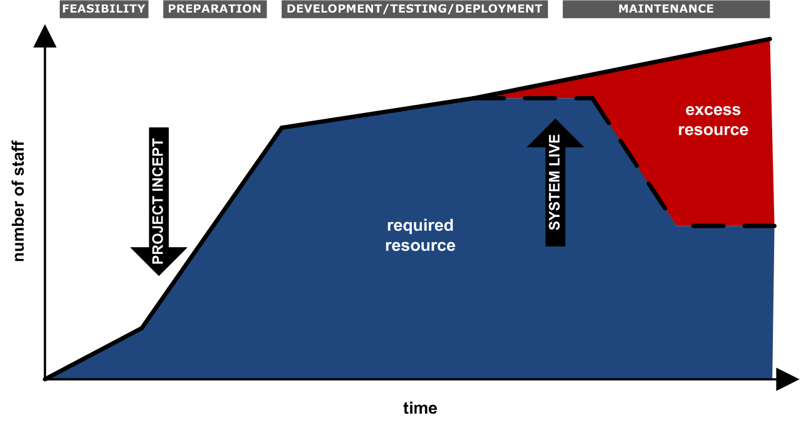
The combination of these factors can modify our resource graph to look more like Figure 2 below.

Figure 2 - The problem with the IT Cycle

Here, when the project has notionally reached the maintenance stage, resource does not reduce and may indeed continue to grow. The red area demonstrates the difference between actual staff numbers and what the IT cycle model would predict. This may be seen as excess resource, or perhaps as a loss in productivity in IT. If, instead, this excess resource can be re-deployed, we have an opportunity to increase the overall effectiveness of the IT organisation.
 
 
The Budget Problem

The normal budget process can exacerbate this phenomenon. Often the manager of an IT department will start with their existing budget plus wage inflation as a base line. Anticipating future cuts, they may increase this by say 20%. What then follows is a turf war with each IT manager trying to hold on to their budget. While there is no incentive for any given manager to take a more flexible approach, such behaviour is rational and will continue. Of course it should be stressed that IT is not the only area to suffer from this type of problem.
 
 
The “Latest and Greatest” Problem

On top of this we can add some attributes of IT staff which, although generally desirable, can have a downside as well. Many IT people want to be involved in the latest and greatest technology – this is not always what is going to add most value to the business. Sometimes, in order to retain the best people, IT management can give in to this trait. At the positive end of the potential results, this can lead to happy staff and greatly enhanced systems. At the negative end are projects to re-write systems in new technology for little reason other than the staff would like to do this and may leave if they do not get the opportunity.

There is no right answer here, what might be seen as indulging IT staff’s whims may actually be the hard-headed, practical thing to do in some circumstances. What is most important is to achieve an appropriate balance between the need to retrain and motivate the best staff and the need to align work to business priorities.
 
 
So there are a number of problems facing IT in this area. However I believe that they are all tractable and I will offer some ideas for addressing each problem in a future article.


Continue reading about this area in: Mitigating problems with the IT cycle.
 

Holistic vs Incremental approaches to BI

There is a strong link here to my Vision vs Pragmatism article. In this I argued that Vision and Pragmatism are both essential for the success of any project, be that related to change, to IT, and certainly when using IT to drive change. Unsurprisingly, similar comments apply to whether a holistic or incremental approach to BI is the superior route. However, in this case, I will come down more firmly on the side of one of the options.
 
 
The benefits of an incremental approach

Of course the secret of the success of many projects is their incremental nature. Incremental deliveries, particularly those early on in a project, enable you to do a number of things, including: –

  1. Proving that business value can be added the work that you are doing
  2. Showing tangible evidence of progress
  3. Demonstrating that the project team is responsive to business priorities
  4. Chopping up funding into more digestible parts
  5. Providing early exposure to change management issues; allowing time to learn from mistakes when still operating at on a smaller scale

Overall incremental work can enhance the credibility of a project team and thereby made it easier to secure senior management support. Such work is indispensable to any project.
 
 
How does the sum of the parts measure up?

However there is a point to be made here in favour of a holistic approach which goes beyond my previous preference for always having an overarching vision. This is something that is specific to business intelligence and relates to the nature of information delivery. In a nutshell the sum of several incremental BI developments may be considerably less than the whole if each is not part of an overall strategy.

BI is about having the information necessary to run the business. However, it is also about how that information is delivered and how internally consistent it is. Often BI projects aim to address a fragmentation of existing reporting systems that leads to confusion amongst users and even a general distrust of figures. It is entirely possible to perpetuate this situation, simply replacing older reporting technology with shiny new ones. Each of these new systems may be easier to use that its predecessor and offer significantly greater access to information, but the fragmented nature of information provision will not have been addressed; it may even have been made worse.
 
 
A single platform

The ideal for a BI solution is to have a single platform which supports all pertinent reporting needs. There will undoubtedly be different segments of this, tailored to different groups of users, but these should use subsets of the same dimensions and measures and the same reporting and analysis tools should be used. Adhering to these precepts means that when users of one part of the system need to employ another part, they are not taking a step into terra incognita, but instead are familiar with their surroundings and get the sense that the same logic pervades all of the system.

On a practical level, this approach minimises costs due to software licenses and simplifies your technical architecture, again keeping a lid on expenditure. Fewer people are also needed to both build and maintain a single, central system than many divergent ones. Just as importantly, a single-platform approach means that training becomes focussed on business issues rather than the functionality of a different reporting suites. My experience suggests that, after an initial investment in thorough training for users, introduction of new reporting capabilities can be very smooth and efficient in such a set-up.

Of course developing good BI takes time and effort. Getting to the eventual ideal state that I have described above will undoubtedly take some time (in my most recent BI project it took five years to fully realise). This means that there is no real alternative to the incremental approach that I described at the beginning. However, taking a more holistic approach ensures that your incremental deliveries are aligned with both each other and overall business needs. It also means that with each incremental release there is a related reduction in fragmentation. This is the difference between slowly unveiling a large, coherent edifice and revealing several separate sculptures one at a time.
 
 
The link with cultural transformation

In particular if an aim of your BI project is to transform how users behave (of course this should be a central aim of any BI project, what else is BI for?), then this is going to be most easily achieved with a holistic approach where each phase builds on the success of the previous ones. In this scenario, each incremental delivery can be seen more as extending the remit of your BI system to a new area, rather than adding on a new module. Phase N+1 always reinforces the messages from Phases 1 to N. Each step reduces fragmentation, increases consistency and further improves decision-making. This is the best way to make sure that your BI efforts exceed the sum of their parts, rather than falling short of them. Such a rigorous approach is also the best way to ensure that you meet your cultural transformation objectives.
 

Actionable Information

sarah-burnett

I was browsing through Sarah Burnett’s blog and came across an article about Actionable Information. I thought that this was making a very strong point about what constitutes good BI and what doesn’t. While BI technologists can become incredibly focussed on the intricacies of warehouse design or complex ETL, it is undeniable that all of this is worthless unless it serves to answer real business questions. You can have a perfect technical information architecture and yet all of your efforts will go to waste if there is not sufficient alignment with what people actually want to report on.

This seems like a really obvious point to make, but during my career I have seen many reporting and analysis systems fail to take it into account and observed their designers consequently scratching their heads over poor usage numbers. Elsewhere I have argued that it is helpful to treat the systems (and the change related to them) like products that have to be marketed professionally. The product analogy works equally well in stating that BI needs to address the requirements of its users, else it will stay on the shelf of the systems’ super market. Sarah makes this point very well in her article and it is one that I will come back to in the future.


Sarah Burnett is a software industry analyst. Her main area of research is Business Intelligence. She am also interested in Public Sector IT and Green IT.
 

Scaling-up Performance Management

This was the title of a presentation that I made at the Butler Group BI Symposium in London during October. In this article I wanted to focus on just one theme that I discussed; namely meeting the management information needs of a variety of business units, each of which spanned a number of different countries across Europe.

The eight European countries impacted by my BI project

This seems like a very obvious thing to say, but if you goal is to meet the management information needs of a wide range of business units across multiple countries, then it helps to work with quite a few of them to figure out what they want, where this overlaps with your project objectives and how to get everything aligned.

In my experience things have always worked best when the project team have recognised this early on. In a recent European-based project, my team initially spent nine months working with a group of 30 business people from ten different departments and eight different countries (of course this process lasted a total of nine months, we did not lock them up in a room for the duration). We called this group our Extended Team. Part of our work with them was gathering requirements – we started with a blank sheet of paper and asked them what metrics they wanted to run their company. We then went through the painstaking work of better defining these ideas, distilling them down into different themes, making mock-up reports and eventually iterative prototypes. At each stage, we met again with the Extended Team and got their further input.

Now while this is a great way of gathering requirements and ensuring that your product will answer real business questions, it is and even better way to create a core group of business people who feel strong ownership of the product and are proud of their association with it. In turn, this helps amazingly with driving cultural change. On returning to their day jobs after a typical two-day meeting, the members of the Extended Team would be very positive about what they were involved in doing and share their enthusiasm with their colleagues. Momentum starts to gather and you begin to create a buzz about the project.

As well as being the people who helped us to make the eventual business intelligence system user-friendly and business-focussed the Extended Team were also our marketing representatives in the regions and helped to build up positive expectations about the system.

We put a lot of thought into the type of person that we wanted on this Extended Team. We wanted people who were leaders, who were open to doing things in new ways, who were comfortable with technology and who took an analytic approach to their work. This group made a major contribution to the success of the project. It would not have been possible to scale-up our solution without their assistance.


Continue reading about this area in: Developing an International BI Strategy.