By way of [very necessary] explanation, this post is a response to an idea started on the blog of Curt Monash (@CurtMonash), doyen of software industry analysts. You can read the full article here. This is intended as an early April Fools celebration.
A summary:
[…] the Rules of the No-Fooling Meme are:
Rule 1: Post on your blog 1 or more surprisingly true things about you,* plus their explanations. I’m starting off with 10, but it’s OK to be a lot less wordy than I’m being. I suggest the following format:
A noteworthy capsule sentence. (Example: “I was not of mortal woman born.”)
A perfectly reasonable explanation. (Example: “I was untimely ripped from my mother’s womb. In modern parlance, she had a C-section.”)
Rule 2: Link back to this post. That explains what you’re doing.
Rule 3: Drop a link to your post into the comment thread. That will let people who check here know that you’ve contributed too.
Rule 4: Ping 1 or more other people encouraging them to join in the meme with posts of their own.
*If you want to relax the “about you” part, that’s fine too.
I won’t be as dramatic as Curt, nor will I drop any names (they have been changed to protect the guilty). I also think that my list is closer to a “things you didn’t know about me” than Curt’s original intention, but hopefully it is in the spirit of his original post. I have relaxed the “about me” part for one fact as well, but claim extenuating circumstances.
My “no-fooling” facts are, in (broadly) reverse chronological order:
I have recently corrected a Physics paper in Science – and please bear in mind that I was a Mathematician not a Physicist; I’m not linking to the paper as the error was Science’s fault not the scientists’ and the lead author was very nice about it.
My partner is shortly going to be working with one of last year’s Nobel Laureates at one of the world’s premier research institues – I’m proud, so sue me!
My partner, my eldest son and I have all attended (or are attending) the same University – though separated by over 20 years.
The same University awarded me 120% in my MSc. Number Theory exam – the irony of this appeals to me to this day; I was taught Number Theory by a Fields Medalist; by way of contrast, I got a gamma minus in second year Applied Mathematics.
Not only did I used to own a fan-site for a computer game character, I co-administered a universal bulletin board (yes I am that old) dedicated to the same character – even more amazingly, there were female members!
As far as I can tell, my code is still part of the core of software that is used rather widely in the UK and elsewhere – though I suspect that a high percentage of it has succumbed to evolutionary pressures.
I have recorded an eagle playing golf – despite not being very good at it and not playing at all now.
I have played cricket against the national teams of both Zimbabwe (in less traumatic times) and the Netherlands – Under 15s and Under 19s respectively; I have also played both with and against an England cricketer and against a West Indies cricketer (who also got me out), but I said that I wasn’t going to name drop.
[Unlike Curt] I only competed in one chess tournament – I came fourth, but only after being threatened with expulsion over an argument to do with whether I had let go of a bishop for a nanosecond; I think I was 11 at the time.
At least allegedly, one of my antecedents was one of the last hangmen in England – I’m not sure how you would go about substantiating this fact as they were meant to be sworn to secrecy; equally I’m not sure that I would want to substantiate it.
And a bonus fact (which could also be seen as oneupmanship vis à vis Curt):
One of the articles that I wrote for the UK climbing press has had substantially more unique views than any of my business-related articles on here (save for the home page itself) – sad, but true, if you don’t believe me, the proof is here.
Persistence can mean a lot of different things, sadly to me it is often the world of databases that comes to mind first. Having linked to my previous article entitled Perseverance earlier today, I won’t bother to do that again, but this is clearly another meaning.
In this case I am going to employ the sense of “continuance of an effect after the cause is removed” and apply it to the stats of this blog. Aside from today’s spurt and a wish of Season’s Greetings and Goodwill to all Readers back in December, I last blogged in anger back on 30th July 2009. Somewhat ironically, the title of this piece was Inspiration as mine subsequently dried up!
The number of monthly readers dropped significantly in August 2009, however, despite this removal of cause, it plateaued at about 3,000; a level it has never dropped below since. Having taken a look at the more detailed statistics (which regulars will be delighted to hear may lead to a revsion of An update of the most read articles on this site to cover the last six months), the readership seems to be pretty evenly spread and not dominated by any one article.
Whether what I am observing is the general persistence inherent in the Internet (where links from one page to another will exist as long as both pages do), or to do with slow-moving algorithms in search engines I do not know. I suppose it could feasibly be related to the enduring appeal of my writing, though this seems a long way removed from the bleeding edge of Occam’s razor.
Some deeper digging may yield further indications (e.g. did I receive more hits from searches, or via other sites as the fallow period of the last six months progressed), but I can’t imagine that these will be statistically significant.
From an experimental perspective, I guess I should have refrained from posting for a bit longer and then calculated the half-life of my writing.
The main reason for my lack of blogging since August last year has been starting a new job. I have been very busy and the new role has many challenges that have occupied a lot of my thinking time, however I am not sure that this has been the only factor at work. Having not written – for public consumption at least – for some time, I suppose I felt that it would be good to mark my blogging “comeback” with a signature article on a topic of interest and importance. Perhaps this led to a slight, unconscious build-up of pressure somewhere in my mind. Several people have been very kind about my work on this site and maybe I felt that I should live up to their encouraging comments.
Several months down the line, I have decided that the best way to kill this particular demon is to simply put fingertip to keyboard and write something. Sadly this is not going to be the signature piece that I had hoped for, but my current case of writer’s block is such that if I don’t write something then my concern about not being able to write another engaging and insightful piece will become a self-fulfilling prophecy.
As ever, maybe there is a learning here for the business world and IT in particular. IT people are, by definition, analytical, logical and have a great attention to detail. This can lead to a desire to create the perfect piece of code via endless polishing of the same 5-line “rock”, or to understand every nuance of a business requirement before beginning to scope out a solution. Without wanting to leap on the agile bandwagon, sometimes a good way to get to a solution is to start to write one. Create something, test whether it works and meets user expectations and adapt it if not. Also consider discarding initial attempts that are wide of the mark, so long as you learn something from them.
Back when I wrote Perseverance, I quoted Beckett’s adage about failing better. This is not a bad way of looking at IT work. Jumping in with no real understanding of an area is a major mistake, to be avoided at all costs, but holding back until you form a perfect understanding (or have a perfect article to write in the context of this piece) is almost as serious a problem. As with most things in life, what is required is some balance, a willingness to tolerate some false steps initially and a desire to make sure that these lead to improvement.
With this thought in mind, and in the hope that my creative flow can hereby be unblocked, I’ll close this short piece and trust that the next one follows on fairly shortly from it.
Inspiration can come from many places. For me it is often via making a connection between two separate areas. I wrote about this phenomenon in my earlier artcile, Synthesis.
A couple of inspiration-related events have led me to pen this piece today and, as a great man once said:
When two separate events occur simultaneously pertaining to the same object of inquiry we must always pay strict attention.
Thing One
The first occurrence was an article on Jeff Shuey’s blog entitled Surely, you must be joking. This borrows from the title of Nobel Laureate Richard P. Feynman‘s book Surely You’re Joking Mr. Feynman (as edited by his friend and co-drummer Ralph Leighton). I have found Feynman to be an inspirational character since I first saw him interviewed in depth on the BBC’s science magazine programme, Horizon. Some footage of this interview appears in the BBC’s archives, and may be viewed here. It is well worth a look.
I happen to have recently referenced Feynman, albeit rather obliquely, in a review of my bogging experiences, New Adventures in Wi-Fi – Track 1: Blogging. I have been delighted to receive some messages from people saying that this article had prompted them to take up blogging themselves. There can surely be no greater compliment paid in social media and I am honoured to receive it.
The idea for Jeff’s article came both from Microsoft featuring Feynman’s work on its Project Tuva site (this doesn’t seem to work for me in Chrome, though it’s fine in IE8 – maybe I’ll keep quiet about this in case the European Commission is listening in) and a subsequent exchange of tweets and links that we shared on twitter.com. Jeff’s handle is @jshuey if you would like to follow him. Also check out Jeff’s article to learn more about how a remarkable human being has influenced both him and Project Tuva.
and Thing Two
The second event relates to the traditional American diner that is round the corner from where I live. I appreciate that I live in London, but nevertheless I do have a traditional American diner round the corner. It is even owned by a Packers fan from Wisconsin. Lauren is one of the people who regularly works there and she has a talent for drawing in chocolate – no you haven’t misread that, she draws in chocolate, specifically on the plate that holds the diner’s very pleasant flourless chocolate cake.
Mermaids have been a favourite theme for Lauren, but more recently she has moved on to more ambitious works. The first was Michael Jackson for obvious reasons. This was followed by Barak Obama. The other day I suggested that, if she was working her way through American icons, then the next obvious person would be Marilyn Monroe. Lauren liked this idea and when I visited this morning to get my customary cup of coffee (skinny cappuccino rather than black and hot sadly) her lastest work greeted me:
I’m really happy that my input has played a small part in two creative acts. This is particularly the case as I am normally acknowledging the inspiration that I have drawn from other people.
This sort of give and take of ideas has of course been happening during the entire course of human history. Clearly, even if I live to be 100, I could never hope to be as inspirational or influential as Richard Feynman. However it is both gratifying and humbling to be able to take part in the cycle of human interaction, no matter how minor my role. Maybe these two small recent examples are further evidence that the pace is increasing.
In my earlier article, Accuracy, I compared the need for precision in cricket reporting to the verity of different types of breaking news on twitter.com and closed by stressing the importance of accuacy in Business Intelligence. It’s generally all in a day’s work for me to make such connections; yesterday’s piece linked rock climbing, the car market, Business Intelligence [again] and IBM’s proposed acquisition of SPSS.
I am going to lay the blame for me continuing to blog about cricket firmly at the door of @JohnFMoore, who made the fatal mistake of encouraging me. However the current article will be rather shorter in duration than my last work in this area.
Aside from John, what has moved me to write today was the news that wunderkind opening bastmen Phillip Hughes has been dropped from the Australian team for the 3rd Test Match against England which starts today in Birmingham, England (inundated pitch allowing).
Hughes is only 20 and has burst onto the international cricketing scene in a matter of months. Before the current tour to England, he had played just three Tests (the name given to five day cricket matches between different countries). However, these were all against South Africa, one of the strongest teams in the world at present. In his six innings (a team generally bats twice in a Test Match) he had made 415 runs at the eye-catching average of 69.16 [number of runs / (number of innings – times not out)]. By way of reference, this is higher than any other player in either of the current Australian and English teams.
Hughes built on these achievements by spending the early part of the season playing for English cricket team Middlesex. For them he scored 574 runs at a stratospheric average of 143.50. England cricket fans were beginning to be very, very worried at this point.
However, as can happen in many sports, some one can make an initial impact and then have their performances return to average or below. This has proved to be the case with Hughes who in three innings in the current Test Match series has scored 36, 4 and 17 for a rather less stellar average of 19.0. More important than these bald figures is the fact that the England bowlers seem to have detected and then exploited a deficiency in Hughes’ technique.
It could be argued that Hughes clearly has immense talent and potential and the Australian selectors have been overly hasty in dropping him after two poor matches. Such things can severely dent a player’s confidence and I hope that he can rebound from this set-back. However for me the real story is not the unfortunate Hughes being dropped but the manner in which it was announced.
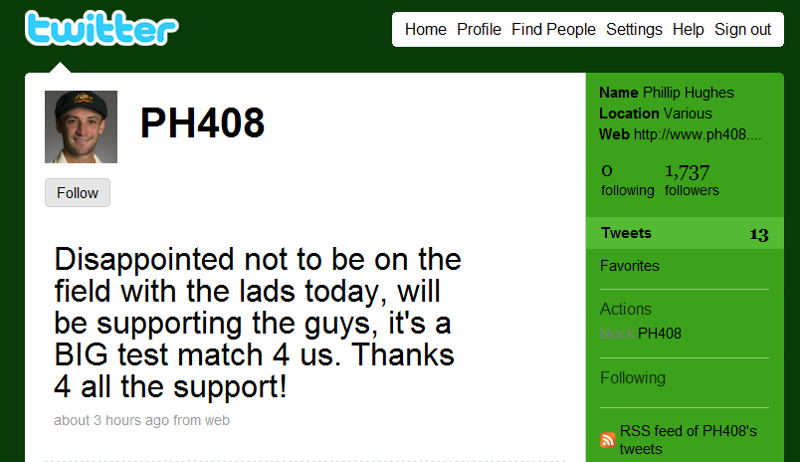
As a 20-year-old it is not perhaps surprising that Phillip Hughes has a twitter account – @PH408. What is surprising is that he used this to announce his axing from the Australian team today as follows:
The general media had been speculating about what might be Hughes’ fate for this match ever since he failed twice in the preceding game. Articles suggesting that he may have been dropped began to appear last night, but his tweet preceded any official announcement about the make up of today’s Australian team.
A case of Twitter beating “old media”, of public figures interacting with the rest of us via social media and of nothing beating getting news straight from the horse’s mouth.
The two images of actual cricket matches above are drawn from the excellent cricinfo.com web-site and are copyright Getty Images and AFP respectively.
My Keynote Articles page gathers together links to my more substantial blog posts in one place and groups them into broad areas of interest. When I first created this, the four areas were as follows:
Back in April 2009, at the height of the Oracle / Sun fervour, I added a new section to reflect the number of articles I was writing about general technology issues such as these and also BI industry news. This was as follows:
In a similar vein, I have recently been writing more about issues in Social Media (very self-referential for a blog of course). I have also had my artciles syndicated on SmartDataCollective.com for many months.
The thing that finally decided me to have a section dedicated to Social Media was joining SmartDataCollective’s parent site, SocialMediaToday.com, who were recently kind enough to syndicate the first of my series of articles on Social Media: New Adventures in Wi-Fi – Track 1: Blogging (the original article may be viewed here).
My thinking was, if I am having my articles posted on a site devoted to Social Media, then the time has come to recognise this by creating a new section. This is what I have done with:
As with the other sections, I will keep this list up-to-date as I add new content. In particular my forthcoming pieces on micro-blogging with Twitter.com and professional networking on LinkedIn.com will have a shiny new home.
I established this blog back in November 2008 – shortly after this I joined twitter.com in December 2008 – I had already been a member of LinkedIn.com since July 2005. However, my involvement with what is now collectively called social media goes back a lot further than this. Back then we tended to use the phrase on-line communities to describe what we were engaged in.
My first foray into this new world was in 1998/99 when I joined a, now defunct, discussion forum (then known as a Bulletin Board). This was focused on computer games. I wasn’t terribly in to such games at the time, I didn’t own a console and my PC was used for more prosaic purposes. Nevertheless, for reasons that I will not bore the reader with, I signed up. Since then I have been a member of a number of on-line forums, mostly with some sporting element, for example rock climbing.
In May 1999, my forum activities led me to creating my first web-site (again now also defunct). I started on Geocities (another chance to use the word “defunct”) and then moved to having my own domain and an agreement with a hosting company. I even ended up jointly running a very successful forum with an on-line friend from Australia. Back then the men were real men, the women were real women and the HTML was real HTML. However this article is not about ancient history, but rather about my more recent experiences in social media.
Nowadays, nobody seems to think of it as being odd that you regularly “speak” to people you have never met and who inhabit countries on the other side of the world. People do not slowly back away from you at parties if you drop the fact that you have your own web-site into a conversation (though maybe one reason that the portmanteau of web-log became socially acceptable is that its abridgement to blog sounds the opposite of technological). It was not always thus and maybe I retain something of the spirit of those pioneering days. For example, I am currently typing these words into the HTML pane of WordPress.com. Old habits die hard and WYSIYWG is for softies!
Social media is now mainstream – in fact you could argue that it is real life that has become a minority activity – and things are a lot easier. Although I doggedly insist on still cutting HTML, you can be up and running with a fairly professional-looking blog on WordPress in minutes and without having to know much about any of the technical underpinnings. Software as a Service certainly works really well as an approach to blogging.
Over a number of articles, I am going to touch upon my recent experience of Social Media in the three areas that I first mentioned at the beginning: blogging, micro-blogging and professional networking. Without fully revealing the denouement of this series, I will state now that one of the most interesting things is how well these three areas work in combination and how mutually reinforcing they have become for me. The sequence starts with my thoughts on blogging.
WordPress and Motivation
I suppose I have to thank my partner for getting me in to this area as she started her blog long before any of mine. However, having suffered a couple of climbing-related injuries I started my own training blog, both to chart my recovery and to act as a motivational tool.
I started out using Blogger as that was what my partner had used, but got rather frustrated with its lack of support for some basic HTML constructs (e.g. tables). A friend suggested WordPress instead and this became the venue for my training blog. Somewhat amazingly this is not defunct. However, after a period when I religiously posted at least once or twice every week, I haven’t updated it in a long while.
When I wanted to start a professional blog, WordPress seemed the way to go and I have been mostly happy with my choice. But what were my motivations for blogging about business-related issues? I guess that there were a few of these, in no particular order:
I like writing and the idea of doing this in a more general context than internal strategy papers and memoranda seemed appealing.
Based on the feedback I had received from my public speaking, I believed that I had quite a lot of relevant experience to draw on which might make interesting reading; at least for a niche audience.
Although it would be fair to say that I started writing mostly for myself, over time the idea of building a blog following seemed like a challenge and I like challenges.
In this same category of emergent motivation, after a short while the notion of establishing a corpus of work, spanning my ideas about a range of issues also became a factor. Maybe some element of Narcissism is present in most blogging.
There was a big slice of simple curiosity about the area, how it worked and how I could be a part of it. You get some interaction in public speaking, but I was intrigued by the idea of getting the benefit of the input of a wider range of people.
So I leapt in with both feet and my first article was based on some reflections on attending a Change Management seminar. It was entitled Business is from Mars and IT is from Venus and dealt with what I see as an artificial divide between IT and business groups. I suppose it makes sense to start as you mean to go on and IT / Business alignment has been a theme running through much of what I have written.
Things that I have learnt so far
In a subsequent piece, Recipes for success?, I expressed my scepticism about articles of the type “My Top Ten Tips for Successful Blogging”, so the following is not meant to be a set of precepts to be followed to the last letter. Instead, with the benefit of over 60,000 page views (small beer compared to many blogs), here are some things that have worked for me. If some of these chime with your own experience, then great. If others are not pertinent to you, then this is only to be expected.
Finally I should also stress that these observations relate mostly to professional blogs, for personal blogs there are essentially no constraints on your creativity (assuming that the results of this are legal of course).
Write about areas that you know something about. You don’t have to be a world authority, but on a professional blog, no one is going to be that interested in your fevered speculations on something that you know nothing about. This is one of many reasons that you will never see me blogging about IT Infrastructure!
When you blog about an area of personal expertise, then you can be pretty free in expressing your opinions, though [note to self] a dose of humility never did anyone any harm.
When the subject is one in which your own knowledge is less well-developed (for me something like text analytics would fall into this category), then seek out the opinions of experts in the field and quote these (even if you disagree with them). Linking to the places that experts have expressed their thoughts also expands you network and increases the utility of your blog, which becomes part of a wider world.
It helps if you are interested in the majority of the topics that you cover. If you are unmotivated about something, them why write about it? If you decide to do so for some reason (maybe because you haven’t written anything else this week, or because a piece of news is “hot” at present) then your personal ennui will seep into your words and be evident to your readers. No doubt it will generate similar feelings in them.
Beyond the previous point, I would go further and say that it is crucial that you are truly passionate about at least one thing that you write about and ideally several. Expressing strong opinions is fine, assuming that you have some reason for holding them and that you remain open to the ideas of other people. For me, these areas of passion are Business Intelligence, its intimate connection with Cultural Transformation and the related area of IT / Business Alignment.
Passion is not only important because it will hopefully infuse your words, but because it will sustain you returning to write about these areas over a long period of time. There are an awful lot of blogs out there where a bright beginning has petered out because the author had nothing left to say, or has lost interest.
For the same reasons relating to sustaining your blog, I would recommend being yourself. If you really want to present an alternative personality to the world, then good luck to you (and your therapist), you will have to possess enormous perseverance and be a very talented actor.
For me this means the presence of strong elliptical and eclectic qualities to my articles. I can do terse and to the point when it is necessary, but circumlocution is more my stock-in-trade. I’m more comfortable being myself and if this means my audience is one composed of people yearning for elliptic, eclectic, circumlocutory writing, then so be it!
To me being yourself extends to the quantity of your writing. In an era sometimes characterised as one of short attention spans and instant gratification, the orthodox advice is to be punchy and direct. Sometimes the point I want to make in one of my articles (assuming that I can remember what this is by the time I get to the end of writing it) takes some time to develop – like a fine wine I like to think (or a mould the less kind might add).
This means that my writing tends to resemble the River Amazon in both its meandering nature and length. I appreciate that this narrows my potential audience, but hope that it also means that at least a few people get some more out of it than they would from the CliffsNotes version.
Blogging should also be about interaction. If you simply want to broadcast your incredibly wise thoughts, then write a book. I hope that some of the pieces that I write spur others to record their own thoughts, either as comments here, or in their own blog articles. If some of my ideas make it into other people’s PowerPoint decks or project proposals, then I am honoured.
Equally, virtually everything that I write has been inspired to some degree by other people: co-workers, authors, the people that I come into contact with on the Internet and in real life on a daily basis and so on. I try to explicitly acknowledge (and link to) what has inspired me when I write, but I am sure that thousands of unconscious influencers go un-credited.
In this area I also try to avoid deleting comments that are derogatory about my ideas. The approach I take is rather to either seek further clarification on why the contributor thinks this way, or to politely argue why I still believe that the points that I have made are valid. Of course I have not always 100% lived up to this aspiration!
As in virtually every aspect of life, treating others as you would like to be treated yourself is not a bad approach. If you enjoy people commenting on your articles or linking to your blog, then maybe proactively doing these things yourself is a good idea. I don’t mean adding comments purely for the sake of it; that sounds awfully like spam. But if you read something that you find interesting, then thank the author.
Better still, augment what they have written with your own ideas – either on their blog or in a piece on your own site that links back to their article. Even in this day and age, it is amazing how far being nice to people can get you. For the same reason, try to be as polite on-line as you would be in your more traditional professional life.
[Yes I am aware of the irony of having ten bullet points here!]
Finally, I mentioned the Narcissistic tendencies that can either be a cause or effect of blogging. I think that trying to not take yourself too seriously is a must as an antidote to this. Both the medium and my prose can veer towards the preachy sometimes, so some well-placed self-deprecation to balance this never goes amiss.
I hope that some readers will have been interested in my observations and that they will have helped a further subset of these in their blogging. For those who are pondering whether to join the blogosphre, my simple advice is give it a go. You will either hate it or love it, but at least you won’t die wondering “what if?”
The New Adventures in Wi-Fi series of articles on Social Media continues by discussing the relatively new world of micro-blogging and the phenomenon that is Twitter here.
This seems to be just another of those annoying facts of life. I should be used to it by now, after all “Akismet has protected your site from 2,607 spam comments already.” However it seems to me that the spammers could perhaps do a better job of targeting their work. Maybe this is a breakthrough area for text analytics.
Saying that, what prompted me to refer to this rather sad phenomenon today was a recent spamvert (in English) for “on-line English classes.” I’m not sure if this was placed in reference to the author, or his readers. Either way I somehow feel diminished today.
As might be inferred from my last post, certain sporting matters have been on my mind of late. However, as is becoming rather a theme on this blog, these have also generated some business-related thoughts.
Introduction
On Friday evening, the Australian cricket team finished the second day of the second Test Match on a score of 152 runs for the loss of 8 (out of 10) first innings wickets. This was still 269 runs behind the England team‘s total of 425.
In scanning what I realise must have been a hastily assembled end-of-day report on the web-site of one of the UK’s leading quality newspapers, a couple are glaring errors stood out. First, the Australian number 4 batsman Michael Hussey was described as having “played-on” to a delivery from England’s shy-and-retiring Andrew Flintoff. Second, the journalist wrote that Australia’s number six batsman, Marcus North, had been “clean-bowled” by James Anderson.
I appreciate that not all readers of this blog will be cricket aficionados and also that the mysteries of this most complex of games are unlikely to be made plain by a few brief words from me. However, “played on” means that the ball has hit the batsman’s bat and deflected to break his wicket (or her wicket – as I feel I should mention as a staunch supporter of the all-conquering England Women’s team, a group that I ended up meeting at a motorway service station just recently).
By contrast, “clean-bowled” means that the ball broke the batsman’s wicket without hitting anything else. If you are interested in learning more about the arcane rules of cricket (and let’s face it, how could you not be interested) then I suggest taking a quick look here. The reason for me bothering to go into this level of detail is that, having watched the two dismissals live myself, I immediately thought that the journalist was wrong in both cases.
It may be argued that the camera sometimes lies, but the cricinfo.com caption (whence these images are drawn) hardly ever does. The following two photographs show what actually happened:
Michael Hussey leaves one and is bowled, England v Australia, 2nd Test, Lord's, 2nd day, July 17, 2009
Marcus North drags James Anderson into his stumps, England v Australia, 2nd Test, Lord's, 2nd day, July 17, 2009
As hopefully many readers will be able to ascertain, Hussey raised his bat aloft, a defensive technique employed to avoid edging the ball to surrounding fielders, but misjudged its direction. It would be hard to “play on” from a position such as he adopted. The ball arced in towards him and clipped the top of his wicket. So, in fact he was the one who was “clean-bowled”; a dismissal that was qualified by him having not attempted to play a stroke.
North on the other hand had been at the wicket for some time and had already faced 13 balls without scoring. Perhaps in frustration at this, he played an overly-ambitious attacking shot (one not a million miles from a baseball swing), the ball hit the under-edge of his horizontal bat and deflected down into his wicket. So it was North, not Hussey, who “played on” on this occasion.
So, aside from saying that Hussey had been adjudged out “handled the ball” and North dismissed “obstructed the field” (two of the ten ways in which a batsman’s innings can end – see here for a full explanation), the journalist in question could not have been more wrong.
As I said, the piece was no doubt composed quickly in order to “go to press” shortly after play had stopped for the day. Maybe these are minor slips, but surely the core competency of a sports journalist is to record what happened accurately. If they can bring insights and colour to their writing, so much the better, but at a minimum they should be able to provide a correct description of events.
Everyone makes mistakes. Most of my blog articles contain at least one typographical or grammatical error. Some of them may include errors of fact, though I do my best to avoid these. Where I offer my opinions, it is possible that some of these may be erroneous, or that they may not apply in different situations. However, we tend to expect professionals in certain fields to be held to a higher standard.
For a molecular biologist, the difference between a 0.20 micro-molar solution and a 0.19 one may be massive. For a team of experimental physicists, unbelievably small quantities may mean the difference between confirming the existence of the Higgs Boson and just some background noise.
In business, it would be unfortunate (to say the least) if auditors overlooked major assets or liabilities. One would expect that law-enforcement agents did not perjure themselves in court. Equally politicians should never dissemble, prevaricate or mislead. OK, maybe I am a little off track with the last one. But surely it is not unreasonable to expect that a cricket journalist should accurately record how a batsman got out.
Twitter and Truth
I made something of a leap from these sporting events to the more tragic news of Michael Jackson’s recent demise. I recall first “hearing” rumours of this on twitter.com. At this point, no news sites had much to say about the matter. As the evening progressed, the self-styled celebrity gossip site TMZ was the first to announce Jackson’s death. Other news outlets either said “Jackson taken to hospital” or (perhaps hedging their bets) “US web-site reports Jackson dead”.
By this time the twitterverse was experiencing a cosmic storm of tweets about the “fact” of Jackson’s passing. A comparably large number of comments lamented how slow “old media” was to acknowledge this “fact”. Eventually of course the dinosaurs of traditional news and reporting lumbered to the same conclusion as the more agile mammals of Twitter.
In this case social media was proved to be both quick and accurate, so why am I now going to offer a defence of the world’s news organisations? Well I’ll start with a passage from one of my all-time favourite satires, Yes Minister, together with its sequel Yes Prime Minister.
In the following brief excerpt Sir Geoffrey Hastings (the head of MI5, the British domestic intelligence service) is speaking to The Right Honourable James Hacker (the British Prime Minister). Their topic of conversation is the recently revealed news that a senior British Civil Servant had in fact been a Russian spy:
Hastings:
Things might get out. We don’t want any more irresponsible ill-informed press speculation.
Hacker:
Even if it’s accurate?
Hastings:
Especially if it’s accurate. There is nothing worse than accurate irresponsible ill-informed press speculation.
Was the twitter noise about Jackson’s death simply accurate ill-informed speculation? It is difficult to ask this question as, sadly, the tweets (and TMZ) proved to be correct. However, before we garland new media with too many wreaths, it is perhaps salutary to recall that there was a second rumour of a celebrity death circulating in the febrile atmosphere of Twitter on that day. As far as I am aware, Pittsburgh’s finest – Jeff Goldblum – is alive and well as we speak. Rumours of his death (in an accident on a New Zealand movie set) proved to be greatly exaggerated.
The difference between a reputable news outlet and hordes of twitterers is that the former has a reputation to defend. While the average tweep will simply shrug their shoulders at RTing what they later learn is inaccurate information, misrepresenting the facts is a cardinal sin for the best news organisations. Indeed reputation is the main thing that news outlets have going for them. This inevitably includes annoying and time-consuming things such as checking facts and validating sources before you publish.
With due respect to Mr Jackson, an even more tragic set of events also sparked some similar discussions; the aftermath of the Iranian election. The Economist published an interesting artilce comparing old and new media responses to this entitiled: Twitter 1, CNN 0. Their final comments on this area were:
[…]the much-ballyhooed Twitter swiftly degraded into pointlessness. By deluging threads like Iranelection with cries of support for the protesters, Americans and Britons rendered the site almost useless as a source of information—something that Iran’s government had tried and failed to do. Even at its best the site gave a partial, one-sided view of events. Both Twitter and YouTube are hobbled as sources of news by their clumsy search engines.
Much more impressive were the desk-bound bloggers. Nico Pitney of the Huffington Post, Andrew Sullivan of the Atlantic and Robert Mackey of the New York Times waded into a morass of information and pulled out the most useful bits. Their websites turned into a mish-mash of tweets, psephological studies, videos and links to newspaper and television reports. It was not pretty, and some of it turned out to be inaccurate. But it was by far the most comprehensive coverage available in English. The winner of the Iranian protests was neither old media nor new media, but a hybrid of the two.
Aside from the IT person in me noticing the opportunity to increase the value of Twitter via improved text analytics (see my earlier article, Literary calculus?), these types of issues raise concerns in my mind. To balance this slightly negative perspective it is worth noting that both accurate and informed tweets have preceded several business events, notably the recent closure of BI start-up LucidEra.
Also main stream media seem to have swallowed the line that Google has developed its own operating system in Chrome OS (rather than lashing the pre-existing Linux kernel on to its browser); maybe it just makes a better story. Blogs and Twitter were far more incisive in their commentary about this development.
Considering the pros and cons, on balance the author remains something of a doubting Thomas (by name as well as nature) about placing too much reliance on Twitter for news; at least as yet.
Accuracy an Business Intelligence
Some business thoughts leaked into the final paragraph of the Introduction above, but I am interested more in the concept of accuracy as it pertains to one of my core areas of competence – business intelligence. Here there are different views expressed. Some authorities feel that the most important thing in BI is to be quick with information that is good-enough; the time taken to achieve undue precision being the enemy of crisp decision-making. Others insist that small changes can tip finely-balanced decisions one way or another and so precision is paramount. In a way that is undoubtedly familiar to regular readers, I straddle these two opinions. With my dislike for hard-and-fast recipes for success, I feel that circumstances should generally dictate the approach.
There are of course different types of accuracy. There is that which insists that business information reflects actual business events (often more a case for work in front-end business systems rather than BI). There is also that which dictates that BI systems reconcile to the penny to perhaps less functional, but pre-existing scorecards (e.g. the financial results of an organisation).
A number of things can impact accuracy, including, but not limited to: how data has been entered into systems; how that data is transformed by interfaces; differences between terminology and calculation methods in different data sources; misunderstandings by IT people about the meaning of business data; errors in the extract transform and load logic that builds BI solutions; and sometimes even the decisions about how information is portrayed in BI tools themselves. I cover some of these in my previous piece Using BI to drive improvements in data quality.
However, one thing that I think differentiates enterprise BI from departmental BI (or indeed predictive models or other types of analytics), is a greater emphasis on accuracy. If enterprise BI is to aspire to becoming the single version of the truth for an organisation, then much more emphasis needs to be placed on accuracy. For information that is intended to be the yardstick by which a business is measured, good enough may fall short of the mark. This is particularly the case where a series of good enough solutions are merged together; the whole may be even less than the sum of its parts.
A focus on accuracy in BI also achieves something else. It stresses an aspiration to excellence in the BI team. Such aspirations tend to be positive for groups of people in business, just as they are for sporting teams. Not everyone who dreams of winning an Olympic gold medal will do so, but trying to make such dreams a reality generally leads to improved performance. If the central goal of BI is to improve corporate performance, then raising the bar for the BI team’s own performance is a great place to start and aiming for accuracy is a great way to move forward.
A final thought: England went on to beat Australia by precisely 115 runs in the second Test at Lord’s; the final result coming today at precisely 12:42 pm British Summer Time. The accuracy of England’s bowling was a major factor. Maybe there is something to learn here.
I have been a featured blogger on SmartDataCollective.com almost as long as I have been a blogger. SDC.com is Social Media Today’s community site, focussed on all aspects of Business Intelligence, Data Warehousing and Analytics, with a pinch of social media thrown in to the mix.
Brian Roger, the SDC.com editor, was recently kind enough to interview me about my career in BI, the challenges I have faced and what has helped to overcome these. This interview is now available to listen to as part of their Podcast series – click on the image below to visit their site.
I would be interested in feedback about any aspect of this piece, which I am grateful to Brian for arranging.
Social Media Today LLC helps global organizations create purpose-built B2B social communities designed to achieve specific, measurable corporate goals by engaging exactly the customers and prospects they most want to reach. Social Media Today helps large companies leverage the enormous power of social media to build deeper relationships with potential customers and other constituencies that influence the development of new business. They have found that their primary metrics of success are levels of engagement and business leads. One thousand people who come regularly and might buy an SAP, Oracle or Teradata system some day is better than a million people who definitely won’t.
Social Media Today LLC, is a battle-tested, nimble team of former journalists, online managers, and advertising professionals who have come together to make a new kind of media company. With their backgrounds, and passions for, business-to-business and public policy conversations, they have decided to focus their efforts in this area. To facilitate the types of convresations that they would like to see Social Media Today is assembling the world’s best bloggers and providing them with an independent “playground” to include their posts, to comment and rate posts, and to connect with each other. On their flagship site, SocialMediaToday.com, they have brought together many of the most intriguing and original bloggers on media and marketing, covering all aspects of what makes up the connective tissue of social media from a global perspective.



















 Facebook
 del.icio.us
 digg
digg Reddit
 Stumble